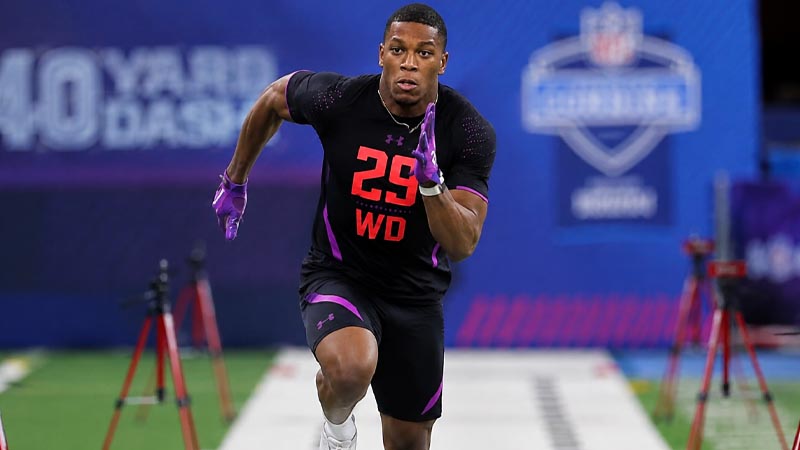
The NFL Scouting Combine is designed to isolate and measure the raw physical capabilities of elite athletes, providing front offices with standardized metrics to evaluate how a prospect’s physical traits will translate to the professional level.
When wide receiver DJ Moore entered the 2018 NFL Scouting Combine, establishing a definitive athletic profile was a top priority for decision-makers.
His performance across the full suite of testing drills did not disappoint, delivering elite numbers that heavily contributed to his selection in the first round of the 2018 NFL Draft.
By evaluating Moore’s performance through a sports science lens, we can understand the precise physical qualities that make an elite wide receiver prospect.
This analysis breaks down his precise measurements, examining how straight-line speed, vertical power, horizontal displacement, and lateral agility converged to form a highly coveted, first-round athletic profile.
The DJ Moore Athletic Profile: 2018 Combine Metrics at a Glance
To understand the complete physical package Moore presented to evaluators, it is helpful to look at his official measurements collectively. Below is the complete data set from his 2018 Combine testing:
| Athletic Metric | Official Performance | Analytical Significance |
|---|---|---|
| 40-Yard Dash | 4.42 seconds | Straight-line velocity and runaway speed |
| 10-Yard Split | 1.54 seconds | Starting burst and acceleration off the line |
| 20-Yard Split | 2.58 seconds | Mid-phase acceleration and stride transition |
| Vertical Jump | 39.5 inches | Vertical elevation, catch-radius potential, and leg drive |
| Broad Jump | 132 inches (11 feet) | Horizontal explosion and lower-body power |
| Three-Cone Drill | 6.95 seconds | High-speed change of direction and joint flexibility |
| 20-Yard Shuttle | 4.07 seconds | Lateral agility, deceleration, and short-area redirection |
The Speed Equation: Analyzing the 40-Yard Dash and Sprint Splits
The 40-yard dash is widely regarded as the benchmark for straight-line speed. DJ Moore recorded an official 40-yard dash time of 4.42 seconds.
While a sub-4.45 time is historically excellent for a wide receiver, the true story of a wide receiver’s speed is found within the incremental split times.
The 40-yard sprint is not a uniform movement; it is a progression of phases that includes start execution, acceleration, and maximum velocity maintenance.
The 10-Yard Split: 1.54 Seconds
The first ten yards of the 40-yard dash isolate an athlete’s starting acceleration and initial burst from a stationary position.
Moore recorded a 10-yard split of 1.54 seconds. In football, this metric is often considered more critical than the final 40-yard time, as wide receivers rarely run 40 yards in a straight, uninterrupted line.
Instead, they must explode off the line of scrimmage, defeat press coverage, and establish immediate separation.
A 10-yard split of 1.54 seconds demonstrates exceptional force production during the initial drive phase, indicating that Moore possesses the rapid muscle-fiber recruitment necessary to threaten defensive backs instantly.
The 20-Yard Split: 2.58 Seconds
Following the initial start phase, the athlete transitions into the acceleration phase. DJ Moore recorded a 20-yard split of 2.58 seconds.
This metric highlights his ability to transition smoothly from the low-driving start phase into an upright, maximum-velocity stride.
Maintaining acceleration over the first 20 yards requires sustained force application against the ground.
Moore’s 2.58-second mark shows that his acceleration curve does not plateau early; rather, he continues to build momentum efficiently, making him highly dangerous on medium-depth routes where transition speed is paramount.
Mathematical Breakdown of Sprinting Efficiency
By analyzing the intervals between his splits, we can map Moore’s acceleration curve:
- First 10 Yards: 1.54 seconds
- Second 10 Yards (10-to-20-yard interval): 1.04 seconds (2.58s – 1.54s)
- Final 20 Yards (20-to-40-yard interval): 1.84 seconds (4.42s – 2.58s)
This progression reveals that Moore covered his second 10 yards in just 1.04 seconds, indicating a rapid transition into his top-end gear.
He then maintained a blistering pace over the final 20 yards, averaging 0.92 seconds per 10 yards during the maximum velocity phase.
This distribution of speed confirms that his athletic profile features both short-area acceleration and long-distance runaway speed, a combination that makes a wide receiver highly versatile across different routing concepts.
Explosive Power: The Vertical and Broad Jumps
Sprinting speed is highly dependent on an athlete’s ability to generate vertical and horizontal force against the ground.
The jumping events at the combine—specifically the vertical jump and the broad jump—are designed to measure this raw lower-body explosive power.
The Vertical Jump: 39.5 Inches
The vertical jump measures an athlete’s ability to generate explosive power in a purely vertical direction from a static, two-footed stance.
DJ Moore recorded an exceptional vertical jump of 39.5 inches. Mechanically, this explosive leap requires tremendous hip extension and rapid force development through the ankles, knees, and hips.
In a practical game environment, a 39.5-inch vertical jump translates directly to a wide receiver’s catch radius and ability to win contested catch situations.
By elevating nearly 40 inches off the ground, a receiver can outreach defensive backs, turning 50-50 passes into high-probability completions.
Additionally, a high vertical jump is indicative of the pure leg drive needed to run through arm tackles and break contact at the line of scrimmage.
The Broad Jump: 132 Inches (11 Feet)
While the vertical jump measures upward force, the broad jump measures an athlete’s ability to propel their body mass forward through the horizontal plane.
DJ Moore recorded a broad jump of 132 inches, which equates to exactly 11 feet.
Propelling oneself horizontally for 11 feet requires a seamless transfer of lower-body power into forward momentum while maintaining balance upon landing.
From an evaluation standpoint, a strong broad jump indicates excellent posterior chain strength, specifically in the glutes and hamstrings.
This horizontal explosion is directly linked to a receiver’s broad-plane power, which is critical for pushing off the line of scrimmage, executing explosive cuts, and maintaining balance when absorbing contact from physical defenders.
Lateral Agility and Change of Direction: Shuttle and Three-Cone
Straight-line speed and vertical power are essential, but football is a game played in all directions. A wide receiver must be able to decelerate, plant their feet, change direction, and re-accelerate without losing momentum.
The 20-yard shuttle and the three-cone drill are the standard evaluations for lateral agility and directional efficiency.
The 20-Yard Shuttle: 4.07 Seconds
The 20-yard shuttle (often called the short shuttle) measures lateral quickness, short-area agility, and the ability to sink the hips to change direction rapidly.
The drill requires the athlete to sprint 5 yards in one direction, touch the line, sprint 10 yards in the opposite direction, touch the line, and sprint 5 yards back to the starting point.
DJ Moore completed the 20-yard shuttle in a swift 4.07 seconds. A sub-4.10 shuttle time for a wide receiver indicates advanced lateral mobility.
Mechanically, it shows that Moore can decelerate his body mass, plant his foot outside his frame, and transition his center of gravity in the opposite direction with minimal energy leak.
This lateral quickness is crucial for sudden route breaks, such as whips, slants, and out-routes, where a defender must be forced to overrun the play.
The Three-Cone Drill: 6.95 Seconds
The three-cone drill evaluates an athlete’s change-of-direction mechanics, body control, and ankle flexibility at high speeds. The drill outlines an L-shaped path, requiring the athlete to weave around cones while executing tight loops and sharp turns.
DJ Moore finished the three-cone drill in 6.95 seconds. Recording a time under seven seconds is a key threshold for elite NFL prospects.
This sub-seven-second time proves that Moore can maintain a high percentage of his speed while carving tight angles.
It highlights his joint mobility and core stability, which prevent him from having to round off his routes. In route-running, the ability to make sharp, angular cuts at 90 or 180 degrees without losing speed is what separates elite separators from coverage-bound receivers.
The Holistic Athletic Profile: A First-Round Formula
An athletic profile is greater than the sum of its individual parts. NFL front offices look for players whose metrics complement one another to form a complete physical package. In the case of DJ Moore, his 2018 Scouting Combine metrics painted the picture of a highly balanced, elite athlete.
His straight-line speed (4.42-second 40-yard dash) provided the baseline threat of deep vertical separation.
This serious threat was supported by his explosive power (39.5-inch vertical and 11-foot broad jump), which ensured he could win physical matchups at the catch point and drive hard off the line of scrimmage.
Finally, his change-of-direction metrics (6.95-second three-cone and 4.07-second shuttle) demonstrated that his speed and power were fully functional in short spaces, allowing him to run a diverse route tree with sharp breaks and lateral elusiveness.
When scouts and general managers evaluated these numbers collectively, they saw an athlete who checked every critical physical box for the wide receiver position. This comprehensive athletic excellence was a primary driver behind his first-round selection in the 2018 NFL Draft.