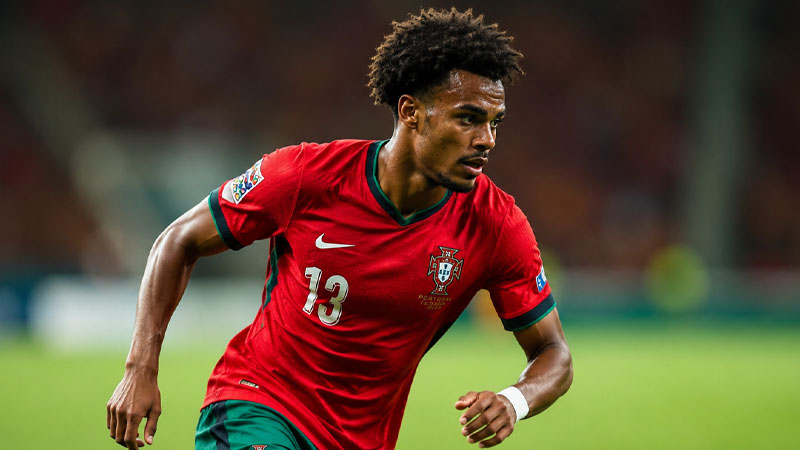
Renato Veiga has rapidly established himself as one of European football’s premier defensive prospects, combining elite physicality with a sophisticated tactical mind.
At just 22 years of age, the Portuguese international has successfully transitioned from a highly-coveted utility player into a cornerstone defensive pillar for both Villarreal CF in La Liga and the Portugal national football team.
Standing a towering 1.90 meters tall, Veiga represents the quintessential modern prototype for elite, multi-functional tactical systems.
His meteoric rise from Chelsea to becoming a standout performer in the 2026 World Cup has sparked intense global debate regarding his ultimate ceiling in the professional game.
The Tactical DNA and Hybrid Profile of Renato Veiga
To truly understand the value of Renato Veiga, one must look beyond simple positional labels and analyze how he fundamentally alters a team’s structural dynamics.
He is not merely a defender; he is a tactical Swiss Army knife who allows managers to rotate formations mid-match without the need for substitutions.
This versatility is a rare commodity in high-stakes European football, where the ability to adapt to opposition shifts is often the difference between winning and losing.
Positional Elasticity Across Three Zones
While Veiga naturally favors operating as a left-sided center-back, his physical capacity and technical composure enable him to transition effortlessly into an inverted left-back or step up into the engine room as a traditional, structural number six defensive midfielder.
This positional elasticity allows his team to build out in a fluid three-man backline while maintaining defensive stability against transition-heavy opposition.
Whether he is tucking inside to create a midfield overload or holding the width of the defensive line, his spatial intelligence ensures that the team’s shape remains cohesive and difficult to break down.
Elite Physicality and Duel Dominance
With a robust 1.90-meter frame weighing approximately 82 kilograms, Veiga handles the physical demands of top-tier football with ease.
He consistently dominates aerial duels in both penalty boxes, clearing high defensive lines and presenting an offensive threat during set-piece routines.
On the ground, his long strides provide him with excellent recovery speed, allowing him to track back and execute precise slide tackles or shield opposing forwards out of play using pure body leverage.
This combination of size and speed makes him a nightmare for traditional strikers who rely on physical presence to hold up play.
Technical Progression and Build-Up Architecture
The defining attribute that separates Veiga from standard physical defenders is his exceptional left-footed distribution. In an era where “ball-playing defenders” are mandatory, Veiga excels by being a high-volume build-up catalyst rather than just a safe passer.
He is comfortable receiving the ball under high pressure, shifting his weight, and firing line-breaking ground passes into the half-spaces or launching diagonal long balls to switch the point of attack.
Precision Passing and Ball-Striking
Veiga’s ball-striking capability extends beyond simple distribution; he possesses a powerful shot from distance and can deliver whipped, accurate crosses from wide positions.
This makes him particularly dangerous when he steps into the midfield or overlaps from a full-back position.
His ability to hit a 40-yard diagonal pass with the same ease as a 5-yard square ball forces opposition blocks to stay wide, creating more space for his creative midfielders to operate centrally.
Progressive Action and Press Resistance
Analyzing his metric footprint places him in the upper echelons of modern ball-playing central defenders.
He averages more forward-progressing actions per 90 minutes than most traditional center-backs, often driving into the middle third of the pitch before initiating offensive actions.
His low turn-over rate inside his own half provides his defensive line with consistent stability, acting as an elite security valve during deep build-up phases. This press resistance is vital for teams that look to play out from the back against aggressive high-pressing opponents.
Data-Driven Review of Professional Performance
A rigorous analysis of Renato Veiga’s statistical profile reveals a high-volume defensive engine that acts as the primary build-up catalyst for his team.
His recent season with Villarreal in La Liga showcased a player capable of sustaining elite performance levels over a demanding, long-term domestic campaign.
The numbers suggest a player who is not just participating in matches but actively dictating their defensive and transitional rhythm.
Villarreal CF Domestic Performance Matrix (2025–26)
During his standout campaign in Spain, Veiga became an indispensable starter under intensive tactical demands. The following table highlights his durability and statistical output over 32 league matches:
| Performance Metric | Statistical Output | Tactical Significance |
|---|---|---|
| Matches Started / Played | 27 / 32 | Demonstrates squad durability and elite starting consistency |
| Minutes Played | 2,478 | Reflects continuous physical conditioning and structural trust |
| Pass Completion Rate | 90.1% | High-volume accuracy under intensive defensive pressing |
| Total Clearances | 222 | Elite positioning inside the penalty box under pressure |
| Defensive Blocks | 27 | High spatial awareness in protecting the danger zone |
| Yellow / Red Cards | 5 / 1 | Reflects an aggressive, front-foot tackling methodology |
Career Milestones and Long-Term Durability
As of June 2026, Veiga has accumulated 121 senior club appearances across several of Europe’s most competitive leagues. His journey through FC Basel, Chelsea, and a developmental loan at Juventus has provided him with a diverse tactical education that most players his age lack.
- Total Senior Club Appearances: 121
- Total Senior International Caps: 11
- International Trophies: UEFA Nations League Champion (2024–25)
- Disciplinary Frequency: Averages a card every 4.4 matches
The Chelsea Transfer Paradox and Market Valuation
One of the most heavily debated subplots of Veiga’s career is his swift movement through West London.
Signed by Chelsea from FC Basel on a seven-year contract for a reported €14 million, Veiga immediately impressed supporters with his utility, even scoring in the UEFA Conference League.
However, the club eventually sanctioned his departure to Villarreal for a fee reaching up to £26 million, a move that left many fans questioning the long-term sporting strategy.
Financial Asset Modeling vs. Sporting Merit
In the modern football landscape, elite clubs operating under stringent Profit and Sustainability Rules (PSR) often view highly talented young prospects through a dual lens of sporting merit and financial liquidity.
Chelsea recognized Veiga’s exponential market appreciation after a short, successful loan spell at Juventus. By securing a substantial markup on a player who was primarily viewed as a high-potential squad rotation option in London, the club achieved accounting profit to balance their long-term infrastructure books.
The Villarreal Synthesis
For Veiga, this transfer was a significant sporting blessing. Villarreal recognized his elite ceiling and offered him the one thing Chelsea’s deep squad could not guarantee: consistent, starting minutes in a top-five European league.
Moving to Spain allowed Veiga to shed the “utility player” label and transform into a primary defensive centerpiece, a development that directly fueled his senior international breakthrough.
The £25–26 million investment by Villarreal now looks like a bargain given his current trajectory.
International Ascendancy and World Cup Impact
Veiga’s club performances caught the attention of Portugal manager Roberto Martínez, who quickly integrated the young hybrid defender into the senior international setup.
His transition has been seamless, as he has moved from a tactical “insurance policy” to a guaranteed starter on the world’s biggest stage. His ability to cover multiple defensive roles proved invaluable during Portugal’s successful UEFA Nations League campaign in 2025.
The 2026 FIFA World Cup Breakthrough
At the ongoing 2026 FIFA World Cup, Veiga has taken his game to a global audience. Handed a starting role in Portugal’s tournament opener against the DR Congo, he put on a masterclass in composed, high-volume distribution.
His performance in that match serves as a benchmark for what a modern defender can achieve under extreme pressure.
- Pass Accuracy: 97% (88 out of 90 attempted passes)
- Defensive Interventions: 7 critical clearances
- Total Minutes: 90 (Played the full duration)
This performance proved that his technical and physical profile translates perfectly to the absolute highest levels of international tournament football.
Areas for Growth: Refining the World-Class Ceiling
Despite his immense upside, an objective scouting report must highlight specific areas where Veiga needs structural refinement.
At 22, his aggressive profile can occasionally be weaponized against him by intelligent opposition managers who look to exploit his proactive tendencies. If he can temper his enthusiasm with calculated patience, he will be almost impossible to play against.
Disciplinary Records and Over-Aggression
Veiga’s proactive defensive style means he prefers to step out of the defensive line to intercept passes or engage attackers early. While highly effective when timed correctly, this high-risk methodology occasionally leads to mistimed challenges in open space.
Accumulating 27 yellow cards and 2 red cards across 121 career club games illustrates a need to find a better balance between aggression and defensive safety.
Low-Block Positional Awareness
When forced into deep, sustained low-block defending—where lateral tracking and spatial awareness take priority over physical duels—Veiga can sometimes suffer minor lapses in tracking secondary runners.
Improving his micro-positioning when dealing with intricate, one-touch passing sequences inside the penalty box remains his primary path toward reaching a truly elite defensive status.
Frequently Asked Questions
What is Renato Veiga’s best position on the pitch?
While he is incredibly versatile, football experts agree that his optimal long-term position is as a left-sided center-back in a team that prioritizes building possession from the back.
His left-footedness gives his team natural passing angles that are incredibly difficult for opposing presses to disrupt.
How much did Villarreal pay for him, and what is he worth now?
Villarreal secured Veiga’s services for approximately £25–26 million plus performance-related add-ons. Given his 2026 World Cup performances and his status as a regular starter in La Liga, his current market value is estimated to have significantly exceeded that initial investment.
Is Renato Veiga a regular for the Portugal national team?
Yes. Since his debut, he has become a key component of Roberto Martínez’s squad. He played a role in the 2025 Nations League victory and is currently a starter in the 2026 FIFA World Cup.
Final Verdict: The Decade of the Powerhouse
Renato Veiga possesses a rare, elite combination of raw physical power, tactical intelligence, and world-class left-footed distribution.
While his aggressive tackling style requires minor maturity and positional discipline in low-block systems, his rapid rise across Europe’s top divisions confirms that he has all the tools to become an established, multi-functional powerhouse on the global stage for the next decade.
What are your thoughts on Renato Veiga’s rapid development? Do you believe Chelsea made a calculated mistake by prioritizing financial profit over his long-term sporting ceiling, or was the move to Villarreal the necessary catalyst for his growth?
Join the discussion in the comments below and share this analysis with fellow football enthusiasts!