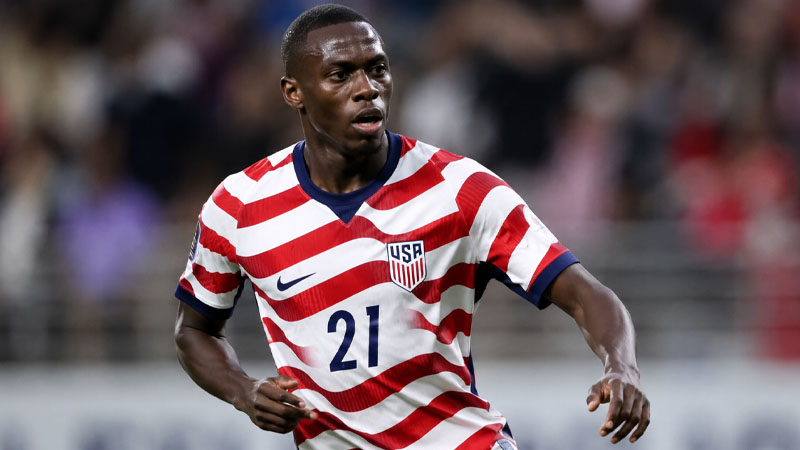
The rise of Timothy Weah as a cornerstone of the United States Men’s National Team (USMNT) presents one of the most compelling narratives in modern international soccer.
To the casual observer, it is a staggering revelation that a starting winger for the United States is the son of a sitting world leader and one of the greatest athletes in history.
This unique intersection of global politics, sporting royalty, and American identity has sparked intense curiosity across the globe.
While Timothy’s father, George Weah, is a legendary Ballon d’Or winner and the former President of Liberia, Timothy’s path was forged on the public pitches of New York, leading to a deliberate choice that has redefined his family’s sporting legacy.
A Rare Choice: Four Nations and One Professional Jersey
Timothy Weah’s international eligibility was a complex puzzle that few athletes ever encounter, offering him the chance to represent four distinct nations with deep cultural and familial ties.
This section explores the diverse options available to him and the factors that influenced his final decision to wear the Stars and Stripes.
The Multi-National Eligibility Framework
Due to his multicultural family background, Timothy had the rare legal standing to represent the United States, Liberia, Jamaica, or France.
His eligibility for the United States was established by birth, while his connection to Liberia came through his father, the iconic George Weah.
Furthermore, his mother, Clar Weah, provided a path to representing Jamaica, and his years spent in the Paris Saint-Germain youth academy during his teens made him eligible for French citizenship through residency.
This level of choice is almost unprecedented in the sport, allowing a player to choose between established European powerhouses and rising Concacaf nations.
The Decision to Represent the United States
Despite the prestige of the French national team or the emotional pull of his father’s homeland, Timothy chose the United States because he felt a deep personal connection to his birthplace.
He has been vocal about his desire to give back to the country that nurtured his early passion for the game, stating that his choice was made entirely on his own terms without pressure from his famous parents.
To Timothy, being American is not just a legal status but a core part of his identity, having been immersed in the American soccer ecosystem from a very young age.
The Shadow of a Legend: George Weah’s Sporting Legacy
Understanding Timothy’s career requires a look at the massive legacy of his father, George Weah, whose achievements set a nearly impossible standard for any successor.
The elder Weah is not only a political figure but a symbol of African excellence in global sport, a fact that makes Timothy’s choice even more significant to fans worldwide.
The Phenomenon of George Weah
George Weah’s career remains one of the most decorated in football history, highlighted by his 1995 Ballon d’Or win and being named the FIFA Player of the Year in the same year.
His club career saw him dominate for European giants like AC Milan, Paris Saint-Germain, Monaco, Chelsea, and Manchester City.
In Liberia, he is viewed as a true icon of the game, a status that eventually helped propel him to the presidency of the nation. For many fans, the idea of the President’s son playing for a different country is a point of constant fascination and debate.
The Missing Piece: The World Cup Dream
Despite his individual brilliance, George Weah is often cited as the greatest player to never appear in a FIFA World Cup, as the Liberian national team never qualified during his prime.
This historical gap created a unique opportunity for Timothy to fulfill a family milestone that had eluded his father for decades.
When Timothy scored the opening goal against Wales in the 2022 World Cup, it was a moment of profound family redemption, as George Weah was reportedly in the stands in Qatar to witness his son achieve what he never could.
An American Upbringing: From Brooklyn to Queens
While his name carries global weight, Timothy Weah’s roots are firmly planted in the neighborhoods of New York City.
His development as a player and an individual was shaped by the specific culture of American youth soccer, which provided the foundation for his eventual rise to the international stage.
The Rosedale Soccer Club Connection
Born on February 22, 2000, in Brooklyn, Timothy spent his formative years in the diverse neighborhood of Rosedale, Queens. It was here, playing for local community clubs like the Rosedale Soccer Club, that his passion for the sport was first ignited.
This grassroots American experience is central to why he feels such a strong bond with the USMNT; he is a product of the very system he now represents on the world stage.
A Cultural Identity Rooted in the States
Observers have noted that when Timothy speaks, he is “as American as you can be,” reflecting his “born and raised” upbringing.
While he spent time in France during his development at PSG, those years were viewed as professional training rather than a shift in his national identity.
His Americanism is characterized by a desire to push the sport forward in his home country, contributing to a generation of players who are changing the perception of American soccer globally.
Navigating the Economics of American Soccer
The journey of Timothy Weah also brings to light the systemic challenges within the American soccer landscape, specifically the controversial “pay-to-play” model.
While Timothy’s high-profile background provided certain advantages, his path highlights the broader discussion regarding how the United States identifies and develops talent.
The Challenges of the Pay-to-Play System
A significant hurdle in growing the sport in the United States is the cost associated with high-level youth training, often referred to as the pay-to-play system.
Critics argue that soccer in the States is frequently a sport for the wealthy, with travel team costs ranging from $3,000 to $10,000 annually, excluding travel and lodging.
This financial barrier inherently excludes a large percentage of talented children who cannot afford the “premier” path to professional visibility.
The Evolution of the American Academy Path
| Feature | Traditional Pay-to-Play | Modern MLS/Pro Academy |
|---|---|---|
| Cost to Family | $3,000 – $10,000+ per year | Often free or subsidized for elite talent |
| Coaching Quality | Varies; often parent-led at lower levels | Professional, full-time coaching staff |
| Primary Goal | Participation and college visibility | Professional player development |
| Accessibility | Limited to those who can afford fees | Based on merit and scouting (improving) |
While the pay-to-play model remains a dominant force, there is a visible shift toward professional academies, particularly within Major League Soccer (MLS), which are beginning to mirror the European model of merit-based, cost-free development.
Timothy’s journey, while unique due to his family’s success, serves as a backdrop to this ongoing evolution in how the USMNT finds its next stars.
The World Cup and the Path to 2026
As Timothy Weah continues to establish himself as a leader for the USMNT, his focus has shifted toward the future and the massive opportunity presented by the 2026 World Cup.
His role in the team is no longer just about his famous name; it is about his ability to deliver results on the pitch during the most critical moments.
A Symbol of the New Generation
Timothy is part of a “golden generation” of American players who are competing at the highest levels of European club soccer.
His presence in the squad, alongside other “legacy” players like Gio Reyna, signifies a maturing of the American soccer culture where professional heritage is becoming more common.
This group is focused on moving past the political noise often associated with their high-profile backgrounds to simply “play football”.
The 2026 “Redemption Tour”
Looking ahead, Timothy and his teammates view the 2026 World Cup—hosted in North America—as a pivotal moment for the sport’s domestic growth.
He has characterized the upcoming tournament as a chance for the team to prove they belong among the world’s elite and to build on the success of their 2022 campaign.
For Timothy, 2026 represents the ultimate stage to cement his own legacy, independent of his father’s immense shadow.
Frequently Asked Questions About Timothy Weah
Why didn’t Timothy Weah play for Liberia?
While he was eligible through his father, Timothy was born and raised in the United States. He has stated that he felt a stronger personal and professional connection to the U.S. soccer system, and he wanted to make his own way in the sport rather than simply following his father’s path.
Is Timothy Weah a citizen of other countries?
Yes, Timothy’s background gave him the right to claim citizenship or eligibility for Liberia, Jamaica, and France. However, once he represented the USMNT in a competitive senior international match, his “football citizenship” was permanently tied to the United States under FIFA regulations.
What was George Weah’s reaction to his son’s choice?
George Weah has been incredibly supportive of Timothy’s decision. He has been seen at numerous USMNT matches, including the 2022 World Cup in Qatar, where he watched Timothy score against Wales. There is no indication of any family friction regarding his choice of national team.
How does Timothy handle the pressure of his father’s fame?
Timothy has consistently focused on his own development and has expressed a desire to keep his professional life separate from the political world of his father. He often remarks that he just wants to “play football” and let his performance on the pitch speak for itself.
Conclusion: A Legacy Defined by Personal Choice
The story of Timothy Weah is a testament to the power of individual identity in an increasingly globalized world.
By choosing to represent the United States, Timothy did not reject his father’s heritage; rather, he embraced his own reality as a kid from Brooklyn and Queens who dreamed of playing on the world stage.
His journey from the Rosedale Soccer Club to scoring goals in the World Cup serves as an inspiration for the next generation of American players, proving that heritage is a foundation, but personal choice defines the destination.
As the USMNT prepares for 2026, Timothy Weah stands not as a “president’s son,” but as an American hero carving out a legendary status all his own.