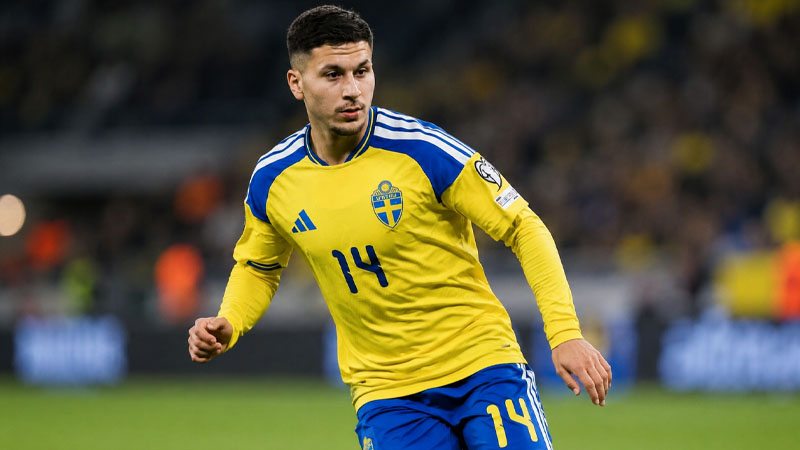
Roony Bardghji is a name that echoes through the corridors of elite European football, yet his story extends far beyond his clinical finishing. While he dazzles fans under the Swedish flag, his personal narrative is deeply rooted in the Middle East.
Understanding Roony Bardghji’s ethnicity provides a lens into the resilience and multi-layered identity of a modern athlete. From the ancient streets of Aleppo to the stadiums of Copenhagen, his journey represents a cultural bridge.
This article delves into his Syrian-Assyrian (Suryoyo) heritage, his family’s migration, and how he maintains a strong connection to his roots today.
Defining Roony Bardghji’s Multi-Layered Ethnicity
To truly understand the player, one must first understand the man’s origins. Roony’s background is a complex tapestry of Middle Eastern history, spanning multiple ethnic groups and Christian traditions.
His identity is not defined by a single border but by a rich lineage that he carries with him on and off the pitch.
The Syrian-Assyrian (Suryoyo) Heritage
The core of Roony Bardghji’s ethnicity is his Syrian-Assyrian, often referred to as Suryoyo, identity. This community represents a distinct ethnic and linguistic group within the Middle East, primarily descending from the ancient inhabitants of Mesopotamia.
For Roony, these roots trace directly back to the Syriac Christian community of Aleppo, Syria. This heritage is central to his family’s history, influencing their traditions, values, and social circles.
The Suryoyo people have a long history of resilience, maintaining their unique cultural and religious practices throughout centuries of regional change.
By identifying with this group, Roony aligns himself with a community that prides itself on its ancient language and enduring cultural strength.
The Armenian Connection through Paternal Lineage
Adding another layer to his complex ethnic profile is his Armenian descent. This connection comes through his paternal grandfather, highlighting the historical interconnectedness of ethnic minorities in the Levant.
For generations, Syrian, Assyrian, and Armenian communities have coexisted in cities like Aleppo, often intermarrying and sharing cultural spaces while maintaining their distinct identities.
This Armenian lineage further enriches Roony’s background, linking him to a broader history of diaspora and survival.
It underscores that his “Syrian” identity is a beautiful mosaic of different backgrounds that found a home within the borders of Syria before the modern conflict displaced many of its people.
Early Life: A Journey Through Kuwait and Sweden
The geographic path of Roony’s early life is as diverse as his ethnic background. His journey reflects the modern reality of many families from the Middle East who have sought stability and opportunity across international borders.
| Key Fact | Detail |
|---|---|
| Birthplace | Kuwait City, Kuwait |
| Ethnicity | Syrian-Assyrian (Suryoyo) & Armenian |
| Migration Year | 2012 |
| Host Country | Sweden |
| Age at Migration | Approximately 6 years old |
| Cultural Language | Arabic (Fluent) |
Roony Bardghji was not born in his ancestral homeland of Syria, nor was he born in his adopted country of Sweden. Instead, his story began in Kuwait City, Kuwait, where his family resided before the regional shifts of the early 2010s.
His birth in Kuwait adds a Gulf-Arab layer to his upbringing, though his family remained steadfast in their Syrian identity throughout their time there.
In 2012, as the conflict in Syria intensified, the Bardghji family made the life-altering decision to move to Europe. Seeking safety and a future for their children, they arrived in Sweden as refugees.
At the time, Roony was just six years old—a formative age where he would begin to balance his Middle Eastern heritage with the realities of Swedish society.
This migration was the catalyst for his footballing career, providing the infrastructure and scouting networks that would eventually recognize his world-class potential.
The Cultural Identity of a Modern Footballer
Despite spending the majority of his life in Sweden and becoming a Swedish citizen, Roony has never allowed his original identity to fade. His sense of self is not a trade-off between “Old World” and “New World” but rather a harmonious blend of both.
Linguistic Heritage and Arabic Fluency
One of the most significant indicators of Roony’s connection to his roots is his linguistic ability. Despite his integration into Swedish society and his professional life in Denmark, he remains fluent in Arabic.
This fluency is more than just a skill; it is a bridge to his family, his history, and the millions of fans across the Arab world who follow his career with immense pride.
Language serves as the primary vessel for culture, and by maintaining his Arabic, Roony ensures that he can communicate directly with his community and understand the nuances of his heritage without a translator. It is a testament to his family’s dedication to preserving their identity in the diaspora.
Public Pride: “I’m Proud to be Syrian”
Roony’s public stance on his ethnicity is one of unwavering pride. In a professional landscape where young players are often pressured to minimize their differences to fit a specific national mold, Roony has been refreshingly vocal.
He has stated in interviews, “I’m from Syria. My name is Roony Bardghji, and my whole family is Syrian. I’m proud to be Syrian”.
This declaration is powerful, particularly for a player who represents the Swedish national team at various levels. It signals to the world that his loyalty to his current home does not require the erasure of his past.
This level of transparency has made him a beloved figure among Syrian and Assyrian youth worldwide.
Navigating Dual Identity in International Sports
The intersection of sport and identity is often where the most compelling stories are found. Roony Bardghji stands as a prominent example of the “New European” athlete—one who honors his adopted country while remaining a symbol for his ancestral homeland.
Representing Sweden on the Global Stage
As a holder of Swedish citizenship, Roony has chosen to represent Sweden in international competitions. This decision is a reflection of his gratitude toward the country that welcomed his family and provided him with the platform to become a professional athlete.
His performance on the pitch for Sweden is a point of pride for Swedish fans, who see him as the future of their national team.
However, Roony’s success also creates a unique dynamic where every goal he scores is celebrated in two places at once: the suburbs of Stockholm and the diaspora communities of Aleppo.
He proves that national representation is not an ethnic monolith but an inclusive category.
A Symbol of Success for the Diaspora
For the millions of Syrians and Assyrians displaced by conflict, Roony Bardghji represents a beacon of hope and excellence. His rise to stardom at a young age serves as a reminder of the talent and potential inherent in refugee communities.
By being open about his ethnicity, he provides a success narrative that counteracts common stereotypes often associated with migration.
He is not just a “Swedish player”; he is a Syrian-Assyrian success story that resonates with anyone who has had to rebuild their life in a new land.
His journey encourages young athletes from similar backgrounds to pursue their dreams while holding their heads high regarding their origin.
Understanding the “Suryoyo” Context
The term “Suryoyo” is frequently used in relation to Roony’s background, yet it is a term that many football fans may not be familiar with. Understanding this term is essential to grasping the full scope of his cultural reality.
Suryoyo refers to the Syriac-speaking Christians who are indigenous to parts of modern-day Syria, Iraq, Turkey, and Lebanon. They are an ethnic group with a history that predates the modern national borders of the Middle East.
In the context of Roony Bardghji, his identity as a Syrian-Assyrian (Suryoyo) means he belongs to a community with its own distinct liturgy, traditions, and collective memory.
This community has a significant presence in Sweden, particularly in cities like Södertälje, which has become a hub for the Syriac diaspora.
This existing community likely provided a support network for the Bardghji family upon their arrival, helping them maintain their traditions while navigating a new culture.
Frequently Asked Questions
What is Roony Bardghji’s nationality?
Roony Bardghji holds Swedish citizenship and represents Sweden in international football. However, he is ethnically Syrian-Assyrian and was born in Kuwait.
Does Roony Bardghji speak Arabic?
Yes, Roony is fluent in Arabic. He has maintained the language despite moving to Sweden at a young age, allowing him to stay connected to his Syrian roots and family heritage.
Where was Roony Bardghji born?
He was born in Kuwait City, Kuwait. His family lived there before migrating to Sweden as refugees in 2012 to escape the conflict in Syria.
Is Roony Bardghji related to the Armenian community?
Yes, Roony has Armenian descent through his paternal grandfather. This adds to his multi-ethnic background, which primarily consists of Syrian-Assyrian roots.
Why did Roony Bardghji’s family move to Sweden?
The family moved to Sweden in 2012 to escape the Syrian conflict. They arrived as refugees when Roony was approximately six years old.
The Future of a Global Icon
Roony Bardghji’s trajectory in football suggests he is destined for the highest levels of the sport. As he continues to develop, his ethnicity will remain a core part of his public identity.
He is part of a generation of athletes who are redefining what it means to be a “national” player, showing that one can be fully Swedish and fully Syrian at the same time. His story is one of migration, resilience, and the power of cultural pride.
As he moves forward, potentially to the biggest clubs in the world, he carries with him the hopes of the Syriac Christian community and the wider Syrian diaspora.
Whether he is speaking Arabic in an interview or celebrating a goal for Sweden, Roony Bardghji is a testament to the fact that our roots do not limit us—they ground us as we reach for the stars.
Stay updated on Roony Bardghji’s career and cultural journey by following our deep dives into the world’s most promising talents.
Join our community of fans who value the stories behind the stats and celebrate the diversity that makes modern football the world’s most beautiful game.