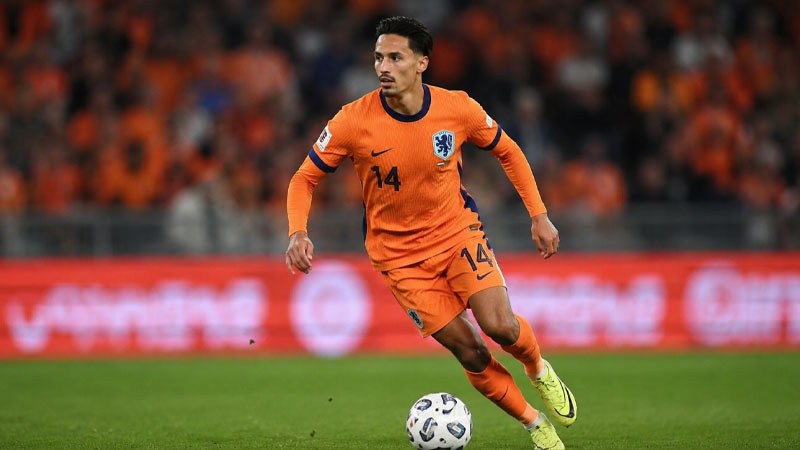
In the modern landscape of international football, few stories are as culturally layered as that of the midfielder representing the Netherlands on the global stage: Tijjani Reijnders.
While his technical prowess and composure in the center of the pitch have earned him accolades at the highest levels of European club and international competition, it is his personal history that offers a fascinating case study in globalism.
Reijnders is a bridge between three distinct cultures, representing a Dutch upbringing, an Indonesian heritage, and a Nigerian namesake.
The Dutch Foundation: A Product of Zwolle
The narrative begins in the city of Zwolle, located in the northeastern province of Overijssel, Netherlands.
Born in this historic city, Tijjani Reijnders is fundamentally a product of the Dutch footballing machine. From a young age, he was immersed in the “Total Football” philosophy that defines the nation’s sporting identity.
His development through various Dutch academies and his eventually pivotal role in the national team underscore his deep-rooted connection to his birthplace.
In professional sports, the “homegrown” label often carries significant weight regarding marketability and fan loyalty.
For the Dutch supporters, Reijnders is a local hero who embodies the work ethic and tactical intelligence expected of an elite Oranje midfielder.
However, for a global audience, his story becomes significantly more complex when one looks beyond the passport and the jersey.
The Moluccan Connection: A Mother’s Legacy
The most prominent branch of Reijnders’ heritage stems from his mother, who is of Indonesian (Moluccan) descent.
This connection is not merely a biographical footnote; it represents a significant historical and cultural link between the Netherlands and the Maluku Islands.
The Moluccan community in the Netherlands has a deep and often complex history, dating back to the mid-20th century.
For athletes like Reijnders, this ancestry provides a dual sense of belonging. While he has chosen to represent the Netherlands internationally, his Indonesian roots have made him a figure of immense interest and pride in Southeast Asia.
This “dual-market” appeal is a rare asset in professional football, allowing a player to resonate with fans across different continents simultaneously.
The Maluku Islands, known historically as the Spice Islands, have contributed a distinct cultural thread to the tapestry of Dutch society.
By carrying this heritage into the stadiums of Europe, Reijnders serves as a modern ambassador for the Moluccan diaspora.
His success is seen as a shared victory, a testament to the talent that emerges from the intersection of different cultural backgrounds.
The Nigerian Namesake: A Tribute to an Ajax Legend
Perhaps the most unique aspect of his identity is his first name. To a casual observer, “Tijjani” might suggest a direct West African lineage.
However, the origin is rooted in his parents’ passion for the game rather than a biological link to Nigeria.
Tijjani was named after the legendary Nigerian forward Tijani Babangida. During the late 1990s, Babangida was a celebrated figure at Ajax, known for his blistering speed and contribution to the Amsterdam club’s success.
Reijnders’ parents, being “massive fans” of the former Nigerian international, chose to honor the player by naming their son after him.
This naming convention highlights the profound influence of the 1990s Eredivisie on the personal lives of Dutch families. It also creates a symbolic link between Reijnders and the rich history of Nigerian football.
Though he possesses no Nigerian blood, he carries the name of one of the country’s most famous sporting exports, adding another layer of international intrigue to his profile.
Identity as a Competitive Advantage
In the corporate world of elite athletics, a player’s “brand” is increasingly defined by their background. Reijnders’ multicultural identity—Dutch, Indonesian, and symbolically Nigerian—positions him as a truly global athlete. This diversity is not just a personal trait; it is a reflection of the evolving nature of the Netherlands itself.
For the Dutch national team, players with diverse backgrounds bring different perspectives and cultural resilience to the squad. Reijnders’ ability to navigate these various identities while maintaining a focus on peak performance is a hallmark of his professional maturity.
The Global Appeal of Tijjani Reijnders
The intersection of these three cultures has created a unique phenomenon in fan engagement. In the Netherlands, he is the hometown star from Zwolle.
In Indonesia, he is the son of the Moluccan islands, celebrated for his connection to the archipelago. In footballing circles globally, his name evokes memories of the great Nigerian teams of the past.
This multi-faceted identity is particularly valuable in an era of digital connectivity. Fans in Jakarta can follow his progress with the same fervor as fans in Amsterdam, creating a massive, cross-continental following.
This level of engagement is a primary objective for top-tier clubs and sponsors who seek athletes with “borderless” appeal.
Frequently Asked Questions About Reijnders’ Background
Where was Tijjani Reijnders born?
He was born in Zwolle, Netherlands, and grew up within the Dutch football system.
What is the specific origin of his Indonesian heritage?
His mother is of Moluccan descent, a group from the Maluku Islands with a significant historical presence in the Netherlands.
Is Tijjani Reijnders Nigerian?
No. While he bears the name of Nigerian legend Tijani Babangida, he does not have Nigerian ancestry. His parents named him after the player out of admiration for his performance at Ajax.
Which national team does he play for?
He represents the Netherlands (the Oranje) at the international level.
The Future of the Reijnders Legacy
As Tijjani Reijnders continues to evolve on the pitch, his story will remain a powerful example of how sports can transcend traditional boundaries.
He is a player who belongs to many places at once, yet remains focused on his goal of excellence in the Dutch jersey.
For those tracking the intersection of culture and sport, Reijnders is more than just a talented midfielder. He is a living bridge between European structure, Indonesian heritage, and the lasting influence of African football legends.
His journey reminds us that in the modern world, identity is rarely a single note, but rather a complex and beautiful symphony of influences.
By embracing his Moluccan roots and carrying a name inspired by a Nigerian icon, Tijjani Reijnders has crafted a professional identity that is as diverse as the game of football itself.
As he moves forward in his career, he does so with the support of multiple nations, proving that greatness knows no borders.