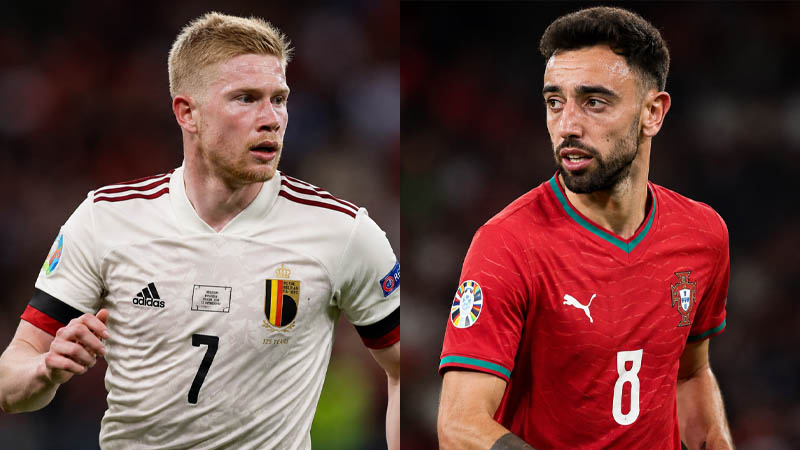
The debate between Kevin De Bruyne and Bruno Fernandes represents a collision of two distinct football philosophies.
De Bruyne redefined the role of a central playmaker through surgical precision and elite spatial awareness at Manchester City. Fernandes brought a high-volume, relentless energy to Manchester United that transformed their attacking output since his arrival.
As De Bruyne embarks on a new journey with SSC Napoli in the 2025/26 season, the statistical gap between these icons continues to shift. This analysis explores their career records, tactical impacts, and the legacy they leave in the Premier League and beyond.
Statistical Breakdown: Efficiency vs. Volume
Comparing these two midfielders requires looking at both total output and the efficiency of their actions on the pitch. While one player focuses on maximizing every touch, the other thrives on being the constant focal point of every attack.
Premier League Career Totals
The statistical comparison in the Premier League is particularly fascinating because their paths overlapped for several high-intensity seasons. Since Fernandes arrived in England, he has often surpassed De Bruyne in raw goal-scoring numbers.
| Statistic | Kevin De Bruyne (PL) | Bruno Fernandes (PL) |
|---|---|---|
| Appearances | 288 | 230 |
| Goals | 72 | 71 |
| Assists | 121 | 72 |
| Passing Accuracy | 81.73% | 78.34% |
| Possession Lost | 4,096 | 5,531 |
De Bruyne maintains a higher assist total and superior passing accuracy despite playing in a similar number of games during their shared era.
Fernandes, however, has proven to be a more frequent goal threat, logging 103 goals to De Bruyne’s 67 since the 2019/20 season across all competitions.
The Durability Factor
A significant gap in their statistical profiles stems from their respective injury records. Fernandes is often cited as one of the most durable players in world football.
Between 2019 and 2025, Fernandes played 47 more games than the Belgian playmaker. De Bruyne’s extended periods on the treatment table have occasionally “frozen” his statistics, allowing Fernandes to close the gap in total chances created.
Distinct Playing Styles: The Surgeon and The Engine
Understanding why their statistics differ so much requires a deep dive into how they actually play the game. They operate in the same area of the pitch but with completely different tactical instructions and personal inclinations.
Kevin De Bruyne: The Architect of Precision
De Bruyne earned the nickname “The Surgeon” because of his ability to pick apart defenses with minimal effort. He relies on peerless football intelligence and spatial awareness to find gaps that others cannot see.
His crossing technique is arguably the greatest in the history of the sport, characterized by low, driven balls that bypass entire defensive lines. He thrives in highly structured systems where his teammates’ movements are predictable and elite.
Bruno Fernandes: The High-Risk Creative Hub
Fernandes operates as “The Engine,” a high-risk and high-reward volume creator who never stops running. He is willing to lose possession frequently if it means eventually finding a game-winning pass.
Throughout his career at Manchester United, he has often carried the creative burden for a transitioning squad. This has forced him to move box-to-box, taking low-percentage shots and making daring passes to spark an attack.
Head-to-Head Confrontations
The rivalry between these two stars was most intense during the Manchester Derby. They have faced each other 16 times in competitive matches across their careers.
Domination in the Manchester Derby
In their head-to-head meetings, De Bruyne holds a significant lead with eight wins compared to four for Fernandes. This reflects the general dominance of Manchester City over their local rivals during this specific period.
In their nine Premier League meetings specifically, the individual battles have been very close. De Bruyne recorded two goals and four assists in these games, while Fernandes answered with three goals and two assists.
International Clashes
Their only competitive meeting on the international stage occurred during Euro 2020. Belgium secured a 1-0 victory over Portugal in Seville to knock them out of the tournament.
Interestingly, the two players never actually shared the pitch during that specific match. Fernandes was brought on as a substitute shortly after De Bruyne had been forced off with an injury.
Trophies and Individual Accolades
Success in football is often measured by the weight of the silverware in a player’s trophy cabinet. In this category, there is a distinct divide between club-level dominance and international triumphs.
Club Dominance and League Titles
De Bruyne’s tenure at Manchester City resulted in one of the most decorated periods for any individual in English history. He secured six Premier League titles, five League Cups, and two FA Cups.
His crowning achievement came with the UEFA Champions League title and the FIFA Club World Cup victory. In contrast, Fernandes has struggled for team silverware at Manchester United, winning only one FA Cup and one EFL Cup.
International Glory and Personal Awards
While De Bruyne dominates the club scene, Fernandes has found more tangible success with his national team. He helped Portugal win the UEFA Nations League in both 2019 and 2025.
De Bruyne’s “Golden Generation” in Belgium peaked with a third-place finish at the 2018 World Cup. Individually, Fernandes has also claimed five Premier League Player of the Month awards, a trophy that has surprisingly eluded De Bruyne.
The 2025/26 Season: A New Chapter
The landscape of this debate changed dramatically in the summer of 2025. De Bruyne left the Premier League to join SSC Napoli on a free transfer, marking the end of an era in Manchester.
Bruno’s Peak as Europe’s Leading Creator
The 2025/26 season was arguably the finest of Fernandes’ career. He led the top five European leagues in both assists and big chances created.
- Total Assists: 21
- Big Chances Created: 32
- Individual Honor: Premier League Player of the Season
These numbers cemented his status as the premier playmaker in England following the departure of his long-term rival. He proved that his high-volume style could lead to elite-level efficiency when given the right surrounding cast.
De Bruyne’s Transition to Serie A
Moving to Italy at age 34, De Bruyne adapted his game to the slower, more tactical pace of Serie A. His market value saw a natural decline to 8 million euros as he entered the final years of his contract.
Despite the change in environment, his surgical passing remains a vital asset for Napoli. He continues to provide a veteran presence in a league known for valuing high football intelligence over raw athletic power.
Frequently Asked Questions (FAQ)
Who has more assists in the Premier League?
Kevin De Bruyne holds the advantage with 122 career assists in the Premier League compared to 72 for Bruno Fernandes. De Bruyne’s total is currently “frozen” due to his move to Italy.
Which player has won more international trophies?
Bruno Fernandes is the more successful player on the international stage. He has won the UEFA Nations League twice with Portugal, whereas De Bruyne has not won a major trophy with Belgium.
How many times have they played against each other?
They have faced off 16 times in their careers. De Bruyne has won eight of those matches, Fernandes has won four, and four matches ended in a draw.
Who is older, De Bruyne or Fernandes?
Kevin De Bruyne is the senior player, born in June 1991. Bruno Fernandes was born in September 1994, making him approximately three years younger.
Who has the higher passing accuracy?
De Bruyne generally maintains a higher passing accuracy, averaging around 81.73% compared to 78.34% for Fernandes. This reflects their different approaches to risk-taking on the ball.
Final Verdict: Who Reigns Supreme?
Deciding who is “better” often depends on what a manager requires for their specific system. If the goal is high-efficiency playmaking within a dominant, ball-heavy team, De Bruyne is the undisputed choice.
If a team needs a relentless leader who can create something out of nothing through sheer volume of effort, Fernandes is the superior option. De Bruyne has the trophies and the records to prove his historical standing.
Fernandes has the durability and the ongoing production that might eventually see him eclipse some of those Premier League milestones. Both players have secured their places as the defining midfielders of their generation.
Their rivalry defined a decade of Manchester football and set a new standard for what a modern attacking midfielder should contribute. Whether in the blue of City, the red of United, or now the blue of Napoli, their influence on the game remains profound.