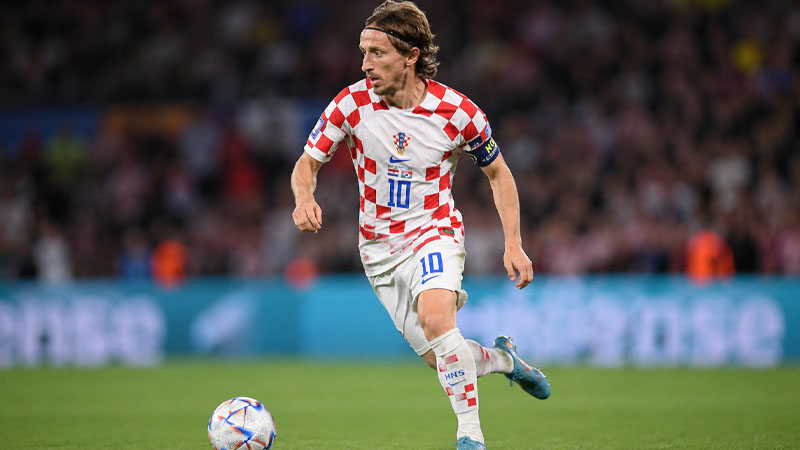
Reports surrounding the future of Croatian icon Luka Modrić indicate that the legendary midfielder is planning to retire from professional football following the 2026 FIFA World Cup.
This decision follows a period of intense reflection after his current club, AC Milan, failed to secure qualification for the UEFA Champions League.
At nearly 41 years of age, the 2018 Ballon d’Or winner is reportedly “oriented” to conclude his historic career on the international stage in North America.
This transition marks the end of an era for a player who defined modern midfield excellence through resilience, tactical intelligence, and unmatched technical skill.
Why Luka Modrić is Retiring After the 2026 World Cup
The decision for a player of Modrić’s stature to step away is rarely the result of a single event; rather, it is the culmination of shifting competitive goals and the reality of a changing club environment.
For Modrić, the 2025–26 season served as a tipping point where the project he believed in began to dismantle, leading him to prioritize his final international obligations over continued club-level play.
The AC Milan Champions League Catalyst
The most immediate factor driving this retirement news was the disappointment at AC Milan. Modrić’s arrival at the San Siro was fueled by a desire to bring the club back to the pinnacle of European football.
However, a 2-1 defeat to Cagliari on the final day of the Serie A season cost the Rossoneri their Champions League qualification spot.
Because his contract extension was reportedly contingent on securing top-tier European football, the absence of the Champions League platform fundamentally altered his willingness to continue.
Managerial Instability and Front-Office Shifts
Beyond the results on the pitch, the internal culture at AC Milan underwent a significant transformation that unsettled the veteran.
The departure of head coach Massimiliano Allegri, with whom Modrić maintained a close professional relationship, was a major blow to his commitment.
Furthermore, a sweeping overhaul of the club’s front office meant that many of the figures who recruited him were no longer present, leaving Zlatan Ibrahimović as one of the few familiar faces remaining.
For a player who arrived in Italy driven by a specific competitive vision, starting over under a brand-new leadership structure at age 41 held little appeal.
The Final Dance: Croatia and the 2026 FIFA World Cup
While his time in club football appears to be nearing its end, Modrić is not quite ready to hang up his boots entirely. His focus has now shifted exclusively toward the 2026 FIFA World Cup, where he intends to lead Croatia one last time.
This tournament is viewed as the “final act” of his playing career, allowing him to retire while competing at the highest possible level of international sport.
A Historic Fifth World Cup Campaign
Leading Croatia into the 2026 tournament in North America would mark Modrić’s fifth World Cup appearance, an extraordinary feat of longevity.
Despite his age, he remains the heartbeat of the national team, recently demonstrating his enduring quality with a goal against Slovenia.
His desire is to “say goodbye while competing” for his country, a sentiment that resonates deeply with a nation that has seen him lead them to a World Cup final and semifinal in successive tournaments.
The Emotional Weight of the Farewell
Observers have noted the emotional toll this transition is taking on the Croatian captain. Following the conclusion of the Serie A season, Modrić appeared visibly emotional, a sign that he was already processing the end of his professional journey.
Although he has settled happily into life in Milan—where his daughter is even part of the club’s youth setup—the professional reality of missing out on the biggest stages has forced a difficult conclusion.
He is now expected to deliver a formal retirement announcement either immediately before or following the 2026 World Cup.
A Legacy of Excellence: The Real Madrid Years
To understand the magnitude of Modrić’s retirement, one must reflect on his unparalleled success, particularly during his thirteen-year tenure at Real Madrid.
Once unfairly labeled as a “worst signing,” he evolved into arguably the greatest midfielder in the history of the sport.
The Trophy Cabinet of a Legend
Modrić’s career is defined by a staggering collection of silverwares that few players in history can match. His time at the Santiago Bernabéu saw him become a cornerstone of the most successful modern era in European football.
| Competition | Titles Won |
|---|---|
| UEFA Champions League | 6 |
| FIFA Club World Cup | 6 |
| UEFA Super Cup | 5 |
| La Liga | 4 |
| Supercopa de España | 5 |
| Copa del Rey | 2 |
| Total Major Trophies | 28 |
Defying the “Mediocrity” of Age
Modrić has often spoken about the high standards required at Real Madrid, noting that it is a club that “doesn’t tolerate mediocrity”. His ability to maintain a world-class level of performance from age 27 to nearly 40 is a testament to his professionalism.
Even in his debut season with AC Milan, he made 37 appearances, contributing goals and assists while playing through physical hardships like a cheekbone fracture, which he famously played through wearing a protective mask.
Life After the Pitch: Returning to the Bernabéu
The end of Luka Modrić’s playing career does not signify his departure from the football world. Plans are already in motion for him to transition into a significant off-field role, likely back at the club where he became a global icon.
A Future in Real Madrid Management
Multiple reports from Spanish and Italian media suggest that Real Madrid CF is preparing a welcome-home package for Modrić once he retires.
The club intends to integrate him into their hierarchy, potentially as a senior director or in a technical advisory capacity. This move would ensure that his immense tactical knowledge and leadership continue to benefit the club’s next generation of talent.
The Coaching Path and the Mourinho Connection
- There is also significant speculation regarding a potential coaching role. Some analysts suggest he could join the coaching staff of José Mourinho, the man who was instrumental in bringing him to Madrid in the first place.
Modrić has previously stated that if it weren’t for Mourinho, he might never have joined the Spanish giants, and a reunion on the sidelines would be a poetic continuation of their professional relationship.
Frequently Asked Questions About Luka Modrić’s Retirement
Is Luka Modrić officially retiring now?
He has not yet held a formal press conference, but insiders like Nicolò Schira and major outlets like beIN SPORTS report he has decided to retire following the 2026 World Cup.
Why did the AC Milan season influence his decision?
The club’s failure to qualify for the Champions League triggered a re-evaluation of his future, as he preferred to compete at the highest level.
What was the “Emirates football” confusion online?
A viral post on social media platforms like Reddit mentioned “professional Emirates football,” which was later clarified by the community as a typo for professional football, likely caused by brand associations or auto-correct.
Will he play another club season before the World Cup?
While he has considered his options, the “sweeping overhaul” at Milan and the loss of Champions League revenue make a continued stay at the club less likely than a pivot to full international focus.
What is his legacy at Real Madrid?
He retires as one of their most decorated players, having won 28 major trophies and the 2018 Ballon d’Or.
Conclusion: The Final Act of a Midfield Maestro
Luka Modrić’s career is a masterclass in resilience and artistic precision. From his early days in Croatia to his status as a six-time European champion, he has consistently defied expectations and age.
While the disappointment at AC Milan provided a somber catalyst for his decision, the prospect of a final World Cup run offers the “Last Dance” that a player of his magnitude deserves.
Whether he returns to the Bernabéu as a director or begins a new chapter in coaching, his influence on the game will remain permanent.
As the 2026 World Cup approaches, the footballing world prepares to bid farewell to a genius who made the difficult look effortless for over two decades.