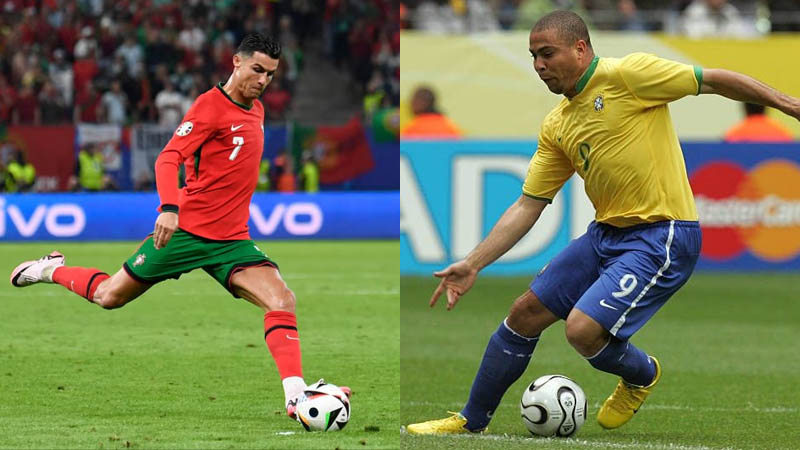
The footballing world remains perpetually divided by a single name: Ronaldo. On one side stands Cristiano Ronaldo (CR7), a Portuguese icon of relentless discipline, unmatched longevity, and statistical dominance that has redefined the limits of the sport over two decades.
Opposite him is Ronaldo Nazário (R9), the Brazilian “O Fenômeno,” whose peak was characterized by a terrifying blend of explosive speed and natural flair that many observers believe remains the highest level of individual talent ever witnessed.
This comparison explores the fundamental tension between a career of sustained excellence and a brief, unplayable window of pure footballing genius.
The Clash of Two Distinct Footballing Eras
The debate between these two legends is not merely a comparison of players, but a clash of distinct footballing philosophies: unmatched longevity and statistical dominance versus raw, explosive peak talent.
Ronaldo Nazário was an absolute force of nature at the start of his career, performing extraordinary feats for PSV, Barcelona, and Inter Milan while making legendary defenders look “silly”.
However, his career was ultimately blighted by severe knee injuries, leading to a steady decline at the turn of the century.
In contrast, Cristiano Ronaldo burst onto the scene in 2002 and proceeded to build a career of “ridiculous” consistency across the Premier League, La Liga, and Serie A.
While their careers overlapped for several years, fans never had the opportunity to witness them battle in a competitive fixture during their respective primes.
This historical gap leaves us to rely on data and the “eye test” to determine who truly deserves the mantle of the “Real Ronaldo”.
The Legend of O Fenômeno
Before the devastating injuries that altered his trajectory, Ronaldo Nazário played with a physical power and technical skill that many argue has never been matched.
He was a player who played with pure instinct, using one touch or one move to make entire defenses “extinct”. For a generation of fans, his sheer flair and natural genius carry more weight than any rigid career statistics.
The Rise of the CR7 Machine
Cristiano Ronaldo’s legacy is defined by continuous, high-level reinvention. He evolved from a flashy winger into the ultimate goal-scoring machine, prioritizing results and efficiency over unnecessary flair.
His ability to maintain an elite, injury-free standard well into his late 30s is a testament to a level of physical discipline rarely seen in global sports.
A Lone Encounter: The 2005 Charity Match
While a competitive peak-vs-peak match never occurred, the two legends did meet once on a pitch in the Algarve in July 2005.
This charity match featured Ronaldo Nazário playing for Luis Figo’s Foundation against Cristiano Ronaldo, who represented the Ronald McDonald House Charity.
At the time, Nazário was an established star nearing the end of his elite years, while Cristiano was a rising talent just beginning his legendary journey.
The match ended in a 2-1 victory for Nazário’s side, with the Brazilian proving his experience by scoring both goals for his team. He opened the scoring within six minutes and doubled the lead later with a signature move involving a trademark stepover and a dinked finish.
While Cristiano showed flashes of the explosive dribbling that would define his early Manchester United years, it was the elder Ronaldo who emerged as the winner that day.
Peak Performance vs. Career Longevity
To analyze this debate with professional depth, one must examine the staggering statistical disparity created by Cristiano’s longevity compared to Nazário’s injury-shortened peak.
Cristiano has scored more than double the total career goals of Nazário, solidifying his position as the top goalscorer in the history of the sport.
| Metric | Cristiano Ronaldo (CR7) | Ronaldo Nazário (R9) |
|---|---|---|
| Total Career Goals | 973 | 414 |
| Total Appearances | 1,323 | 616 |
| Ballon d’Or Wins | 5 | 2 |
| Champions League Titles | 5 | 0 |
| World Cup Titles | 0 | 2 (1994, 2002) |
| International Goals | 143 | 62 |
Cristiano Ronaldo’s remarkable endurance—remaining an elite force even at age 40—stands in sharp relief against the later career of Ronaldo Nazário, whose final seasons were defined by physical setbacks and fitness struggles.
While the Brazilian’s peak burned with the intensity of a brief “supernova” before fading due to injury, the Portuguese icon has forged a relentless, two-decade-long dynasty at the sport’s summit.
Ronaldo Nazário’s Unstoppable 1996/97 Season
Many analysts point to the 1996/97 season at Barcelona as Nazário’s absolute prime. During this campaign, he recorded 47 goals and 13 assists, which equates to an incredible 1.2 goal contributions per game.
He was “destroying teams in Europe for fun” and was widely considered the most unplayable player on the planet.
Cristiano Ronaldo’s Dominant 2011/12 Campaign
When comparing primes, Cristiano’s 2011/12 season at Real Madrid provides a superior statistical footprint. He achieved 1.36 goal contributions per game, a number that surpasses Nazário’s best efforts.
This season was just one of many where Cristiano shattered the perception of what a top-tier player could achieve, proving that his “peak” was not just a brief window but a sustained era of dominance.
The Eye Test: Analyzing Skill and Explosivity
Beyond the numbers, the “eye test” often favors the Brazilian. Ronaldo Nazário is frequently described as the “personification of skills and flair”. His dribbling skills are considered nearly unmatched in football history, particularly given his role as a center-forward.
While a winger might be expected to have high dribbling volume, Nazário averaged 4.67 successful dribbles per game in 1997, a figure that puts him in the 99th percentile of all strikers.
Cristiano, in his 2011/12 peak, averaged 2.9 successful dribbles per game with a 58% success rate. While elite, these figures do not match the raw, instinctual trickery of R9, who famously “walked past” the opponent’s goalkeeper nine times in a single season before scoring.
Physicality and Speed
In terms of pure physical attributes, the comparison yields surprising results. While Cristiano is a world-class athlete with a recorded top speed of approximately 32 km/h, Nazário’s unofficial peak speed was a staggering 37 km/h.
This would place him on par with modern speedsters like Kylian Mbappé. Nazário’s combination of this elite speed with immense physical strength meant he rarely had to simulate fouls; he simply powered through defenders.
Big Game Impact: World Cups vs. Champions League
The debate often hinges on which stage one values more: the international arena or European club football. Ronaldo Nazário’s legacy is inextricably linked to the FIFA World Cup.
He won the tournament twice (1994 and 2002) and was the hero of the 2002 final, scoring both goals to secure the trophy for Brazil. To many, the World Cup is the hardest prize to win, and Nazário’s success there gives him an edge in “legendary” status.
Cristiano Ronaldo, conversely, has built a “dynasty” in the UEFA Champions League. He is arguably the greatest player in the history of the competition, holding the records for most goals (140) and most assists (42) while winning the trophy five times.
While he won Euro 2016 with Portugal, the World Cup remains the one trophy he has “chased but never found”.
Statistical Reliability and Opposition Quality
A critical differentiator often overlooked is the quality of opposition during their respective peaks. Data-driven analysis reveals that Cristiano Ronaldo was quantifiably more effective against elite teams.
In his 2011/12 season, over half of his goal contributions came against teams that finished in the top 10 of the league.
Furthermore, Cristiano had over 20% of his goal involvements against the top 5 hardest teams in the league. In contrast, during Ronaldo Nazário’s legendary 1996/97 season, only 36% of his goals were against top 10 opposition, and a mere 4% were against the top 5 teams.
This suggests that while Nazário’s style was more breathtaking, Cristiano was a more reliable “net positive” for his team regardless of the difficulty of the opponent.
Conclusion: Choosing Your GOAT
Ultimately, the choice between Cristiano Ronaldo and Ronaldo Nazário depends on the specific criteria for greatness.
If you value pure, unadulterated talent, spectacular flair, and the ability to dominate the world’s biggest stage in the World Cup, Ronaldo Nazário remains the “Phenomenon”. He played with an instinct and joy that modern, data-driven coaching rarely produces.
However, if you are building a team to win a single game, a tournament, or a 38-game league season, the professional consensus favors Cristiano Ronaldo.
His focus on maximizing goal-scoring opportunities and his relentless competitive drive make him the most productive attacker in history. One is perhaps the greatest footballer to ever play, while the other is the greatest athlete the sport has ever seen.
Enhanced FAQ Section
Who scored more goals in their prime?
Statistically, Cristiano Ronaldo had a higher output. In his 2011/12 peak, he averaged 1.36 goal contributions per game, compared to 1.2 for Ronaldo Nazário in his 1996/97 peak.
Did they ever face each other in a professional match?
No. Their only meeting was in a 2005 charity match where Ronaldo Nazário’s team won 2-1.
Who was faster at their peak?
Data suggests Ronaldo Nazário was faster, reaching an unofficial top speed of 37 km/h, while Cristiano Ronaldo’s peak speed was recorded around 32 km/h.
How many World Cups did Cristiano Ronaldo win?
Cristiano Ronaldo has never won a World Cup. Ronaldo Nazário won two (1994 and 2002).
Which Ronaldo was a better dribbler?
Based on the “eye test” and statistics, Ronaldo Nazário was the superior dribbler, averaging 4.67 successful dribbles per game as a striker—a feat nearly unmatched by any other forward.