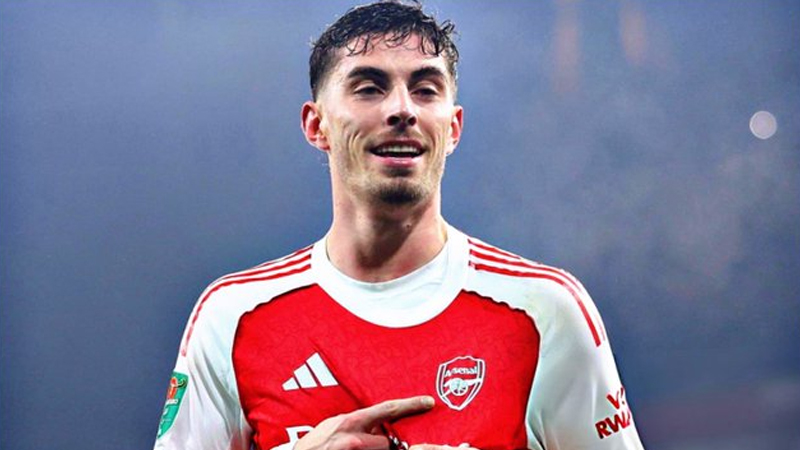
Kai Havertz has emerged as one of the most intriguing physical specimens in modern football. Since his high-profile move to Arsenal FC, fans and analysts alike have scrutinized how his specific physical profile influences his unique playing style.
Standing significantly taller than the average attacking midfielder, Havertz offers a rare blend of height and technical grace.
This analysis delves deep into his physical metrics, exploring how his stature provides a competitive edge in the high-intensity environment of the Premier League. We examine the data behind his frame and the tactical implications of his presence on the pitch.
Official Metrics: Kai Havertz Height and Weight
Understanding the baseline physical data of an elite athlete is essential for evaluating their performance capacity and durability. For a player like Kai Havertz, his dimensions are not merely numbers but are the foundation of his tactical utility on the pitch.
According to official team records and physical profiles, Kai Havertz stands at 1.93 metres (6 feet 4 inches) and weighs approximately 83 kilograms (183 pounds).
This profile places him among the tallest attacking players currently competing in the top flight of English football. To better understand how these figures translate to his role at Arsenal FC, we can break down his physical profile in the following table:
| Physical Attribute | Metric Value | Imperial Value |
|---|---|---|
| Height | 193 cm | 6′ 4″ |
| Weight | 83 kg | 183 lbs |
| Primary Position | Centre-Forward | Attacking Midfielder |
| Current Club | Arsenal FC | North London |
| Body Type | Ectomorphic/Lean | Athletic Build |
The combination of a 6’4″ frame with a weight of 183 lbs suggests a lean, “rangy” build.
This weight-to-height ratio is significant because it allows Havertz to maintain high levels of cardiovascular endurance and agility, which are often compromised in heavier, more muscular players of similar height.
The Strategic Impact of Havertz’s 6’4″ Frame
In the modern Premier League, physicality is often equated with raw strength or explosive speed. However, Havertz utilizes his height as a strategic weapon, particularly in how he occupies space and interacts with opposing defenders.
His tall frame makes him one of the most unique attacking players in the league, granting him a distinct advantage in aerial duels and the ability to hold up the ball against physically imposing center-backs.
This physical presence allows his manager, Mikel Arteta, to utilize various tactical setups that would be impossible with a shorter, more conventional playmaker.
Aerial Dominance in the Final Third
The most immediate benefit of Havertz’s 1.93m height is his capability in the air. Unlike many traditional “Target Men” who rely solely on bulk to win headers, Havertz uses his height in conjunction with elite timing.
This makes him a constant threat during set pieces and a reliable outlet for long goal kicks or crosses.
His ability to win first-contact headers in the box provides Arsenal with a vertical dimension that stretches opposing defenses and creates second-ball opportunities for trailing midfielders.
Technical Proficiency and Hold-up Play
While his height is an asset for winning the ball, his 83kg weight ensures he remains nimble enough to protect it.
Havertz excels at using his long limbs to shield the ball from defenders, effectively creating a “buffer zone” that makes it difficult for opponents to poke the ball away.
This hold-up play is vital during transition phases, allowing the rest of the team to move up the pitch while he maintains possession under pressure.
Versatility Across Positions: Centre-Forward vs. Midfielder
One of the most debated aspects of Havertz’s career has been his “best” position. His physical profile is so versatile that he has successfully operated as a “False Nine,” a traditional Centre-Forward, and a deep-lying Attacking Midfielder.
His ability to adapt to these roles is a direct result of how he leverages his height and weight. Whether he is dropping deep to link play or staying high to challenge defenders, his physicality remains his most consistent tool for tactical disruption.
The Dynamics of the Modern “False Nine”
When playing as a Centre-Forward, Havertz does not play the role in a traditional sense. Instead of staying pinned to the last defender, he uses his 6’4″ frame to drop into pockets of space.
Because he is so tall, he remains a target for teammates even when he is surrounded by several opposing players.
His lean weight of 183 lbs allows him to make quick, ghosting runs into the box after laying the ball off, a hallmark of his “Raumdeuter” or “space interpreter” style.
Defensive Contributions and the High Press
Modern football demands that every player contributes to the defensive phase, and Havertz is no exception. His long stride, a byproduct of his 193cm height, allows him to cover ground quickly when pressing the opposition.
He can close down passing lanes more effectively than shorter players simply by having a larger physical reach.
This makes him an integral part of Arsenal’s high-pressing system, as he can disrupt the rhythm of opposing goalkeepers and defenders with minimal effort.
Comparing the Physicality of Premier League Elite
To truly appreciate the uniqueness of Kai Havertz’s height and weight, it is helpful to compare him to other elite forwards and midfielders in the league. Most players who share his height are often central defenders or traditional strikers who lack his mobility.
| Player Name | Height | Weight | Style of Play |
|---|---|---|---|
| Kai Havertz | 1.93m | 83kg | Technical / Hybrid |
| Erling Haaland | 1.94m | 88kg | Power / Explosive |
| Kevin De Bruyne | 1.81m | 70kg | Traditional Playmaker |
| Darwin Nuñez | 1.87m | 81kg | Direct / Physical |
As the table demonstrates, while Haaland shares a similar height, he carries significantly more muscle mass (88kg), which results in a different type of physical impact. Havertz, at 83kg, prioritizes fluid movement and technical interlinking over raw power.
This comparison highlights why Havertz is often described as a “unicorn” in footballing terms—someone who possesses the height of a defender but the movement of a winger.
The Science of Agility in Tall Athletes
There is a common misconception in sports science that taller athletes are naturally less agile due to a higher center of gravity. However, elite athletes like Havertz challenge this notion through specific training and natural biomechanics.
Maintaining a weight of 83kg is likely a conscious choice for Havertz and his training staff. By staying lean, he minimizes the stress on his joints and ensures that his change-of-direction speed remains high despite his long levers.
Biomechanics and Center of Gravity
A player who is 6’4″ has a higher center of gravity, which can theoretically make them easier to knock off balance. Havertz compensates for this through exceptional core strength and a wide “base” when receiving the ball.
By dropping his hips and using his long arms for balance, he negates many of the disadvantages associated with his height. This allows him to turn in tight spaces—a skill usually reserved for much shorter players.
Training for Functional Lean Mass
The training regimen for a player of Havertz’s stature focuses on functional strength rather than hypertrophy (muscle size). Increasing his weight beyond 83kg might provide more “bulk” for duels, but it could also reduce his top-end speed and increase his injury risk.
His current weight represents a “sweet spot” that maximizes his stamina and allows him to perform high-intensity sprints throughout a 90-minute match.
Historical Evolution of the Havertz Physique
If we look back at Havertz’s early days at Bayer Leverkusen, he was often described as a “lanky” teenager. His physical development has been a gradual process of maturing into his 1.93m frame without losing the natural flair that made him a prodigy.
His transition to the Premier League necessitated a greater emphasis on upper-body strength to withstand the more physical style of officiating in England.
While he has remained lean, he is significantly more “robust” now than when he first arrived in London, allowing him to win those crucial aerial duels that are so frequent in the English game.
Frequently Asked Questions About Kai Havertz
How tall is Kai Havertz exactly?
Kai Havertz is 1.93 metres tall, which is approximately 6 feet 4 inches. This makes him one of the tallest attacking midfielders in world football.
What is Kai Havertz’s weight?
He weighs approximately 83 kilograms (183 pounds). This lean weight is ideal for maintaining his agility and endurance.
Does his height affect his speed?
Actually, his height is a benefit for his top-end speed. His long strides allow him to cover large distances quickly, even if his initial acceleration isn’t as explosive as a shorter player’s.
What position does he play for Arsenal?
Havertz is a versatile player who primarily operates as a Centre-Forward or an Attacking Midfielder. His physical profile allows him to adapt to both roles seamlessly.
Is Kai Havertz good in the air?
Yes, his 1.93m height gives him a distinct advantage in aerial duels, making him a major threat in the box and a reliable target for long balls.
Redefining the Modern Attacker
The physical profile of Kai Havertz—defined by his 1.93m height and 83kg weight—serves as a blueprint for the modern “hybrid” attacker.
He defies traditional categories, proving that a player can be tall and physically imposing while remaining technically gifted and agile.
His presence at Arsenal FC has provided the team with a unique tactical dimension, allowing them to compete both on the ground and in the air.
As the game continues to evolve toward a more data-driven and physical approach, players like Havertz will become increasingly valuable.
His ability to use his frame to win duels, hold up play, and provide an aerial threat, all while maintaining the technical standards of a world-class playmaker, makes him an indispensable asset.
Understanding the nuances of his height and weight is key to understanding why he remains one of the most effective and versatile players in the Premier League today.
For fans and analysts, Havertz is a reminder that in football, physical dimensions are only as powerful as the intelligence of the player using them.