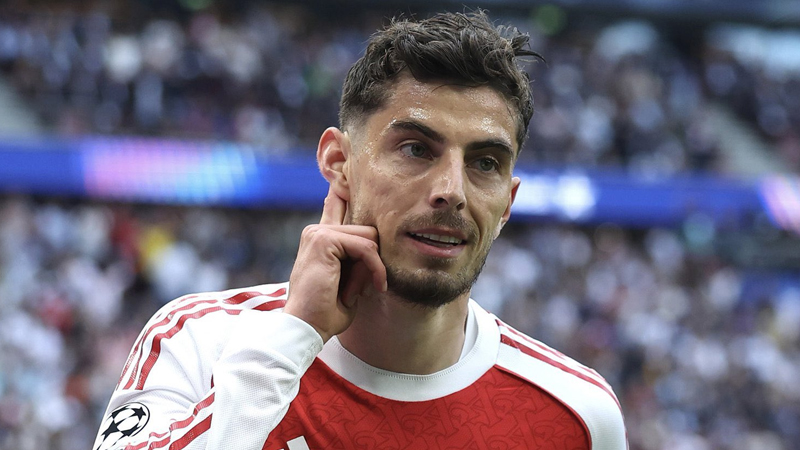
Kai Havertz is a highly effective, elite-level footballer, though he remains a polarizing figure among fans and pundits because his style is subtle rather than flashy.
By June 2026, he has solidified his status as a world-class “clutch” player, establishing a reputation for scoring critical, trophy-winning goals.
Currently a cornerstone for both Arsenal F.C. and the German national team, his value lies in a rare combination of tactical intelligence, spatial awareness, and elite physical traits.
While his journey from Bayer Leverkusen to London has been met with scrutiny, his consistent selection by world-class managers suggests a level of utility that transcends traditional statistical analysis.
The Tactical Architecture of a Modern Playmaker
To understand why managers like Mikel Arteta and Thomas Tuchel have valued Havertz so highly, one must look at his ability to influence the game without the ball.
He is often described as a “tactical Swiss Army knife” due to his ability to transition seamlessly between a “false nine” striker, an attacking midfielder, and a central midfielder.
Elite Off-the-Ball Movement and Space Creation
Havertz excels at dragging defenders out of position, utilizing unselfish vertical runs to open massive gaps for his teammates to exploit.
This specific trait is particularly beneficial for players like Bukayo Saka, who find more room to operate because of the attention Havertz demands from opposing center-backs.
His movement is often described as “Kaka-esque,” characterized by a long, gliding stride that allows him to navigate through the midfield during transitions.
Furthermore, his high tactical IQ allows him to find pockets of space in congested areas, making him a nightmare for defensive blocks to track.
Defensive Work Rate and Pressing Efficiency
Unlike many traditional luxury playmakers, Havertz is an elite presser who routinely triggers defensive actions high up the pitch. Managers value his “clutch” defensive contributions, noting that he works harder off the ball than his calm demeanor might suggest.
He is statistically significant in his defensive output for a forward, often leading his team in winning back possession in the final third.
This defensive grit was particularly noted during his tenure at Chelsea, where he frequently “grinded through” difficult campaigns with noticeable effort.
Physical and Aerial Dominance
Standing 1.93 meters tall, Havertz provides a unique physical profile that many modern attacking midfielders lack.
He serves as a primary target for direct long balls, winning a high percentage of aerial duels to help his team retain possession and move up the pitch.
His height and heading ability provide a distinct advantage against low-block defenses, where he can act as an aerial threat that his teams previously lacked.
This physical presence, combined with his technical skill, makes him an incredibly versatile asset in both offensive and defensive set-piece situations.
Analyzing the Statistical Impact Across Europe
While some critics argue his goal tallies are modest, a deep dive into his career numbers reveals a player who produces when it matters most.
By the summer of 2026, Havertz has surpassed 400 senior appearances, demonstrating remarkable durability and consistency at the highest level.
| Professional Career Phase | Appearances | Goals | Assists | Major Milestones |
|---|---|---|---|---|
| Bayer Leverkusen (2016–2020) | 150 | 46 | 31 | Youngest to 50 & 100 Bundesliga apps. |
| Chelsea F.C. (2020–2023) | 139 | 32 | 12 | Scored 2021 UCL and Club World Cup winners. |
| Arsenal F.C. (2023–Present) | 98 | 29 | 16 | Scored in the 2026 UCL final vs PSG. |
| Germany National Team | 57 | 21 | — | Scored in Euro 2020, 2022 WC, and Euro 2024. |
| Total Career Summary | 444 | 128 | 66+ | 194+ Direct Goal Contributions. |
The data shows that while he is not a high-volume poacher, his contribution of 194+ direct goal involvements in 444 games is elite for a player who frequently plays in deeper midfield roles.
His efficiency in the Champions League is particularly noteworthy, where he recently became the first player to score in a final for two different English clubs.
Debunking the Polarizing Myths of Kai Havertz
Despite his successes, Havertz remains a subject of intense debate, often labeled a “mystery” or a “flop” by those who focus solely on raw finishing stats. This divide in opinion often stems from a misunderstanding of his unique player profile.
The “Apathy” vs. Cerebral Playstyle
Critics frequently point to a perceived “lethargic” or “apathetic” demeanor on the pitch. However, supporters and analysts argue this is a byproduct of his elegant, cerebral style, much like former greats Robin Van Persie or Mesut Özil.
His “wiriness” and frame can sometimes make his movements look clumsy, yet he retains a smoothness in transition that allows him to glide past opponents.
The “mystery” of Havertz is often just the subtle nature of a player who prioritizes tactical positioning over individual flair.
Challenges with Clinical Finishing
A valid criticism often leveled at Havertz is a lack of ruthless, clinical finishing in front of goal. He has been known to miss high-quality chances and sometimes lacks the instinctual “poacher” movement required of a traditional number nine.
During his “dark years” at Chelsea, a loss of belief saw him swing his foot at the ball aimlessly, a clear sign that confidence plays a massive role in his technical execution.
However, when playing with “swagger” and confidence, his touches look crisp, and he has shown the ability to score spectacular goals from distance when given time and space.
The Position Conundrum
For years, the question of “where does he fit?” plagued his career, especially at Chelsea where he was often used as a lone striker in a system that didn’t suit his strengths.
Havertz himself has expressed frustration over the constant positioning debate, asserting that he can play anywhere across the front line.
He is arguably at his best when playing as a “false nine” or a number ten with the freedom to move into half-spaces, rather than being pinned against physical center-backs.
In the right system, such as Mikel Arteta’s Arsenal, this versatility is viewed as a major asset rather than a lack of identity.
The Arsenal Evolution: Finding the Mojo
Since his £65 million move to Arsenal, Havertz has undergone a significant career redemption. This transformation was not immediate, but it has been sustained by a supportive environment and a clear tactical vision.
Arteta’s Tactical Integration
At Arsenal, Havertz initially struggled to adapt to the left-eight role previously occupied by Granit Xhaka. However, as he transitioned into the primary center-forward role, his impact became undeniable.
Mikel Arteta’s system provides the “space and time” Havertz needs to operate, allowing him to be a key facilitator in the team’s build-up play.
His importance to the team was starkly illustrated when Arsenal’s build-up play suffered significantly after he was substituted in key matches.
The Role of Team Culture and Confidence
The “rising tide lifts all ships” mentality at Arsenal played a pivotal role in restoring Havertz’s confidence. A turning point often cited by fans was when teammates Bukayo Saka and Martin Ødegaard “gifted” him a penalty to help him break a goal drought.
This supportive backdrop allowed him to move past the “dark place” he occupied during his final months at Chelsea.
Now playing with renewed belief, he has become one of Arsenal’s most consistent and productive players, proving that his high price tag was a strategic investment rather than an overpay.
Historical Comparisons and Future Outlook
As we look toward the 2026 World Cup, Havertz is no longer seen as a “wonderkid” but as a seasoned veteran with a unique profile in world football.
Analysts often struggle to find a direct comparison for him, though several names frequently arise in tactical discussions.
- Thomas Müller: Like Müller, Havertz is a “space interpreter” (Raumdeuter), though some argue he lacks Müller’s specific “powers” of instinctual positioning.
- Robin Van Persie: Thomas Tuchel famously compared Havertz to a young Van Persie due to his height, technical ability, and movement.
- Mesut Özil: Some fans see him as “Özil 2.0” because of his perceived lack of effort and high technical ceiling, though Havertz offers significantly more defensive output and aerial threat.
Frequently Asked Questions
Is Kai Havertz a striker or a midfielder?
Havertz is a versatile forward who is most comfortable as a “false nine” or an attacking midfielder. While he began his career in Germany as a number ten, his recent success at Arsenal has come primarily as a leading striker who drops deep to link play.
Why was he considered a “flop” at Chelsea?
The “flop” narrative largely stems from his high transfer fee and Chelsea’s overall team struggles during his tenure.
While he scored the winning goal in a Champions League final, his inconsistency and the chaotic nature of Chelsea’s managerial changes made it difficult for him to find a settled role.
What are Kai Havertz’s main strengths?
His primary strengths include elite off-the-ball movement, high tactical intelligence, aerial dominance, and an exceptional defensive work rate for an attacking player. He is a “big-game” player who consistently performs in high-pressure finals.
How has he performed in the 2025/2026 season?
Despite a knee injury early in the campaign, Havertz was instrumental in the winter and spring title run-ins for Arsenal.
He notably scored the opening goal in the 2026 Champions League final, cementing his status as one of the most reliable “clutch” players in Europe.
Conclusion: The Ultimate Tactical Asset
The answer to whether Kai Havertz is “good” is a resounding yes, provided he is evaluated through the lens of modern tactical requirements rather than just individual highlights.
He is a player who makes his teammates better by creating space, maintaining possession, and leading the defensive press from the front.
His ability to deliver in the most significant moments—proven across multiple Champions League finals—separates him from talented players who shrink under pressure.
As he leads the line for Germany in the 2026 World Cup, Havertz stands as a testament to the value of tactical intelligence and the transformative power of the right managerial system.
For Arsenal and Germany, he is not just a player; he is the architect of their tactical structure.