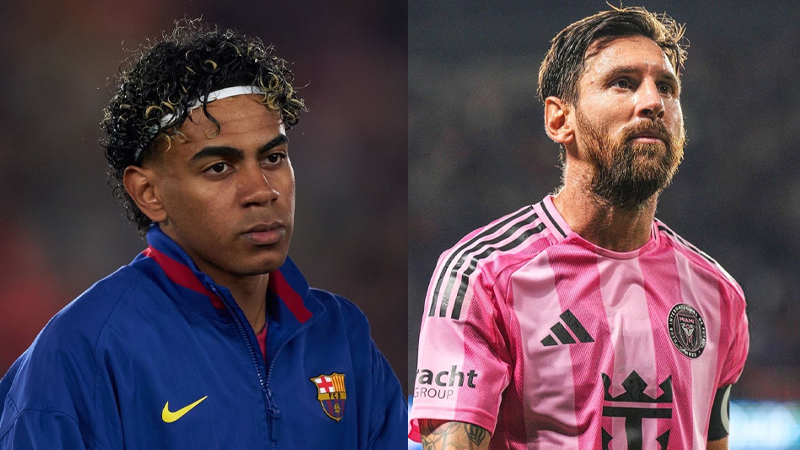
The comparison between Lamine Yamal and Lionel Messi is no longer just tabloid speculation; it is a statistical reality that has redefined the ceiling for teenage athletes.
In 2007, a 20-year-old Messi was photographed bathing a baby Yamal for a charity calendar, an image that now serves as a prophetic passing of the torch.
While Messi is the undisputed “greatest of all time,” Yamal’s trajectory since his debut at age 15 is objectively steeper. We are witnessing a generational transition where the student is not merely emulating the master but actively shattering his early-career records.
The Statistical Explosion: Why Yamal Leads the Early Race
When examining the foundational years of both players, the data suggests that Lamine Yamal is the most productive teenager in the history of FC Barcelona.
Because Yamal broke into the first team at just 15 years and 290 days—nearly two years younger than Messi’s debut at 17—he has had a significant head start in accumulating senior-level experience.
By the time he reached 18, Yamal had already played 105 club games and scored 24 goals, a volume of work that Messi did not reach until he was nearly 21.
The following table provides a high-level comparison of their outputs at age 17, highlighting the massive disparity in early-career involvement:
| Milestone / Metric | Lionel Messi | Lamine Yamal |
|---|---|---|
| Senior Debut Age | 17 years, 114 days | 15 years, 290 days |
| Stats at Age 17 | 1 Goal / 0 Assists | 11 Goals / 17 Assists |
| First 4 Seasons (Club) | 42 Goals / 24 Assists | 43 Goals / 48 Assists |
| International Debut | Age 18 | Age 16 |
| Major International Trophy | Copa América (Age 24) | UEFA Euro 2024 (Age 17) |
Source:
The Efficiency Gap and Goal Contributions
While Messi is remembered as a “beast” of clinical finishing, his early role was more sporadic. In his first three seasons, Messi’s goal-per-90-minute ratio was 0.45, while Yamal’s sits at 0.22.
However, this is largely due to positioning; Messi operated closer to the box and took 3.2 shots per 90, whereas Yamal, playing a deeper playmaking role, takes only 1.8 shots per 90.
Conversely, Yamal is a far superior creator at this age, averaging 0.30 assists per 90 compared to Messi’s 0.20.
Technical Profiles: “Freak of Nature” vs. “Tempo Dictator”
An analytical “eye test” reveals that while both are left-footed inverted wingers, their impacts on the pitch differ fundamentally. Young Messi was a force of physics, characterized by a low center of gravity and ball control that seemed “glued” to his feet.
He was a direct, explosive dribbler who could bypass an entire defense through raw acceleration. In contrast, Yamal operates with a maturity that suggests he has “already solved” the game of football.
Tactical Roles and Ball Progression
Yamal’s role in the current Barcelona system is much more expansive than Messi’s early role.
- Central Hub: Yamal is the center of the team, averaging 75–85 touches per 90 minutes, whereas young Messi averaged 55–60.
- Playmaking Depth: Yamal routinely drops deeper or stays wider to dictate the tempo of the match.
- Chance Creation: Yamal records 2.5 key passes per 90 minutes, significantly higher than Messi’s 1.5 at the same age.
- Dribbling Volume: In the Champions League, Yamal recorded 98 dribbles as a teenager, a record in the Opta era. At age 19, Messi was averaging 4.9 dribbles per 90, while Yamal is currently at 7.2.
The Evolution of the “Inverted Winger”
Messi was often an “option” in a team of stars, whereas the current Barcelona squad often “prays” for Yamal to find a solution when they are down.
Yamal relies heavily on elite decision-making and spatial vision, using his crossing ability to create dangerous chances from wide positions. While Messi was a clinical finisher from the start, Yamal acts as the primary engine for both club and country.
The Mentality Shift: A “Ronaldo” Spirit in a Catalan Body
One of the most striking differences between the two icons lies in their psychological profiles. Messi was famously quiet, almost mute during his first month at La Masia, and always approached teammates and rivals with extreme caution and respect.
Yamal, however, exhibits a vocal, “Cristiano Ronaldo-like” confidence. He is known to joke in the dressing room and has stated publicly that he “left all [his] fears in the park of [his] neighbourhood”.
Fearlessness Under Global Scrutiny
Yamal faces a level of pressure that did not exist in the early 2000s. In the age of social media, every “corny story” he posts or every loss he suffers results in immediate public “cooking”.
Despite this, he has shown an incredible ability to take responsibility for Barcelona’s trajectory at just 17 years old. While Messi was focused on developing under the wing of Ronaldinho, Yamal is expected to carry the team’s aspirations in the Champions League.
The Impact of Fame and Privacy
Unlike Messi, who could develop somewhat quietly before the explosion of YouTube and Instagram, Yamal is a global legend before he can even legally drive in many countries.
He recently returned to his old neighborhood of Rocafonda and realized he can no longer walk the streets freely.
This “fearless” mentality—thinking “I am the best, so it is not a problem”—is a key driver in his ability to perform in high-stakes matches like the Champions League semi-finals.
Contextualizing Greatness: “Finished House” vs. Financial Crisis
To truly understand why Yamal’s rise is so significant, one must analyze the environments in which these players emerged.
Messi joined a “finished house”—a squad stacked with Ballon d’Or winners and world-class talents like Ronaldinho, Deco, Samuel Eto’o, and Xavi. This allowed Messi’s integration to be gradual; the team did not depend on him for results.
The Burden of Necessity
Yamal’s debut was born out of Barcelona’s financial necessity. The club had no money for major transfers and was forced to turn to its youth system for immediate solutions.
- Starter by Default: Yamal became a starter not just because of his talent, but because the club had few other options.
- Defensive Attention: Because he is the “main man,” defenders now man-mark him and “suffocate” him with attention that Messi didn’t face until he was much older.
- Physical Toll: The rapid accumulation of minutes has already resulted in a significant hamstring tear for Yamal in April 2026, putting his World Cup availability at risk.
A New Dynasty at La Masia
Despite the struggles, Yamal is seen as the leader of a new dynasty, much like the 2006 Champions League win marked the beginning of the Messi era.
Alongside Gavi, Pau Cubarsi, and Alejandro Balde, Yamal is part of a crop of teenagers who are performing at a level that Xavi and Iniesta didn’t reach until their mid-20s.
The Road to Longevity: Can Yamal Sustain the Shadow?
The ultimate question is whether Yamal can match Messi’s fifteen years of consistent, world-class influence. While Yamal is objectively the “better youngster” in terms of statistics and impact at age 17, Messi’s career is an anomaly that may never be replicated.
Messi’s ability to influence every final he played for over a decade requires a level of luck, consistency, and mental strength that is rare in any sport.
The Injury Hurdle
The hamstring injury Yamal suffered in late 2026 is a warning sign of the physical toll early stardom can take.
For Yamal to rival Messi’s legacy, he will need to navigate the transition from a “teen prodigy” to a seasoned veteran while maintaining his explosive playstyle.
Experts suggest that while he is “on the way” to greatness, the environment and friends surrounding him will be crucial to his long-term success.
Defining a Unique Legacy
Yamal himself has stated, “I don’t want to compare myself with the best player in football’s history”. The consensus among coaches and former players is that he should not be the “next Messi,” but rather the “first Lamine”.
He has already won La Liga, a European Championship, and finished second in the 2025 Ballon d’Or rankings by the age of 18—milestones that even Messi had not reached at that point in his life.
Frequently Asked Questions
Is Lamine Yamal statistically better than Messi was at 17?
Yes. Yamal has significantly higher goals, assists, and games played than Messi had at the same age. Specifically, Yamal recorded 11 goals and 17 assists by age 17, while Messi had only 1 goal and 0 assists.
Does Yamal play exactly like Messi?
Not exactly. While both are left-footed and play on the right wing, Yamal is more of a “tempo dictator” who drops deep and creates chances through crossing and vision. Young Messi was more of an explosive, direct dribbler who focused on clinical finishing.
What is Yamal’s “304” celebration?
The celebration represents the last three digits of the postcode (08304) for Rocafonda, the neighborhood where he grew up in Mataro.
How has injury affected Yamal’s career?
In April 2026, Yamal suffered a significant left-leg hamstring tear after playing a high volume of matches for club and country. This has put his participation in the 2026 FIFA World Cup group stages at risk.
Conclusion: The First Lamine
Lamine Yamal is not a carbon copy of Lionel Messi; he is a statistical upgrade of a teenager operating in a more demanding era.
While he lacks the “physics-breaking” dribbling that made young Messi a “freak of nature,” he compensates with a playmaking maturity and a fearless, vocal leadership style that is reminiscent of Cristiano Ronaldo.
As he fights to return from injury for the 2026 World Cup, the football world is no longer looking for the “next Messi.” They are watching the “first Lamine” build a dynasty of his own.