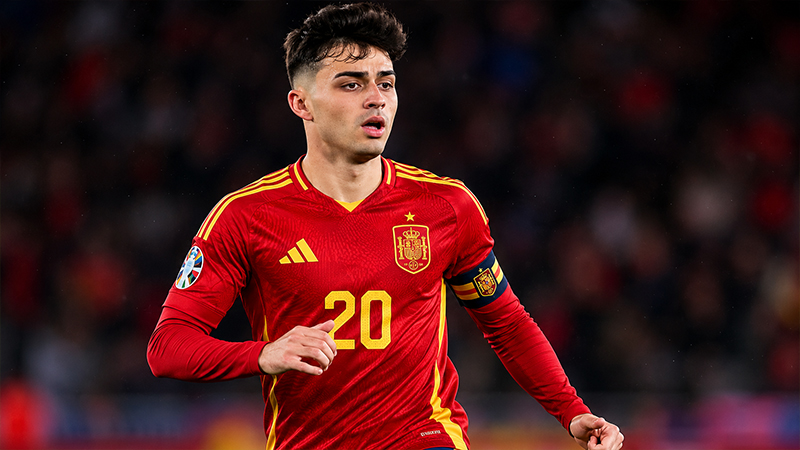
The sight of Pedri orchestrating the Barcelona midfield with surgical precision often leads fans to a logical but incorrect conclusion: he must be a product of the club’s famed youth academy.
His uncanny ability to manipulate space, his rhythmic passing, and his innate understanding of the “Blaugrana” philosophy suggest a decade of training at the farmhouse. However, the reality of his journey is far more fascinating.
While he embodies the technical ideals of the club more than almost any contemporary, he never actually attended the academy. This exploration deconstructs the origins of a modern footballing genius who bypassed tradition to become a legend.
The Reality of the Canary Islander’s Development
To answer the burning question—is Pedri from La Masia—one must look toward the Canary Islands rather than the fields of Catalonia.
Pedri, born Pedro González López, developed his foundational skills far away from the structured environment of Barcelona’s youth system.
His early footballing education took place at grassroots clubs in his hometown of Tenerife, specifically UD Tegueste and Juventud Laguna.
These local institutions provided the raw canvas upon which he began to paint his signature style of play, characterized by a calmness that belies his age.
The Rise Through UD Las Palmas
The most critical stage of his pre-Barcelona development occurred at UD Las Palmas, where he joined the academy in 2018 at the age of 15. Unlike traditional academy graduates who spend years in the youth ranks, Pedri’s ascent was meteoric.
By 2019, at just 16 years old, he was promoted directly to the senior professional team, skipping several developmental steps.
It was during this period that his technical brilliance caught the eyes of elite scouts across Europe, though Barcelona ultimately won the race for his signature in September 2019.
The Direct Path to the Senior Squad
Barcelona’s recruitment strategy for Pedri was a departure from their usual reliance on homegrown talent. The club agreed to an initial fee of €5 million and officially integrated him into the senior first-team squad for the 2020–2021 season.
Crucially, Pedri bypassed the B-team and the youth categories entirely upon his arrival in Catalonia. While he has often playfully remarked that he is “like a Masian” because he has been a “Culé since birth,” his professional training is entirely external to the Barcelona youth apparatus.
Analyzing the “Barça DNA” Paradox
The reason the “is Pedri from La Masia” debate persists is rooted in his “Barça DNA,” a term used to describe a specific profile of technical and tactical intelligence.
Fans and commentators frequently mistake him for an academy graduate because his passing, composure, and spatial awareness mirror the qualities instilled in players from a very young age at the club.
He possesses a unique “calculating” nature on the ball, making decisions that seem choreographed by the ghosts of the club’s past legends.
The Xavi Interaction: A Tactical Validation
One of the most telling anecdotes regarding Pedri’s style involves current manager and club legend Xavi Hernandez.
Upon observing Pedri’s habit of constantly scanning his surroundings and checking his back before receiving the ball, Xavi reportedly asked him, “Who taught you to play like that?”.
This “scanning” is a fundamental tenet taught at the farmhouse, yet Pedri arrived with this skill already mastered. It suggests that his tactical maturity was either innate or self-taught through years of observing the club he supported as a child.
Spatial Intelligence and Modern Metrics
Pedri’s impact is not just aesthetic; it is backed by elite-level data that ranks him among the best midfielders in the world.
His ability to progress the ball into the final third is statistically dominant, often placing him in the top 1% of midfielders across the top five European leagues.
This high-level performance has led some fans to joke that he attended a “La Masia Night School” or an “online school” where he meticulously studied the movements of Xavi and Iniesta to mimic their success.
| Feature | Pedri’s Path | Traditional La Masia Path |
|---|---|---|
| Youth Academy | UD Las Palmas | La Masia (The Farmhouse) |
| Regional Origin | Canary Islands | Primarily Catalonia/Global Recruitment |
| Barça B Experience | None (Direct to First Team) | Years of developmental tiers |
| Key Influences | Grassroots Tenerife Clubs | Direct Club Coaching Staff |
| Scouting Cost | €5 Million Initial Fee | Internal Development Costs |
Others Who Possess the DNA Without the Academy
Pedri is not the only player to display the requisite “Barça DNA” without being a product of the youth system. The club has a history of signing “honorary Masians” who fit the tactical profile perfectly.
This phenomenon suggests that the philosophy is not exclusive to the academy but is a broader footballing ideal that can be found in other technical hubs across the world.
- Frenkie de Jong: Signed from Ajax, a club that shares a deep ideological connection with Barcelona through Johan Cruyff.
- David Silva: Often cited by fans as a player who would have flourished in a Barcelona shirt due to his technical profile.
- Rodri: Noted for his composure and positional discipline, qualities that align with the Mediterranean style of play.
- Dani Alves: While a defender, his technical ability and chemistry with the midfield made him feel like a natural product of the system.
- Luka Modric: Though a rival, fans have acknowledged his playing style as being remarkably “Barça-adjacent”.
Why the Misconception Persists Among Global Fans
The global fan base often struggles to reconcile Pedri’s “non-Masia” status because he is the “protagonist” of the current team’s identity. In the absence of veteran academy leaders, Pedri has stepped into a role that requires him to be the heartbeat of the squad.
When he is missing from the lineup, the drop in technical quality and tactical fluidity is immediately visible, a trait usually reserved for the most influential academy products. This reliance reinforces the narrative that he is the chosen successor to the Xavi-Iniesta lineage.
A Culé From Birth
The emotional connection Pedri has with the club further blurs the lines. Photos of a very young Pedri with former player José Mari Bakero prove that he was a devoted fan long before he was a professional.
This lifelong devotion means he understands the weight of the jersey and the expectations of the crowd, allowing him to play with a level of comfort that usually takes years for an “outsider” to develop. He isn’t just playing for a club; he is playing for his club.
The Influence of Canary Island Football
Residents of Gran Canaria have noted that the style of football played in the region bears a striking resemblance to the technical requirements of Barcelona.
This regional affinity for possession-based, skillful play likely provided Pedri with a “shadow education” that prepared him for the demands of the Camp Nou.
In many ways, his environment in the Canary Islands acted as a decentralized version of the Barcelona youth system, emphasizing flair and vision over raw physicality.
Strategic Scouting: The “La Masia Adjacent” Model
Pedri’s success has sparked a debate regarding the future of Barcelona’s recruitment. Some argue that his trajectory represents a superior business model: identifying young players with high technical ceilings and “La Masia adjacent” qualities and integrating them directly into the first team.
This approach allows the club to maintain its identity even when the academy might not be producing a world-class talent in a specific position.
Benefits of External Recruitment
Signing a player like Pedri provides the club with a finished or near-finished product that has already experienced the rigors of professional football at a club like Las Palmas.
This reduces the transitional risk often associated with moving youth players from the third division directly to the elite level.
It also allows the club to diversify its talent pool, finding players who bring the “Barça style” but perhaps with a different perspective or physical profile developed in another league.
Maintaining the Academy Core
Despite the success of the Pedri model, the academy remains the soul of the club. The current squad features a blend of “scouted Masians” like Pedri and “pure Masians” like Gavi or Lamine Yamal.
This synergy is what makes the modern Barcelona midfield so formidable; it combines the best of internal development with the most astute external scouting.
The “Pedri Paradox” has actually strengthened the academy’s reputation by showing that its philosophy is so powerful that even those outside the walls strive to master it.
Commonly Asked Questions About Pedri’s Career
Is Pedri really not from La Masia?
No, he is not. He was developed by UD Las Palmas and joined Barcelona’s senior squad directly at the age of 17.
How much did Barcelona pay for Pedri?
The initial transfer fee was approximately €5 million, which has since risen with performance-related variables.
Why do people think he is an academy graduate?
His playstyle—specifically his spatial awareness, scanning, and technical passing—is identical to the “DNA” taught at La Masia.
What clubs did Pedri play for before Barcelona?
He played for UD Tegueste, Juventud Laguna, and UD Las Palmas.
Did he ever play for Barcelona B?
No, he was integrated directly into the first team by then-coach Ronald Koeman and has remained there ever since.
The Legacy of an Honorary “Masian”
Ultimately, the question of whether Pedri is from La Masia is a matter of technicality versus spirit. While his registration papers will always show UD Las Palmas as his formative club, his heart and his playing style belong to Barcelona.
He has proven that the “Barça DNA” is not a secret guarded by the walls of a farmhouse, but a philosophy that can be embraced by anyone with the vision and discipline to study it.
Pedri remains the ultimate “honorary Masian,” a player who found his way home without ever needing a map. His presence ensures that the club’s identity remains intact, bridging the gap between historical tradition and modern global scouting.
As the team looks toward the future, Pedri stands as the premier example of how technical excellence can transcend geographical boundaries.