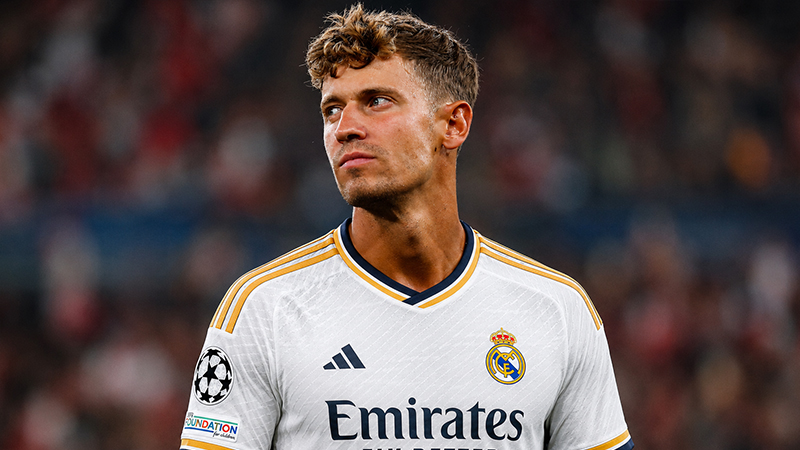
Marcos Llorente’s departure from Real Madrid in 2019 remains one of the most intriguing tactical shifts in modern Spanish football.
Despite being the descendant of club legends, Llorente found himself at a professional crossroads where his lineage could no longer protect his playing time.
His transition to Atlético Madrid was not a simple act of defiance but a calculated move necessitated by a lack of opportunity under Zinedine Zidane.
This analysis explores the tactical bottlenecks, the rise of competitors, and the subsequent transformation that turned a defensive anchor into a world-class offensive powerhouse under the lights of the Metropolitano.
A Legacy Rooted in the Santiago Bernabéu
Marcos Llorente was never just another academy prospect; he was a standard-bearer for a family that is essentially the royalty of Real Madrid history. This background made his eventual exit even more surprising to the global fanbase.
The Weight of a Legendary Name
Llorente carries one of the most distinguished pedigrees in the sport’s history. He is the son of Paco Llorente, who also wore the white shirt, and the grandnephew of the incomparable Paco Gento, the only player to win six European Cups.
Furthermore, his grandfather was Ramón Moreno Grosso, another stalwart of the club’s golden eras. This deep-rooted connection meant that Llorente was expected to spend his entire career at the Bernabéu, following the path of the legends who came before him.
The Journey Through the Academy
His professional path was an exemplary model of the Real Madrid youth system. He joined the academy in the 2008/09 season and progressed meticulously through every rank.
Starting with the Under-14s, he eventually became a dominant force for Real Madrid Castilla in the Segunda División B, where he played 62 matches and developed the tactical discipline that would define his early career.
He made his official first-team debut in October 2015 during a victory over Levante, signaling what many thought would be a decade of dominance in the Madrid midfield.
Statistical Profile and the Real Madrid Record
To understand why a player of his caliber left, one must first look at the impact he had during his limited time on the pitch. While he was highly valued for his professionalism, his role was strictly defined and eventually limited.
Measuring Impact by the Numbers
During his tenure with the first team from 2017 to 2019, Llorente made 39 appearances. Because he was utilized strictly as a defensive midfielder (CDM), his contributions were often measured in defensive stability and ball recovery rather than goals or assists.
Despite the limited minutes, his presence was part of an era that secured significant silverware for the trophy cabinet.
| Competition | Games Played | Goals Scored | Assists |
|---|---|---|---|
| La Liga | 22 | 0 | 0 |
| Copa del Rey | 11 | 1 | 0 |
| UEFA Champions League | 2 | 0 | 0 |
| FIFA Club World Cup | 2 | 1 | 0 |
| UEFA Super Cup | 2 | 0 | 0 |
| Total Career Stats | 39 | 2 | 0 |
The Solari Era and Individual Honors
Llorente’s most successful period at the club came under manager Santiago Solari, who recognized his physical capabilities. He was instrumental in the 2018 Club World Cup victory, where he started the final against Al-Ain.
In that match, he scored a stunning goal from outside the area and was named the MVP of the final. Shortly after, he netted another long-range strike in the Copa del Rey against Girona.
These moments proved he had the technical skill to contribute offensively, yet he remained trapped in a defensive role.
The Tactical Ceiling: Why the Exit Was Necessary
The primary reason for Llorente’s departure was tactical, driven by the preferences of Zinedine Zidane upon his return to the club. The manager had a specific vision for the midfield that did not provide a pathway for Llorente to become a regular starter.
The Dominance of Casemiro
In Zidane’s tactical hierarchy, the defensive midfield role belonged almost exclusively to Casemiro. The Brazilian was considered “unbenchable” because of his unique ability to protect the back four, a role that Zidane viewed as the foundation of his system.
Because Llorente was viewed only as a defensive anchor at that time, he was essentially stuck behind a world-class player who rarely suffered injuries or loss of form, creating an impassable bottleneck.
The Rise of Federico Valverde
Zidane’s preference for younger talent also played a decisive role in the decision. When faced with the choice of which young midfielder to integrate into the squad, Zidane opted to back Federico Valverde as the long-term future of the club’s midfield.
Valverde’s versatility and explosive energy appealed to Zidane more than Llorente’s positional discipline. Consequently, Zidane explicitly informed Llorente that he was surplus to requirements and would not see the regular minutes necessary for his development.
Choosing the Red and White: A Professional Pivot
Faced with the prospect of stagnating on the bench, Llorente made the bold decision to leave his boyhood club. He prioritized his professional growth over the comfort and status of remaining at the Bernabéu as a secondary option.
Ambition Over Comfort
Llorente’s own words provide the clearest insight into his mindset during the summer of 2019. He stated that it was “very clear” he had to leave Real Madrid to continue growing as a player.
He famously remarked that when Atlético Madrid’s offer arrived, he “didn’t doubt it for a minute” because he understood that a player only improves when they are consistently on the pitch.
This drive to play reflected an elite professional mentality that refused to accept a redundant role.
A Strategic Cross-Town Move
The move to Atlético Madrid for €40 million was strategically advantageous for several reasons. Beyond the footballing project, Llorente wanted to stay close to his family and friends in the city of Madrid, making the cross-town move ideal for his personal life.
While some viewed the transfer to a direct rival as controversial, it was a “win-win” for all parties: Real Madrid received a substantial fee for a backup player, and Llorente secured a prominent role in a top-tier team.
The Transformation Under Diego Simeone
The most remarkable part of Llorente’s story began after he left. While Real Madrid saw him as a defensive anchor, Diego Simeone saw something much more dynamic. This positional evolution is widely regarded as a stroke of “Cholo Magic”.
Redefining the Modern Midfielder
Under Simeone, Llorente underwent a radical transformation from a rigid defensive midfielder to a highly dynamic, attacking box-to-box threat.
Simeone realized that Llorente’s elite physical attributes—his incredible speed and “stamina for days”—were better suited for an offensive role.
He began deploying Llorente as a second striker and a right-sided attacker, positions where his goalscoring instincts could flourish. This evolution allowed him to become the team’s most impactful offensive player by 2020, leading in both goals and assists.
The Night at Anfield
The ultimate validation of this tactical shift occurred during the 2020 Champions League campaign. Llorente came on as a substitute against Liverpool at Anfield and scored two goals that eliminated the defending champions.
This performance demonstrated a level of offensive flair that had been completely suppressed during his time at Real Madrid, where he was only allowed to play as a defensive shield.
Analysts noted that he had transitioned from a “Gattuso-style” player to a “beastly offensive player” with a unique skillset.
Long-Term Legacy and Value in Madrid
Years later, the decision to leave has been fully vindicated. Llorente has found a home at the Metropolitano where he feels genuinely valued and essential to the club’s success.
Finding a Home at the Metropolitano
Llorente has publicly expressed his desire to retire at Atlético Madrid, noting that he feels deeply appreciated by the club and its supporters. He has integrated into the culture of the team so thoroughly that he is now a cornerstone of their project.
His journey serves as a lesson for young players that seeking a club that offers consistent minutes is often more important than staying at a prestigious club where one is destined for the bench.
A Comparative Look at the Move
While Real Madrid lost a talented homegrown player, the decision worked out for their squad building as well. By selling Llorente, they cleared space for Federico Valverde to become a world-class talent in his own right.
The €40 million fee was also considered a high price at the time, which Real Madrid reinvested into the squad. Ultimately, the move allowed two elite midfielders to thrive in different environments rather than competing for a single spot in the same lineup.
Frequently Asked Questions
Why did Zidane let Marcos Llorente leave?
Zidane preferred the tactical profile of Federico Valverde and considered Casemiro the undisputed starter in the defensive midfield role. He explicitly told Llorente he would not have a regular role in the team.
How much did Atlético Madrid pay for Llorente?
Atlético Madrid paid a transfer fee of €40 million to secure Llorente’s services in June 2019.
Is Marcos Llorente related to Paco Gento?
Yes, he is the grandnephew of Paco Gento, the legendary Real Madrid winger who won six European Cups.
What was Llorente’s role at Real Madrid versus Atlético?
At Real Madrid, he was strictly a defensive midfielder (CDM). At Atlético Madrid, Diego Simeone transformed him into a versatile box-to-box midfielder, winger, and second striker.
Conclusion: The Power of Professional Growth
The story of Marcos Llorente’s exit from Real Madrid is not one of failure, but of strategic realization. It highlights the importance of tactical fit and the vision of a manager.
While his family history was written in the white of Real Madrid, his professional peak has been painted in the red and white of Atlético.
By having the courage to leave a position of comfort, Llorente unlocked an offensive potential that few believed existed, proving that sometimes a change of environment is the only way to truly grow.
His transformation from a defensive anchor into a dynamic attacker remains one of the most successful “tactical migrations” in the history of the sport.