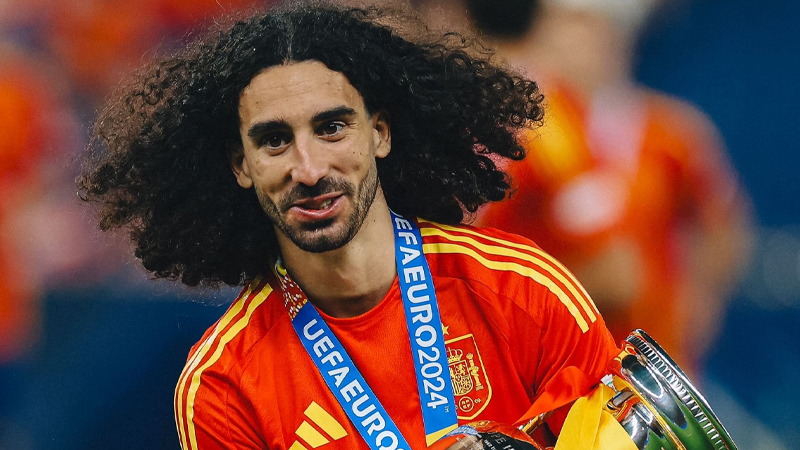
Every time Marc Cucurella touches the ball on German soil, a deafening chorus of whistles and jeers erupts from the stands, a phenomenon most recently witnessed during Chelsea’s Champions League encounter with Bayern Munich.
This relentless hostility is not a random act of sports rivalry but the lingering aftermath of a single, highly controversial moment that defined the Euro 2024 quarter-finals.
For many fans, the Spanish left-back has become the face of perceived sporting injustice, transforming from a talented defender into a permanent pantomime villain for an entire nation still grappling with a bitter exit from their home tournament.
The Defining Moment: That Euro 2024 Quarter-Final
The genesis of the animosity lies in the high-stakes environment of the Euro 2024 quarter-final between Spain and Germany.
With the match locked at 1-1 during extra time in Stuttgart, German midfielder Jamal Musiala struck a powerful shot that clearly hit Cucurella’s outstretched left hand inside the penalty area.
Despite the clear contact, the English officiating team, led by referee Anthony Taylor and supported by VAR official Stuart Attwell, determined that his arm was in a natural downward position and declined to award a penalty.
This decision proved catastrophic for the host nation’s ambitions. Shortly after the non-call, Spain secured a 2-1 victory through a late goal by Mikel Merino, effectively ending Germany’s hopes of winning a major trophy on home soil.
The psychological blow to the German public was profound, leading to a sense of being “robbed” of a fair opportunity to advance.
UEFA’s Admission and the Fueling of Resentment
If the initial “no-call” was the spark, the subsequent official review was the fuel that turned the frustration into a permanent grievance.
Months after the tournament concluded, UEFA’s refereeing commission conducted an internal analysis and officially admitted that a mistake had been made.
The commission concluded that a penalty should indeed have been awarded to Germany, as Cucurella’s hand prevented a shot on target while being in an unnatural position.
This admission did little to satisfy German supporters. Instead, it validated their anger and solidified Cucurella as the physical manifestation of that officiating error.
Because fans find it difficult to direct their ire at abstract entities like VAR or a rotating roster of referees, they have chosen to target the player who benefited most directly from the mistake.
| Key Event | Detail | Outcome |
|---|---|---|
| Date | Euro 2024 Quarter-Final | Spain 2-1 Germany (AET) |
| The Action | Musiala shot hits Cucurella’s hand | No penalty awarded by Anthony Taylor |
| Initial Ruling | Natural arm position | Play continued; Germany eliminated |
| UEFA Review | Official admission of error | Confirmed Germany deserved a penalty |
The Spread of Hostility Across Neutral Venues
The resentment toward Cucurella did not end when Germany was eliminated. Instead, it followed him throughout the remainder of the tournament.
During Spain’s semi-final victory over France and the final against England, German fans who had already purchased tickets to these neutral matches used the platform to loudly jeer every touch he made.
This behavior highlights a unique aspect of tournament football in a host country. Many locals attend the later stages of the competition regardless of whether their own team is playing.
For these fans, booing Cucurella became a way to participate in the tournament’s narrative, even after their team’s exit. This trend has persisted into 2025, with hostile receptions reported during UEFA Nations League fixtures and European club competitions.
Marc Cucurella’s Response to the Jeers
Initially, the Spanish defender was caught off guard by the intensity of the reaction. He noted that he first realized the extent of the hostility when his name was read out over the public address system before the semi-final against France at the Allianz Arena.
While he admitted the feeling was “unpleasant,” he has developed a level of resilience toward the noise.
The “Wasted Tickets” Controversy
Cucurella’s public comments on the matter have occasionally added more friction to the relationship between him and the fans. He expressed sadness that spectators would spend significant amounts of money on tickets specifically to boo a single individual.
He remarked that those seats could have gone to fans who would have truly enjoyed the match for the football itself rather than for “hate watching”.
Experience with Brighton Fans
Interestingly, Cucurella pointed out that he was already accustomed to loud boos before the Euro 2024 incident. Following his high-profile transfer from Brighton to Chelsea, he was subjected to intense whistling whenever he returned to his former club’s stadium.
This prior experience, he suggests, helped him manage the mental pressure of being targeted by the German crowds.
Why the Booing Persists Beyond the Handball
While the Euro 2024 incident is the primary catalyst, several secondary factors contribute to why fans continue to target Cucurella specifically. Footballing history is filled with unpenalized handballs, yet few players face such a sustained backlash.
- An Animated Playing Style: Cucurella is known for his high-energy, aggressive style of play. His tendency to engage in tactical fouls and what some perceive as “wind-up antics” makes him an easy target for opposing supporters who are already looking for a reason to dislike him.
- The “Symbol of the Moment”: Analysts suggest that he has become a symbol of the entire failed VAR process. By booing him, fans are venting their frustration at a system they feel is inconsistent and unfair.
- Transfer Market Scrutiny: Cucurella has noted that fans often judge him through the lens of the £60m+ transfer fee Chelsea paid for his services. He believes that this high price tag creates an expectation that he must be a “machine,” and any perceived flaw or controversial moment is magnified as a result.
The Impact on Performance and Reputation
The psychological effect of being booed by 75,000 people—as was the case during the Bayern Munich vs. Chelsea match—is significant. While some players thrive on being the villain, others find their performance levels dipping under the scrutiny.
Some observers noted that the semi-final against France was one of his more difficult matches, potentially due to the overwhelming noise every time he touched the ball.
However, Cucurella has maintained a professional stance, often “soaking up the hate” and focusing on his defensive duties. He continues to defend his actions during the quarter-final, stating that if the refereeing experts on the pitch said it was not a handball at the time, he has no reason to feel guilty.
Frequently Asked Questions (FAQ)
Why was a replay of the Germany vs. Spain match requested?
Following the controversial handball, over 350,000 fans signed an online petition demanding the game be replayed. They argued that the non-call was a fundamental officiating error that changed the course of the tournament. However, such petitions rarely result in official action from UEFA.
Did UEFA admit that it was a handball?
Yes. Several months after Euro 2024, the UEFA refereeing commission issued a report stating that the officials made a mistake and that Germany should have been awarded a penalty for Cucurella’s handball.
Is Cucurella only booed in Germany?
While the most intense boos occur on German soil, he has also faced similar treatment in the Premier League from Brighton fans and during the Nations League finals held in neutral venues packed with German spectators.
What does Cucurella say about the incident now?
He maintains that his arm was in a natural position and that he followed the referee’s immediate decision. He has expressed a desire to move past the controversy, even if the fans have not.
A Legacy of Resentment in Modern Football
The case of Marc Cucurella serves as a fascinating study of fan psychology in the age of VAR. It demonstrates how a single split-second decision can define a player’s public persona for years.
For German fans, the boos are a form of collective memory, a way to ensure that the “injustice” of Euro 2024 is never forgotten. For Cucurella, it is a test of professional endurance.
As long as the memory of the Stuttgart quarter-final remains fresh, it is likely that the whistles will continue. This situation highlights the deep emotional stakes of international football, where the line between a hero and a villain is often drawn by the whistle—or lack thereof—of a referee.