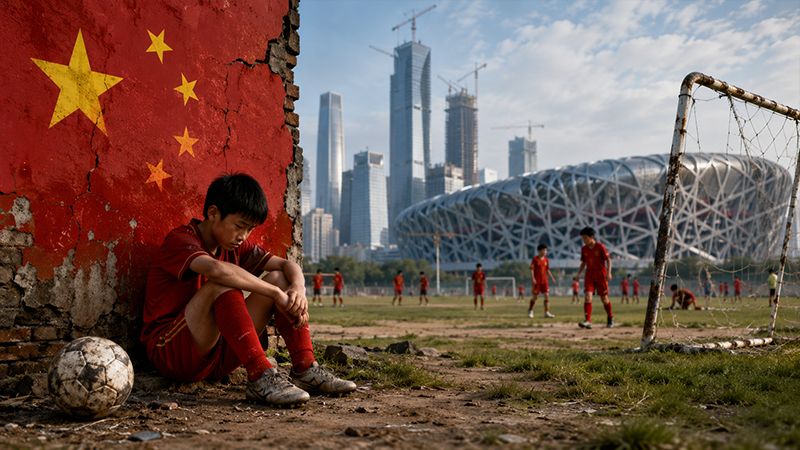
For decades, international sports observers have grappled with a persistent paradox. China, a nation that has mastered the art of the Olympic podium and consistently projects its power through athletic dominance, remains a peripheral figure in the world’s most popular sport.
Despite a population of 1.4 billion and a state apparatus capable of mobilizing immense resources, the Chinese men’s national team finds itself ranked 94th in the world—positioned below much smaller territories like Curacao.
This discrepancy is not merely a sporting curiosity; it is a case study in the limitations of top-down strategic planning and the complexities of global athletic competition.
The Strategic Calculus: Medal ROI and the Olympic Metric
To understand why soccer has not received the same level of effective development as other sports, one must examine the internal logic of the Chinese sports system.
State investment in athletics is often viewed through the lens of Return on Investment (ROI), where the primary currency is Olympic gold.
In this framework, soccer is arguably the least efficient sport for a nation seeking to bolster its international prestige through medal counts.
While an elite swimmer or gymnast can compete for and win multiple medals in a single Olympic cycle, a soccer team requires a squad of roughly 20 players to compete for just one medal.
Furthermore, Olympic soccer is largely considered a secondary event in the sport’s global hierarchy, restricted primarily to Under-23 players and lacking the prestige of the FIFA World Cup.
State planners have historically focused on “niche” sports or individual disciplines—such as diving, gymnastics, and speed skating—where the global pool of professionals is relatively small compared to the billions of people involved in soccer.
It is significantly easier to achieve dominance in a sport with fewer worldwide participants than it is to break into the hyper-competitive, multi-layered ecosystem of global football.
Consequently, talented young athletes are frequently steered toward individual disciplines where their mechanical perfection can be honed in isolation, rather than toward the spontaneous, team-based environment of the soccer pitch.
Institutional Rot: The “Feudal” Governance of the Pitch
While investment exists, it is frequently undermined by systemic issues within the governing bodies. The Chinese Football Association (CFA) has been described as a “feudal society” characterized by internal monopolies and a lack of transparency.
This environment has fostered a “pay-to-play” culture where progress is often determined by personal connections and financial incentives rather than raw talent.
The depth of this institutional failure is evidenced by frequent anti-corruption purges. Numerous high-ranking officials, including former FA chairmen, have faced imprisonment for financial crimes.
When the governing body of a sport is focused on the monopolization of commercial interests rather than the development of a grassroots pipeline, the results on the field inevitably suffer.
This top-down, centralized management style is particularly ill-suited for a sport like soccer, which thrives on decentralized competition and local club culture.
The Cultural and Educational Friction
Beyond the halls of power, the daily lives of Chinese citizens present another significant barrier to soccer excellence. While the sport enjoys massive viewership and high levels of betting activity, there is a distinct gap between being a spectator and being a participant.
Academic Pressure
The Chinese education system is notoriously rigorous, leaving little room for organized sports in a child’s schedule.
In many instances, university football fields remain underutilized by local students, serving instead as the primary recreational space for international exchange students who often display a higher level of foundational skill.
Lack of “Low-Friction” Competition
In nations with a rich soccer history, children have access to informal, “low-friction” ways to play and compete from a young age. In China, the lack of a decentralized club system means that there are few opportunities for talent to emerge organically outside of state-controlled academies.
The Tribal Gap
In Europe and South America, soccer is deeply rooted in “tribal” identification—where every village and city has a club that represents its local identity and nationalism.
This creates a high-stakes, “iron sharpens iron” environment where young players are forced to compete at a high level starting in their preteen years.
China lacks this decentralized, grassroots fervor, relying instead on a state-directed model that struggles to replicate the organic chemistry and creativity required for elite team play.
The Failure of the “Quick Fix”: The CSL Experiment
In an attempt to bypass the decades-long process of building a soccer culture, China previously attempted to buy its way into relevance through the Chinese Super League (CSL).
This strategy involved offering exorbitant salaries to attract aging international stars—a tactic similar to those recently employed in other emerging markets.
This experiment largely failed to produce lasting results for the national team. Instead of fostering domestic growth, the influx of capital led to a situation where domestic players became overpaid relative to their actual performance levels.
When local players are paid high salaries to stay in a mediocre domestic league, they lose the incentive to test themselves in the superior leagues of Europe, where the highest levels of “iron sharpens iron” competition take place.
Furthermore, the CSL’s focus on “washed” international players did little to improve the fundamental coaching and scouting pipelines necessary for long-term success.
Comparative Perspectives: The Asian Benchmarks
The struggle of Chinese soccer is made even more apparent by the relative success of its neighbors, Japan and South Korea.
These nations have successfully integrated soccer into their cultural fabric and developed sophisticated training pipelines that consistently produce players capable of competing in the world’s top leagues.
Interestingly, the materials highlight that even very small territories can outperform China by leveraging external systems. Curacao, for instance, maintains a higher ranking by utilizing players who were trained in the highly developed professional institutions of the Netherlands.
This underscores a critical reality: in the global soccer landscape, population size is irrelevant if the institutional and developmental pipelines are non-existent or broken.
Analyzing the Path Forward
If the goal is to transform from a “nonfactor” into a global competitor, the consensus suggests that there are no shortcuts. Realizing the state’s ambition to become a soccer power by 2050 would require a fundamental shift in strategy:
- Decentralization: Moving away from a top-down, state-managed model toward a grassroots system that encourages local club development.
- Anti-Corruption Reform: Establishing transparent governance within the CFA to ensure that talent, not bribery, dictates who reaches the professional level.
- Educational Integration: Reforming the school system to allow for competitive sports as a core part of the curriculum, rather than a distraction from academics.
- Coaching Excellence: Investing in high-quality youth coaching rather than just high-profile senior team managers.
Frequently Asked Questions (FAQ)
Is soccer popular in China?
Yes, soccer is immensely popular as a spectator sport. Major international tournaments and even domestic matches can draw crowds exceeding 60,000.
However, this popularity does not translate into a large pool of high-level participants because the mechanisms for grassroots competition are lacking.
Why can’t China just use its Olympic model for soccer?
The “medal factory” model works well for individual sports where athletes can be trained in isolation to achieve mechanical perfection.
Soccer requires “chemistry, teamwork, and spontaneity,” which are harder to manufacture in a controlled, top-down environment. Additionally, the ROI for soccer is low in terms of Olympic medals.
Does China have enough professional players?
The statistics vary, but some estimates suggest China has around 100,000 professional players—significantly more than some Western nations like the United States. However, the quality of these players is hampered by a lack of competitive “iron sharpens iron” environments and a domestic league that often overpays for mediocre performance.
How does corruption affect the team?
Corruption has created a “feudal” system where talented players may be sidelined in favor of those with better connections or the ability to pay for their spot on a squad. This prevents the best 11 players in the country from ever reaching the national stage.
Conclusion: The Long Game
China’s status as a soccer nonfactor is not the result of a single failure, but a confluence of strategic, cultural, and institutional hurdles.
While the nation has the financial means and the population to succeed, the “sleeping giant” of Asian soccer cannot be awoken through capital alone.
Success in the world’s game requires a patience that transcends four-year Olympic cycles and a structural reform that reaches deep into the grassroots of society.
Until the system prioritizes the organic development of the game over the centralized pursuit of prestige, the gap between China’s Olympic might and its soccer performance will likely remain.