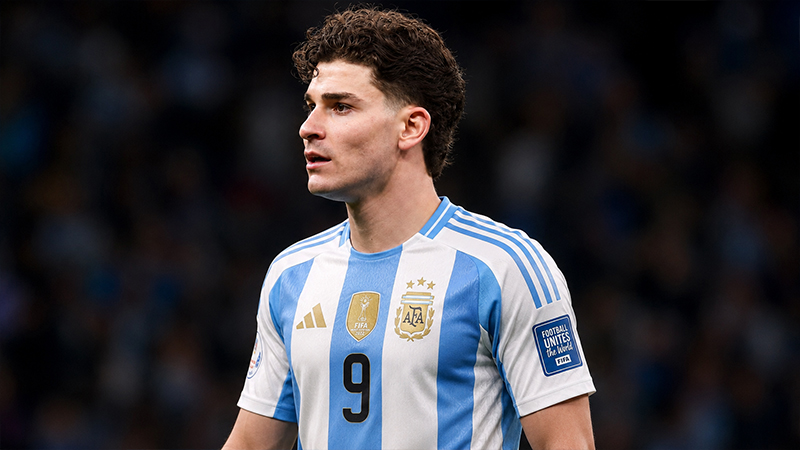
In the high-stakes theater of international football, few symbols have become as instantly recognizable as the crossed-wrist, web-shooting gesture of Julián Álvarez.
While many elite athletes adopt monikers for marketing purposes, the identity of “La Araña” (The Spider) represents a rare confluence of authentic childhood history and world-class technical prowess.
For stakeholders in the sports industry, from analysts to brand managers, understanding the genesis of this persona offers a masterclass in how a player’s organic roots can be leveraged to create a global icon.
This analysis explores the historical, technical, and cultural dimensions of Julián Álvarez’s identity, tracing its trajectory from the dusty pitches of Calchín to the pinnacle of European and international competition.
The Genesis: A Childhood Phenomenon in Calchín
The story of “La Araña” does not begin in a corporate boardroom or through a social media campaign; it began in the small town of Calchín, Argentina, when Julián Álvarez was just five years old.
In Argentine football culture, nicknames (apodos) are often bestowed by family or peers based on physical traits or specific playing styles, and they frequently stay with a player throughout their professional journey.
According to insights provided by his father and brother, the nickname was an immediate reaction to the young boy’s uncanny ability on the field.
Even at age five, Álvarez displayed a level of coordination and ball retention that defied his age. His family noted that he was remarkably fast, small, and seemingly untouchable during matches.
The specific choice of “The Spider” was born from a visual illusion created by his footwork. His brother and father revealed that it appeared as though the boy had multiple legs to control the ball, making it virtually impossible for opponents to dispossess him.
This “extra-limb” effect was not just a testament to his skill but a description of his relentless movement—a trait that remains the cornerstone of his professional profile today.
Technical Translation: Why “The Spider” Fits the Modern Game
In professional scouting and performance analysis, the attributes that earned a five-year-old the name “La Araña” are the same ones that make him a nightmare for modern defenders.
To understand why this identity has endured, one must look at the technical parity between the nickname and Álvarez’s style of play.
1. The “Multiple Legs” Concept in High-Intensity Pressing
The observation that Álvarez appeared to have more than two legs is a perfect metaphor for his work rate. In the contemporary “heavy metal” or high-pressing styles favored by elite managers, a striker is required to be the first line of defense.
Álvarez’s ability to cover ground, close down passing lanes, and “harass” defenders gives the impression that he is in two places at once. This relentless energy is the professional evolution of the “untouchable” child in Calchín.
2. Ball Retention and Low Center of Gravity
The childhood insight that it was impossible for opponents to steal the ball from him remains true at the highest levels of the game. By utilizing a low center of gravity and rapid-fire touches, Álvarez protects the ball in congested areas.
To a defender, his feet move with such frequency and precision that it mirrors the multi-legged dexterity of a spider.
3. The “Stinging” Evolution: La Araña Que Pica
As his career progressed, a variation of the nickname emerged: “La Araña Que Pica” (The Stinging Spider, or The Spider Who Stings). This adds a layer of lethality to his persona.
While “The Spider” describes his movement and control, “The Stinging Spider” describes his clinical finishing. He is not merely a player who occupies space or retains possession; he is a predator who waits for the right moment to deliver a decisive, game-changing “sting.”
Iconography and the Spider-Man Celebration
The transition of “La Araña” from a local nickname to a global brand was solidified by Álvarez’s signature goal celebration. When he scores, he spreads his arms and mimics the web-shooting gesture of the Marvel character Spider-Man.
This celebration serves several strategic purposes:
- Visual Consistency: It provides a “hook” for broadcast media and photographers, ensuring that every goal he scores is accompanied by a unique, recognizable image.
- Demographic Appeal: By aligning his nickname with a popular culture icon like Spider-Man, Álvarez creates a bridge to younger fans, making him an easily marketable figure for global sports brands.
- Self-Actualization: The celebration is a public nod to his roots. It shows that despite playing in the world’s most prestigious stadiums, he still carries the identity given to him by his father and brother in Calchín.
The Cultural Significance of the Argentine “Apodo”
To fully appreciate the weight of Julián Álvarez being called “La Araña,” one must understand the broader context of Argentine football.
The nation has a long history of players whose nicknames are more famous than their given names. From Lionel Messi (La Pulga/The Flea) to Sergio Agüero (Kun), these titles are badges of honor.
In Álvarez’s case, “La Araña” signifies a player who is crafty, industrious, and difficult to pin down. In a country that values la nuestra (a traditional, stylish way of playing), having a nickname that suggests impossible ball control and “multiple legs” is the highest form of praise.
It suggests a player who possesses a natural, almost supernatural, affinity for the ball.
Strategic Takeaways for Brand Development
The trajectory of the “La Araña” persona offers valuable lessons for the development of athlete identities:
- Authenticity is Key: The most enduring brands are those rooted in truth. Because Álvarez’s nickname originated from his actual family and his childhood playing style, it feels authentic rather than manufactured.
- Visual Language Matters: The Spider-Man celebration translated an abstract nickname into a concrete visual action. This made the “Spider” identity accessible to a global audience who might not speak Spanish.
- Evolutionary Potential: By allowing the name to evolve into “La Araña Que Pica,” the persona grew alongside the player’s skill set, moving from a description of agility to a description of elite goal-scoring.
Frequently Asked Questions (FAQ)
Who originally gave Julián Álvarez his nickname?
The nickname was given to him by his family, specifically his brother and father, when he was living in Calchín, Argentina.
At what age did he become known as “La Araña”?
The name originated when he was only five years old.
What does the nickname “La Araña” actually mean?
In English, it translates to “The Spider”.
Why was he called a spider specifically?
His family observed that he was so fast and had such incredible control of the ball that it looked like he had multiple legs, making it impossible for other children to take the ball away from him.
What is the meaning behind his goal celebration?
His celebration, where he mimics a web-shooter, is a direct reference to his nickname. It serves as a tribute to the identity he has carried since childhood.
What is “La Araña Que Pica”?
This is a common variation of his nickname, which translates to “The Stinging Spider” or “The Spider Who Stings”. It emphasizes his lethal ability to score goals.
Conclusion: The Legacy of the Spider
Julián Álvarez’s rise to the top of the football world is a journey of consistency. From the five-year-old boy in Calchín to a World Cup winner and European champion, the core of his identity has remained unchanged.
He is “La Araña”—the player who moves with a frequency that confuses defenders and possesses the ball with a tenacity that suggests he has limbs to spare.
As he continues to “sting” opponents on the world’s biggest stages, the story of the small, untouchable boy with “multiple legs” serves as a reminder of the power of roots in the making of a legend.