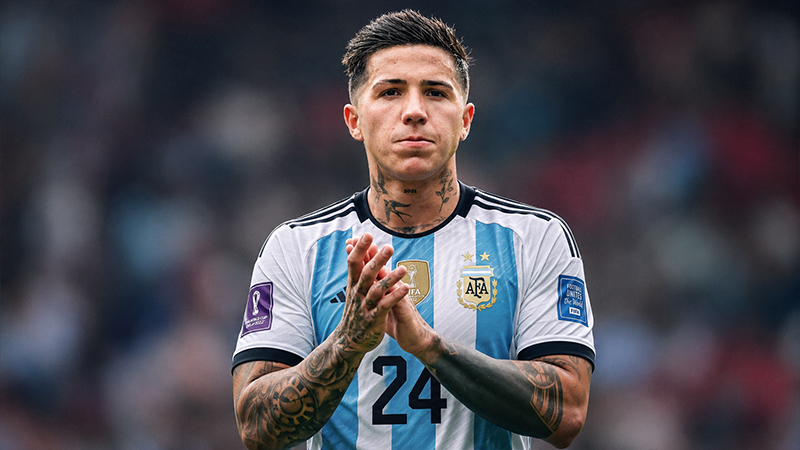
The evolution of modern football has moved away from rigid positional constraints toward fluid, role-based systems. In this landscape, few players embody the concept of the “complete midfielder” as effectively as Enzo Fernández.
To understand his position is to understand the heartbeat of a world-class sporting unit, whether at the club level with Chelsea FC or on the international stage with the Argentina national team.
While a casual observer might simply see a midfielder, a deep tactical analysis reveals a player who functions as a multidimensional asset capable of occupying several distinct zones of the pitch depending on the match phase.
This analysis explores the nuances of his positioning, his primary responsibilities, and why his versatility has made him a cornerstone of modern tactical frameworks.
The Primary Designation: The Central Midfielder (CM)
As of May 2026, the official tactical designation for Enzo Fernández is a Central Midfielder (CM). This position serves as his primary operating base, allowing him to exert maximum influence over the game’s central axis.
Wearing the iconic #8 jersey for Chelsea, he occupies the engine room of the team, acting as the bridge between the defensive line and the attacking third.
The central midfield role in a high-performance environment requires a unique blend of physical endurance, technical precision, and mental awareness. For Fernández, this position is not just about occupying space; it is about managing the transition phases.
When his team is in possession, he is the primary target for defenders looking to play out from the back. When out of possession, he must demonstrate the tactical discipline to screen passing lanes and support the defensive structure.
The Deep-Lying Architect: Operating as a Defensive Midfielder (DM)
One of the most critical components of Fernández’s toolkit is his ability to drop deeper into the Defensive Midfielder (DM) position.
In this capacity, he is often described as a deep-lying playmaker, a role that prioritizes vision and distribution over pure physical disruption.
In the DM role, his primary objective is to dictate the tempo of the game from deep areas. This requires a specialized skill set:
- Passing Range: He possesses the technical quality to execute short, rhythmic passes that keep possession moving, as well as expansive, long-range diagonals that switch the point of attack and stretch the opposition.
- Game Dictation: By sitting just in front of the center-backs, he acts as the team’s “metronome,” deciding when to accelerate the play with a vertical pass and when to slow it down to maintain control.
- Press Resistance: Operating in deep areas often invites pressure from the opposition’s front line. Fernández’s ability to receive the ball under pressure and turn into space is a hallmark of his elite tactical profile.
This deep-lying capability is what allows his managers to experiment with different midfield configurations. He can operate as a lone “pivot” or as part of a double-pivot system, providing a stable platform for more adventurous teammates to push forward.
The “Flow Controller” Philosophy
Beyond traditional positional labels, Fernández is increasingly recognized for a specific functional role: the “flow controller”. This term goes beyond where a player stands on the pitch and focuses on how they influence the game’s internal rhythm.
A flow controller is the tactical architect who ensures the team’s offensive and defensive systems remain synchronized.
For Fernández, this means recognizing when the team’s “flow” is stagnating and intervening with a decisive action—be it a cross-field ball or a tactical foul to stop a counter-attack.
His vision allows him to see the “hidden” passing lanes that bypassed the first and second lines of the opposition’s press, making him an indispensable asset for teams that prioritize high-possession strategies.
The Box-to-Box Engine: The Number 8 Identity
While he excels in deep areas, Fernández is also highly effective as a “number 8” box-to-box midfielder. This role demands a higher level of physical output and a greater presence in the final third.
In this more advanced iteration of his game, he utilizes his energy to support the attack, often arriving late into the penalty area or occupying the “half-spaces” to provide crossing options.
The transition from a deep-lying playmaker to a box-to-box engine demonstrates his exceptional football intelligence; he understands when to hold his position to provide cover and when to take the risk of joining the forward line.
This versatility is a significant competitive advantage. In a single 90-minute match, Fernández can start as a deep playmaker, shift into a box-to-box role to chase a goal, and finish the match as a defensive screen to protect a lead.
Attacking Impetus: The Attacking Midfielder (AM) Secondary Role
Though less frequent than his central or defensive duties, Fernández also possesses the capability to operate as an Attacking Midfielder (AM). When deployed higher up the pitch, his responsibilities shift toward direct goal creation.
In the AM role, his passing range is utilized to provide “the final ball”—the incisive pass that breaks the defensive line and puts a striker through on goal. His ability to operate in these congested areas of the field highlights his technical composure.
While he may not be a traditional “number 10” in the mold of historical playmakers, his modern interpretation of the role focuses on high-intensity pressing and quick interchanges near the opposition’s box.
Tactical Versatility as a Strategic Advantage
The modern game places a premium on players who can solve multiple tactical problems without requiring a substitution. Enzo Fernández’s ability to move between CM, DM, and AM roles makes him a “tactical Swiss Army knife” for both Chelsea and Argentina.
For a manager, this versatility provides several key benefits:
- In-Game Adaptability: The team can switch formations (e.g., from a 4-3-3 to a 4-2-3-1) without changing personnel, as Fernández can seamlessly transition between different midfield roles.
- Squad Depth Efficiency: Having a player who can cover three distinct positions at an elite level allows for more creative squad building and injury management.
- Opposition Confusion: It is difficult for opposing managers to assign a specific marker to Fernández when his starting position and functional role change throughout the match.
Analysis of Key Performance Metrics (Hypothetical Context)
In a professional analysis, we look at how his positioning translates into data. While his primary position is Central Midfield, his heat maps often show a massive “cloud” of activity across the middle third, with significant spikes in the deep-left and deep-right channels where he typically drops to collect the ball from defenders.
His “progressive passes” (passes that move the ball significantly closer to the opponent’s goal) are among the highest in his peer group, reinforcing his status as a playmaker who dictates play from deep.
This data-driven perspective confirms what the tactical eye sees: a player who is constantly looking to move the team forward.
Frequently Asked Questions (FAQ)
What is Enzo Fernández’s best position?
While he is highly versatile, his primary and most effective position is as a Central Midfielder (CM), where he can balance his playmaking abilities with his defensive responsibilities.
Can he play as a lone defensive midfielder?
Yes, he frequently operates as a Defensive Midfielder (DM) or deep-lying playmaker, using his passing range to dictate the game from the base of the midfield.
What does it mean that he is a “flow controller”?
The term “flow controller” refers to his ability to manage the tempo and rhythm of the game, ensuring that possession is maintained and that the team transitions smoothly between different phases of play.
Is he more of a defensive or offensive player?
He is a versatile hybrid. He has the defensive discipline to screen the backline and the creative vision to play as an attacking midfielder or a box-to-box “number 8”.
Conclusion: The Future of the Universal Midfielder
Enzo Fernández represents the pinnacle of the “universal” midfielder. His ability to combine the grit of a defensive shield, the vision of a deep-lying playmaker, and the energy of a box-to-box engine makes him one of the most valuable tactical assets in world football today.
As tactical systems continue to become more complex, the demand for players who can “do it all” will only increase.
By mastering the art of the flow controller while maintaining the flexibility to play across the entire midfield spectrum, Fernández has not only secured his place in the starting XI for club and country but has also set the standard for what a modern midfielder should be.
Whether he is dictating play from deep or driving the team forward from the center, his influence is undeniable, and his tactical profile remains a masterclass in versatility.