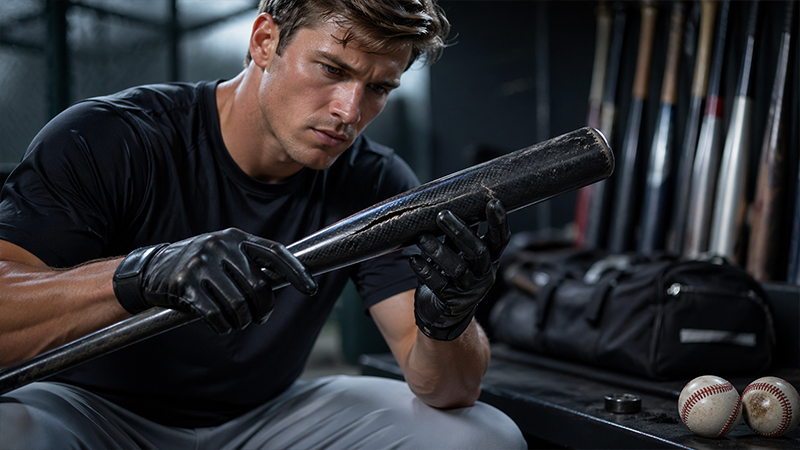
In the high-stakes world of elite baseball and softball, your equipment is a direct extension of your performance.
For the modern athlete, the composite bat represents a significant financial and competitive investment, often costing upwards of $400 to $500.
These precision-engineered tools utilize advanced carbon fiber layers to create a “trampoline effect” that aluminum simply cannot match. However, because composite materials are subject to mechanical fatigue, every bat has a finite lifespan.
The challenge for players, parents, and coaches is distinguishing between a bat that is “perfectly broken-in” and one that has crossed the threshold into structural failure.
Misdiagnosing a dead bat can lead to lost games, diminished recruiting visibility, and—most importantly—significant safety risks.
This comprehensive guide, backed by technical structural analysis and industry standards, will teach you how to audit your gear like a pro.
The Physics of the “Pop”: Why Composite Bats Fail
To understand failure, we must understand the construction. Unlike alloy bats, which are a single piece of forged metal, composite bats are built from layers of carbon fiber bound by resin.
The Trampoline Effect & The Break-In Period When a ball impacts the barrel, the composite layers compress and then rapidly return to their original shape, launching the ball with immense velocity.
As you use the bat, these internal layers undergo “micro-fracturing,” which actually makes the barrel more flexible and increases the trampoline effect. This is why a bat with 150–200 hits is often “hotter” than a brand-new one.
The Peak Performance Paradox A critical insight for any serious ballplayer is that a composite bat is often at its highest performance level (“hottest”) immediately before it fails completely.
This creates a dangerous trap where a player may believe they are hitting better than ever, unaware that the internal structure is seconds away from a violent fracture.
The Audible Audit: Listening for the “Dead” Spot
Your ears are often the first line of defense in identifying a compromised bat.
1. The Sound of Contact
A healthy, high-performing composite bat produces a sharp, crisp “ping” or a distinct “crack” (depending on the brand’s specific resin tech). When the structural integrity is lost, the resonance changes entirely.
- The Red Flag: Instead of a crisp sound, the bat will produce a dull, hollow thud upon contact.
- The Cause: This “thud” occurs because the composite layers have delaminated (separated), preventing the bat from vibrating as a single, cohesive unit.
2. The Internal Rattle Test
One of the most definitive signs of failure is found by simply shaking the bat.
- The Diagnostic: Hold the bat by the handle and give it a vigorous shake, or tap the barrel lightly against your palm.
- The Red Flag: If you hear a rattling sound inside the barrel, it is a primary indicator of structural failure.
- The Cause: This rattle is caused by broken internal composite material or pieces of the glue/resin that have snapped off and are bouncing around inside the hollow chamber.
Visual Inspections: “Shark Teeth” and Structural Fatigue
While some damage is internal, many bats will show clear physical distress signals. You should perform a visual audit of your barrel under bright light after every weekend tournament.
1. Identifying “Shark Tooth” Fractures
Not all cracks are created equal. You are looking for specific geometric patterns that indicate the carbon fibers have snapped.
- The Red Flag: Look for jagged, white-colored cracks that resemble “shark teeth” or zig-zag patterns.
- The Location: These usually run vertically or diagonally along the “sweet spot” of the barrel. Because the raw carbon fiber beneath the paint is often white or light gray, these cracks will stand out against the bat’s graphic design.
2. Delamination and Splintering
Composite bats are “ply” structures. When the glue holding these plies together fails, the bat begins to peel.
- The Red Flag: Physical separation or splintering where you can see or feel the composite layers peeling apart.
- The Red Flag: Deep gouges that go beyond the paint layer and into the gray/black composite material.
3. End Cap Integrity
The end cap is vital for maintaining the internal pressure and structural “hoop tension” of the barrel.
- The Red Flag: A loose, lifted, or rotating end cap. If there is a visible gap between the cap and the barrel, the bat is compromised and likely illegal for sanctioned play.
Sensory Feedback: The “Sting” of a Broken Bat
Advanced players develop a “feel” for their equipment. When a bat dies, the feedback through the handle changes significantly.
- Increased Vibration (The Sting): A healthy composite bat is designed to dampen vibration. However, when the structure is compromised, the energy from the ball isn’t efficiently transferred into the “pop.” Instead, that energy travels down the handle.
- The Red Flag: A distinct and increased vibration or “sting” in the hands upon impact, even on balls hit near the sweet spot. If a bat that used to feel “smooth” suddenly starts vibrating painfully, it’s time for an inspection.
Performance Metrics: Tracking the “Pop”
In the era of Rapsodo and HitTrax, data-driven decisions are easier than ever. However, even without technology, you can track performance through simple observation.
- The Loss of “Pop”: If the ball consistently stops traveling as far as it used to, or if exit velocities drop despite a high-quality swing, the bat has lost its “trampoline effect”.
- The “One-Sided” Bat: Sometimes a bat only fails on one side of the barrel. If you find the bat performs well on some hits but feels “dead” on others, there is likely an isolated structural crack on one face of the composite.
The Critical Distinction: Paint Cracks vs. Structural Failure
One of the most common points of confusion for parents is “spiderwebbing.” It is vital to distinguish between cosmetic issues and terminal damage to avoid throwing away a perfectly good (and expensive) bat.
| Feature | Cosmetic Paint Seams | Structural Failure (Dead) |
|---|---|---|
| Appearance | Fine, hairline “spiderweb” lines. | Deep, jagged, white “shark teeth”. |
| Texture | Usually smooth to the touch. | Feels rough or jagged to the touch. |
| Sound | Continues to “ping” or “crack.” | Produces a dull, hollow thud. |
| Performance | Bat is often at its “hottest” state. | Significant “loss of pop”. |
| Integrity | Paint is brittle; composite is fine. | Internal layers are separating/splintering. |
Safety Warning: The Risk of the Shattered Barrel
Continuing to use a dead bat isn’t just bad for your batting average; it’s a safety hazard.
The Danger of Violent Fractures: A heavily cracked composite bat can break violently during a high-velocity swing. Unlike an aluminum bat that might just dent, a composite bat can “explode,” sending shards of carbon fiber toward the pitcher, third baseman, or the batter’s own face.
Recommendation: You must stop using the bat immediately if the crack is deep or if the sound has transitioned to a flat thud.
Pro Tips for Bat Longevity
To protect your investment and ensure your bat reaches its maximum “broken-in” potential without premature failure, follow these industry-standard guidelines:
- Temperature Control: Never use a composite bat in temperatures below 60°F. Cold weather makes the ball harder and the composite resin more brittle, leading to immediate “shark tooth” cracks.
- Limit “Yellow Ball” Use: Avoid using heavy dimpled balls in batting cages. These balls are denser than leather baseballs/softballs and are the leading cause of internal delamination.
- Rotation is Key: Rotate the bat a quarter-turn after every hit during practice to ensure even wear across the entire circumference of the barrel.
- Warranty Documentation: Keep your digital receipt. Most manufacturers offer a one-year warranty, but they require proof of purchase from an authorized dealer to replace a structurally failed bat.
Enhanced FAQ: Expert Answers to Common Equipment Queries
Q: Can I fix a cracked composite bat with epoxy or tape?
A: No. Any attempt to repair a composite barrel is not only ineffective but also illegal in all sanctioned leagues (USA, USSSA, BBCOR). Altering a bat is considered “doctoring” and can lead to multi-year bans for the player.
Q: My bat has a rattle, but it still hits the ball far. Is it legal?
A: Most umpires and tournament directors will deem a bat with an internal rattle as “defective” and remove it from the game for safety reasons. Even if it still has “pop,” the rattle indicates internal debris that could lead to a violent break.
Q: How many hits should a composite bat last?
A: While it varies by manufacturer, a well-maintained bat typically has a lifespan of 1,000 to 1,500 hits. The “sweet spot” of performance usually begins after the first 200 hits.
Q: Does “spiderwebbing” mean my warranty is void?
A: No. Manufacturers recognize that paint stress is a normal part of the composite break-in process. A warranty claim is typically only approved when there is a visible structural crack, a loose end cap, or a significant internal rattle.
Conclusion: Don’t Let a Dead Bat Cost You the Game
In elite sports, the margin between a game-winning home run and a weak fly-out is measured in millimeters and milliseconds.
Using a bat that has lost its structural integrity is like racing a car with a flat tire—you might still move, but you’ll never reach the finish line first.
By regularly performing the Sound, Sight, and Feel audit, you can ensure that your equipment is working for you, not against you.
Remember: if it thuds, if it rattles, or if you see those white “shark teeth,” it’s time to retire the bat before it fails you in the bottom of the ninth.