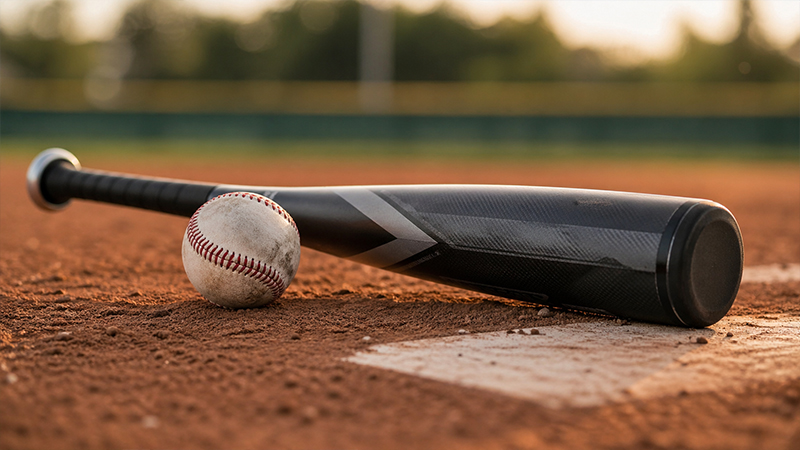
Congratulations. You’ve just invested in a high-performance “gamer.” Whether it’s the latest Marucci CATX2, a Louisville Slugger Meta, or the Rawlings Icon, you are holding some of the most advanced engineering in the history of the game.
But before you step into the box for that high-stakes opening day at-bat, there is a critical ritual every elite hitter must perform: The Break-In.
While alloy bats are often ready to perform right out of the wrapper, composite-barreled bats are a different breed.
They require a specific, methodical break-in period to reach their maximum performance threshold. In this comprehensive guide, we will dive into the science, the steps, and the professional secrets to ensuring your bat is primed to deliver maximum “pop” when it matters most.
The Science Behind the “Pop”: Why Composite Bats Need a Break-In
To understand why you shouldn’t just take your new bat straight to the plate, you have to understand what’s happening inside the barrel.
Composite materials are not a solid block of metal. Instead, they are composed of intricately intertwining microfibers. When a bat is brand new, these fibers are stiff and rigid.
They haven’t yet learned how to work together. The “break-in” process is actually a mechanical conditioning of these fibers. As you make contact with a ball, these microfibers begin to compress.
As they compress and slightly loosen, they create a “trampoline effect” that allows the barrel to flex and propel the ball with significantly more velocity than a stiff, unbroken-in bat.
This isn’t just a myth—it’s physics. Your bat only reaches its peak performance once these fibers have been properly conditioned through repetitive, controlled contact.
The 200-Swing Protocol
Breaking in your bat is an investment of time that pays dividends in home runs. This process is fun, easy, and can typically be completed in less than an hour. To do this correctly, you need a tee or a partner for soft toss, and real baseballs or softballs.
The “Wake Up” (Swings 1–50)
During the first 50 swings, you are introducing the microfibers to the concept of contact.
- Power Level: Swing at roughly 50% of your typical strength.
- The Rotation Rule: This is the most important part of the process. After every single swing, you must rotate the barrel 1/4”. This ensures that you are breaking in the entire circumference of the composite barrel, rather than just creating one “hot spot” that could lead to premature cracking.
The “Calibration” (Swings 51–100)
Now that the fibers have begun to move, it’s time to increase the intensity.
- Power Level: Gradually work your way up toward 75% power.
- Consistency: Continue the quarter-turn rotation after every hit. You may begin to notice a slight change in the sound of the contact—this is a sign the material is responding.
The “Full Release” (Swings 101–200)
By this stage, the bat is nearing its peak “pop.”
- Power Level: Over the final 100 swings, move to 100% full-strength swings.
- Refinement: Use this time to focus on hitting different parts of the barrel (while still rotating) to ensure total coverage. By the time you hit swing 200, the bat is officially “game-ready”.
The “Forbidden Zone”: Crucial Warnings to Protect Your Investment
A high-quality composite bat is an expensive tool, and nothing ruins it faster than improper care during the break-in phase.
NEVER Use Batting Cage Balls
This is the most common mistake players make. Most commercial batting cages use yellow dimpled balls. These balls are significantly denser than a regulation baseball or softball. Using them with a composite bat—especially during the break-in phase—can cause permanent damage, denting, or a massive decrease in the bat’s lifespan.
Avoid Extreme Cold
Note: While the provided sources do not explicitly mention temperature, it is a standard industry practice to avoid using composite bats in temperatures below 60 degrees Fahrenheit, as the material can become brittle and crack. You should independently verify the specific temperature ratings for your bat brand.
Stick to Controlled Drills
Do not take your bat into a high-speed pitching machine for its first 100 swings. Stick to soft toss, front toss, and tee work to ensure the contact is controlled and the rotation is consistent.
The “Gamer” Mindset: Why Trust the Experts?
The difference between a championship and a dugout full of “what-ifs.” For over two decades, hitters have sought out the latest technology to gain an edge on the diamond.
When you follow a professional break-in protocol, you aren’t just prepping a piece of equipment; you are building confidence.
Knowing your bat is at its maximum performance threshold allows you to focus entirely on the pitcher, rather than wondering if your equipment is holding you back.
If you ever feel unsure about the state of your bat or which technology is right for your swing, you don’t have to guess.
Elite resources like the “Bat Coach” can help you find your perfect match by answering a few simple questions. Furthermore, Bat Experts are available via live chat, email, or phone to provide knowledgeable, friendly advice—helping you from “Click to Hit”.
Enhanced FAQ: Everything You Need to Know
Q: Can I use a rolling machine to break in my bat faster?
A: While “bat rolling” is a service offered by some third parties, it is generally discouraged. It can void your manufacturer’s warranty and often pushes the bat past the legal performance limits set by governing bodies like BBCOR or USSSA. The 200-swing manual method is the safest and most reliable way to ensure longevity.
Q: Is there a difference between breaking in a baseball bat vs. a fastpitch softball bat?
A: The fundamental science is the same. Whether it is a baseball or fastpitch bat, the composite microfibers require compression to reach peak performance.
Fastpitch bats are almost exclusively composite, whereas baseball bats vary between alloy and composite.
Q: How do I know when my bat is fully broken in?
A: Beyond the 200-swing count, listen to the sound. A broken-in composite bat typically loses its “stiff” sound and develops a deeper, more resonant “crack” or “thwack.” You will also notice the ball jumping off the barrel with noticeably more velocity during your final 50 swings.
Q: What if I don’t have time for 200 swings before my game?
A: Even 50-100 swings with proper rotation will help. However, to reach the maximum performance threshold, the full 200-swing protocol is highly recommended.