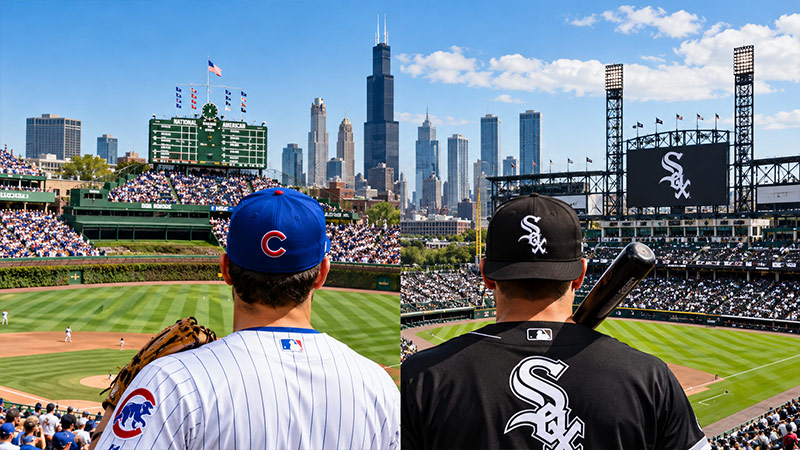
Ask a baseball fan in Chicago which team they root for, and you will learn something about where they grew up.
Chicago is one of just two U.S. cities, along with New York, where two Major League Baseball teams play inside city limits: the Chicago Cubs on the North Side and the Chicago White Sox on the South Side.
To visitors, the setup can seem strange. Many cities struggle to fill one ballpark, yet Chicago has supported two for more than 125 years.
So why does Chicago have two baseball teams? The answer involves a league war at the turn of the 20th century, a booming industrial city and a neighborhood rivalry that never cooled. Here is how the Cubs and White Sox came to share one city.
The Short Answer: Two Leagues, One Big City
Chicago has two baseball teams because each belongs to a different league. The Cubs have played in the National League since it was founded in 1876.
The White Sox arrived in 1901 as a charter member of the American League, which launched as a rival to the older circuit.
The new league wanted a foothold in the biggest markets, and Chicago, then the second-largest city in the country, was too valuable to skip. It planted a team on the South Side, and both clubs have stayed put ever since.
| Chicago Cubs | Chicago White Sox | |
|---|---|---|
| League | National League | American League |
| Joined its league | 1876 | 1901 |
| Side of town | North Side | South Side |
| Home ballpark | Wrigley Field (since 1916) | Rate Field (since 1991) |
| World Series titles | 1907, 1908, 2016 | 1906, 1917, 2005 |
The Cubs Came First: Chicago’s National League Roots
The franchise known today as the Cubs began in 1870 as the Chicago White Stockings. The Great Chicago Fire of 1871 destroyed the team’s ballpark and equipment, forcing a two-year pause before the club returned.
Chicago also helped create the National League. White Stockings president William Hulbert led the effort to form the league in 1876, and his team won the first pennant that same year.
That history makes the Cubs the oldest franchise in American sports to play continuously in the same city.
Over the next few decades, the club cycled through nicknames such as the Colts and the Orphans. Local sportswriters began calling its young roster the Cubs in the early 1900s, and the name became official in 1907. Along the way, the team dropped the White Stockings name, a detail that would matter very soon.
Charles Comiskey and the Birth of the White Sox
The second team came from Charles Comiskey, a former star first baseman, and Ban Johnson, president of the minor Western League.
Johnson wanted to turn his regional circuit into a true rival of the National League. In 1900 he renamed it the American League, and Comiskey moved his St. Paul Saints to Chicago.
Moving in required the blessing of the established Chicago club. According to baseball lore, the National League team agreed only if Comiskey kept his club on the South Side, south of 35th Street. That boundary still echoes today, since the White Sox ballpark sits on 35th Street.
Comiskey also claimed the White Stockings name his crosstown neighbors had discarded, a shrewd way to borrow decades of local loyalty.
Sportswriters shortened it to White Sox, and the name stuck. In 1901 the American League declared itself a major league, and the White Sox won its first pennant. Peace came in 1903, when the two leagues agreed to coexist and meet in a World Series.
Why Chicago Could Support Two Teams
A rival league only works if the market can pay for it, and turn-of-the-century Chicago could. The city rebuilt quickly after the 1871 fire and reached nearly 1.7 million residents by 1900, second only to New York.
Several forces fueled that growth:
- Railroads. Chicago was the nation’s rail hub, pulling workers, goods and money from across the Midwest.
- Industry. The Union Stock Yards, steel mills and factories employed huge numbers of working people hungry for affordable entertainment.
- Immigration. Irish, German, Polish, Italian and other newcomers filled distinct neighborhoods, each with its own loyalties.
- Transit. Streetcars and the elevated “L” let fans reach a ballpark on either side of town for a small fare.
Just as important, Chicago stretches for miles along Lake Michigan. A fan in Bridgeport and a fan in Lakeview lived far apart, so two teams could draw from separate home bases instead of fighting over the same streets.
North Side vs. South Side: Geography and Identity
Over time, each franchise became tied to its half of the city. The Cubs, at Wrigley Field in the Lakeview neighborhood, came to stand for the North Side. The White Sox, rooted near Bridgeport and the old stockyards, became the South Side’s team.
Those labels carry social meaning. Sox fans often describe their club as blue-collar, gritty and unpretentious, like the industrial neighborhoods around its ballpark.
Cubs fans are often stereotyped as younger, wealthier and more drawn to the bar scene in Wrigleyville.
Like most stereotypes, these are only partly true. Plenty of South Siders cheer for the Cubs, and plenty of North Siders wear black and silver.
Still, in Chicago the question “Cubs or Sox?” often doubles as “Where are you from?” Family tradition usually decides the answer, and switching sides is rarely forgiven.
Two Ballparks, Two Personalities
The ballparks deepen the split. Wrigley Field opened in 1914 for a team in the short-lived Federal League, and the Cubs moved in two years later.
Its ivy-covered walls, hand-turned scoreboard and neighborhood rooftop seats make it one of the most recognizable venues in sports. It was also the last MLB park to add lights, hosting its first night game in 1988.
The White Sox played at the original Comiskey Park from 1910 through 1990. Its replacement opened across the street in 1991 and has carried several names: Comiskey Park, U.S. Cellular Field, Guaranteed Rate Field and, since late 2024, Rate Field. Fans know it for its exploding scoreboard, a tradition carried over from the old park, and for some of the best food in baseball.
Another change may be coming. The White Sox lease runs through the 2029 season, and the team has explored building a new ballpark closer to downtown.
The Crosstown Rivalry
Because the teams played in different leagues, they rarely met in games that counted for most of the 20th century. Fans settled for the City Series, postseason exhibitions played in many years between 1903 and 1942, plus occasional charity games later on.
That changed in 1997, when Major League Baseball introduced interleague play. Suddenly the Cubs and White Sox faced each other every season in regular-season games, a matchup known as the Crosstown Classic. The series quickly became one of the most heated dates on the Chicago sports calendar.
The rivalry has produced memorable flashpoints, including a 2006 bench-clearing brawl at the White Sox ballpark that began with a collision at home plate. For fans, the real prize is a year of bragging rights at work and at the family dinner table.
Championships, Curses and Heartbreak
The only World Series between the two clubs came in 1906. The Cubs had won 116 regular-season games, but the light-hitting White Sox, nicknamed the Hitless Wonders, upset them in six games. The Cubs answered with titles in 1907 and 1908, and the White Sox won again in 1917.
Then both teams entered long droughts. The White Sox were stained by the 1919 Black Sox scandal, when eight players were accused of conspiring to throw the World Series.
The Cubs were said to be cursed after a tavern owner and his goat were turned away from Wrigley during the 1945 World Series.
The White Sox broke through in 2005, sweeping the Houston Astros for their first title in 88 years.
Eleven years later, the Cubs beat Cleveland in a seven-game classic, ending a 108-year wait. Since then the paths have split again: the White Sox lost a modern-record 121 games in 2024, while the Cubs reached the postseason in both 2025 and 2026.
Why Other Two-Team Cities Lost One
Chicago’s situation is rarer today than it once was. In the early 1900s, Boston, Philadelphia and St. Louis also hosted one team in each league, and New York had three clubs.
By the 1950s, most of those cities could no longer support two teams. The Boston Braves left for Milwaukee in 1953, the St. Louis Browns became the Baltimore Orioles in 1954 and the Philadelphia Athletics moved to Kansas City in 1955. The Giants and Dodgers left New York for California after 1957, though the Mets later restored a second team there.
Chicago kept both because its population, transit network and fiercely local fan bases stayed strong. The Los Angeles area also has two teams, but the Angels play in nearby Anaheim, and the Bay Area lost its second club when the Athletics left Oakland after 2024.
Conclusion: A City Big Enough for Two
So why does Chicago have two baseball teams? The Cubs were there first as a founding National League club, and the White Sox arrived when the upstart American League needed a strong presence in one of America’s largest cities.
Chicago’s size, industry and sprawling neighborhoods gave both teams enough fans to survive when other cities could not.
More than a century later, the split between the North Side and the South Side is part of the city’s identity. Whether you prefer the ivy at Wrigley Field or the fireworks at Rate Field, picking a team in Chicago means picking a side. Just be ready to defend it.