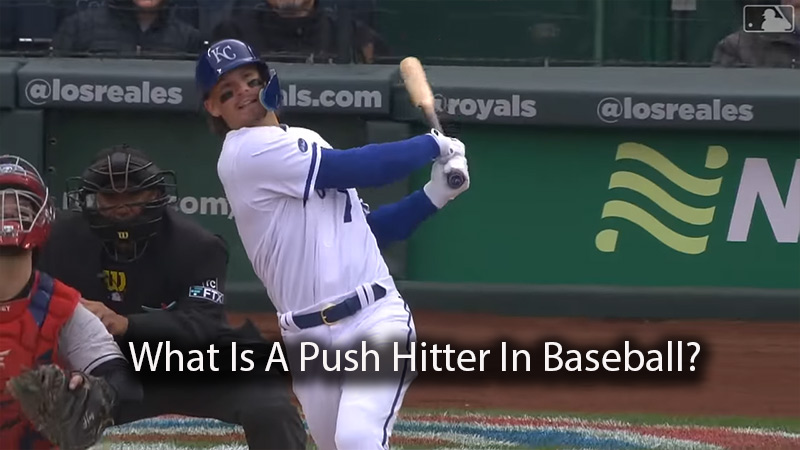
A push hitter sends the ball to the opposite field. Right-handed hitters target right and right-center field. Left-handed hitters aim toward left and left-center field.
The Dickson Baseball Dictionary links the term to a “Punch-and-Judy hitter,” known for short hits and limited home run power.
Modern analysis views opposite-field hitting as more than a sign of weak power. It can help batters find gaps, beat defensive shifts, and handle fast pitches.
The main differences between push and pull hitters involve timing and contact points. Pull hitters meet pitches farther out front. Push hitters let the ball travel deeper before contact.
This approach demands patience, sound pitch judgment, strong hand-eye coordination, and precise bat control to guide the ball the other way.
Real-World Artistry: Biomechanics, Plate Discipline, and Tactical Value
To understand why push hitters succeed at the highest levels of professional baseball, one must analyze the physical mechanics and tactical discipline required to drive pitches to the opposite field with authority.
Contact Point Comparison:
Pull Hitter:  [Contact Made In Front of Home Plate]  ---> Pull Side
Push Hitter:  [Contact Made Deep Over Home Plate]   ---> Opposite Field
The Mechanics of Deep Contact
The cornerstone of the push hitter’s mechanics is the point of contact. When a pitcher delivers a fastball or breaking ball on the outer third of the strike zone, attempting to pull that pitch frequently results in weak contact—such as rolling over into a routine ground ball to the pull-side shortstop or second baseman.
Push hitters avoid this trap by letting the ball travel deeper over the plate before starting their primary wrist turn. By allowing the ball to travel an extra few inches toward the catcher’s mitt, the angle of impact naturally directs the ball toward the opposite outfielders.
Executing this approach requires three key mechanical components:
- The Inside-Out Swing Path: The hitter keeps their hands tight to their chest during the initial movement toward the ball, maintaining the barrel inside the path of the pitch. This prevents the bat head from casting outward prematurely.
- Delayed Hip Cleared Angle: Unlike pull hitters who explode their hips open to pull the ball, push hitters hold their front shoulder closed longer, allowing their lower body to rotate in sync with a deeper contact point.
- Upper Body Extension Through the Outer Zone: Instead of rolling the wrists over at impact, the hitter extends the bat barrel straight through the line of the pitch toward the opposite outfield gap.
Exploiting Outer-Third Pitching Strategies
In modern professional baseball, pitching strategies rely heavily on targeting the outer third of the strike zone with late-moving pitch types like sliders, cut fastballs, and away changeups. A hitter committed purely to pulling the ball struggles against this plan.
Push hitters serve as a direct tactical counter to outer-third pitch distributions. Because their mechanics emphasize waiting on outside offerings, they maintain a higher contact rate against perimeter pitching while drawing more walks through disciplined plate coverage.
The Gold Standard: Derek Jeter
Perhaps the most notable modern example of a master push hitter is Hall of Famer Derek Jeter. Throughout his 20-year Major League Baseball career, Jeter constructed a legendarily productive offensive profile by mastering the inside-out swing.
Facing high-velocity outside fastballs, Jeter routinely held his front shoulder closed, let the ball travel deep into the hitting zone, and drove line drives over the first baseman’s head into the right-field corner.
His ability to repeatedly execute this opposite-field approach yielded 3,465 career hits and validated the push hitting discipline as a primary offensive engine.
Digital Mechanics: Push Hitter Tendencies in Baseball Simulations
The strategic nuance of push hitting is not limited to physical ballparks. In modern sports gaming, particularly in video game simulations such as MLB The Show, hitting tendencies play a central role in competitive strategy. Understanding how developers program hitter tendencies reveals a fascinating bridge between real-world athletic traits and algorithmic game physics.
MLB The Show Timing Window Comparison:
Pull Tendency:  [--- Longer Inside Window ---] [-- Short Outside Window --]
Push Tendency:  [-- Short Inside Window --] [--- Longer Outside Window ---]
How Hitter Tendencies Influence Timing Windows
A common misconception among casual gamers is that player tendencies in video games only control how computer-managed fielders position themselves on the diamond. In reality, a player card’s tendency attribute directly dictates the user’s swing timing windows.
In competitive simulations, swing timing is categorized into distinct windows: Too Early, Early, Good, Perfect, Late, and Very Late. A player card’s assigned tendency alters the size and placement of these timing windows based on pitch location across the strike zone:
- Expanded Outside Timing Window: A player card designated with a push hitter tendency receives an expanded, more forgiving timing window on pitches thrown to the outside corner of the strike zone. The gamer has more milliseconds to react to an outside slider or sinker and can still achieve a “Good” or “Perfect” timing outcome.
- Shifted Ball Flight Physics: The internal physics engine calculates the delayed timing associated with a push profile, generating exit velocity trajectories that drive the ball toward the opposite field outswing of the batter.
Switch-Hitter Nuances
An essential detail within digital baseball simulations is the handling of switch-hitters. A player card for a switch-hitter does not necessarily maintain a single uniform tendency across both sides of the plate.
Depending on real-world historical data, a switch-hitter may be programmed with a push hitter tendency while batting left-handed against right-handed pitching, but shift to a balanced or pull tendency when stepping into the right-handed batter’s box against left-handed pitching.
The Competitive Disadvantage: Navigating the Virtual Meta
While an opposite-field push approach is highly effective on a physical baseball field, it presents a steep structural challenge within high-level esports and online video game competitions.
Digital Meta Hierarchy (Online Play):
1. Extreme Pull  (Maximum forgiveness vs 102 mph inside heat)
2. Pull          (High effectiveness)
3. Balanced      (Neutral coverage)
4. Push          (Challenging vs high-velocity inside pitchers)
The Inside Pitch Penalty
The main tactical flaw of a push hitter card in online play is the inside pitch penalty. Because the push algorithm expands the user’s timing window on outside pitches, it mathematically compresses the timing window on inside pitches.
When a gamer uses a push hitter card:
- They have significantly less time to react to pitches thrown on the inside third of the plate.
- The timing threshold required to make solid contact on an inside pitch becomes narrower, requiring faster thumb reactions on the controller.
The High-Velocity “Outlier” Fastball Meta
This mathematical compression creates an issue in competitive online modes like Diamond Dynasty. The online competitive environment is dominated by elite pitcher cards equipped with high velocity traits—frequently throwing fastballs at 102 miles per hour on the inside corner (commonly referred to by the community as “Outlier” fastballs).
Facing a 102 mph inside fastball with a push hitter card requires near-instantaneous reaction times. Because the timing window on inside pitches is artificially reduced by the push tendency, gamers frequently swing “Late” or “Very Late,” resulting in weak foul balls or awkward pop-outs.
As a direct result of these physics, the online gaming community strongly favors cards featuring an Extreme Pull or Pull tendency. Pull cards offer the widest possible timing window against inside high-velocity fastballs, allowing players to turn on inside pitches with high exit velocity.
The Hank Aaron Paradox
This gameplay mechanic creates a well-known paradox regarding historic player cards. Legendary Hall of Fame sluggers—most notably Hank Aaron—are sometimes assigned a push or balanced hitting tendency in digital games based on their historical real-world spray charts.
However, because push tendencies carry an inside timing penalty against 102 mph fastballs, competitive gamers often find these legendary player cards difficult to use in top-tier online divisions compared to cards with extreme pull tendencies.
How to Verify Hitter Tendency in MLB The Show
- Pause the active game during an at-bat.
- Locate the box at the bottom-right corner of the screen.
- View the active hitter’s attributes alongside the “On-Deck” and “In the Hole” players.
Conclusion
The concept of the push hitter represents a fascinating study in how physical athletics and digital simulations evaluate hitting performance.
- On the Real Diamond: The push hitter represents plate discipline, exceptional barrel control, and tactical adaptability. By allowing the ball to travel deep over the plate, elite batters like Derek Jeter neutralized outside pitching strategies and forged legendary careers by controlling the opposite field.
- On the Virtual Field: Digital baseball games translate these physical habits into algorithmic timing windows. While push hitters gain an advantage against outside breaking balls, the reduced timing window on inside pitches makes them challenging to handle against 102 mph inside fastballs in competitive online play.
Whether you are an athlete looking to expand your spray chart across the outfield grass or a competitive gamer trying to optimize your lineup timing, mastering the mechanics of the push hitter is essential for total control at the plate.