
Planning a baseball field is an exciting venture, whether you are designing a community multi-sport complex, upgrading a high school athletic facility, or carving out a private practice diamond on private property.
However, one of the first and most critical questions every project manager, developer, or league organizer faces is: How much land do you actually need?
While a regulation professional field requires about 4.5 acres of dedicated space just for the playing area, the total footprint expands quickly once you factor in parking, spectator seating, and essential amenities.
This comprehensive guide breaks down exact acreage requirements by league level, calculates the extra space needed for facilities, outlines zoning and layout considerations, and provides a clear roadmap for planning your project successfully.
Quick Summary: Land Requirements at a Glance
Before diving into the detailed breakdown, here is a quick reference table outlining the minimum land size required for different levels of baseball fields, covering the playing diamond, foul territory, and immediate safety perimeters.
| Field Level | Base Paths | Outfield Fence Distance | Estimated Playing Field Acreage |
| Professional / College / High School | 90 feet | 400 feet | ~4.5 acres (approx. 560 ft × 560 ft) |
| Intermediate Youth | 80 feet | 315 feet | ~3.0 acres |
| Junior Youth | 70 feet | 275 feet | ~2.0 acres |
| Little League | 60 feet | 215 feet | ~1.5 acres |
Detailed Breakdown by Field Classification
The geometry of baseball dictates that as base paths and outfield fences expand, the required footprint grows exponentially due to the geometry of a circle and the expansion of foul territory.
1. Professional, Collegiate, and High School Fields (90-Foot Bases)
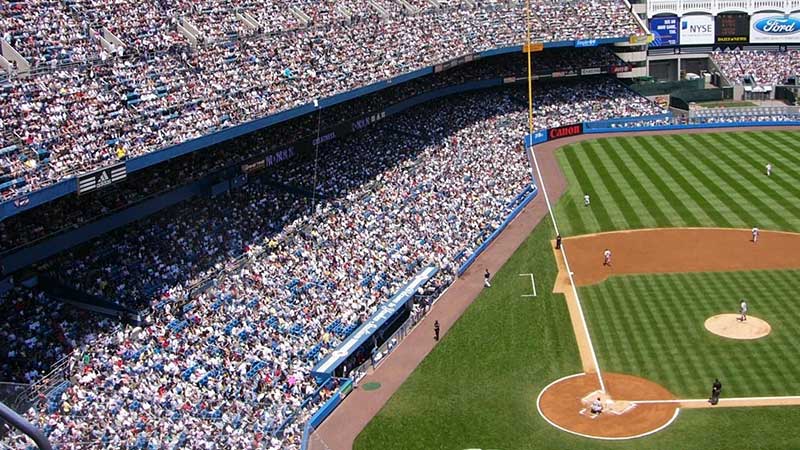
- Playing Area Footprint: ~4.5 acres
- Dimensions: 90-foot base paths, pitching mound set at 60 feet 6 inches, and a recommended center field fence distance of 400 feet (though high school fields frequently range from 350 to 385 feet).
- Spatial Requirements: To accommodate the infield arc, deep outfield grass, and adequate foul territory behind home plate and down the lines, you need a square plot measuring roughly 560 feet by 560 feet.
- Target Audience: Varsity high school programs, junior colleges, NCAA universities, and professional minor or major league affiliates.
2. Intermediate Youth Fields (80-Foot Bases)
- Playing Area Footprint: ~3.0 acres
- Dimensions: 80-foot base paths and an outfield fence generally set between 300 and 315 feet.
- Spatial Requirements: This transition size bridges the gap between youth leagues and full-scale diamonds. It requires a significantly smaller outfield radius, saving nearly 1.5 acres compared to a high school layout while still offering an authentic baseball experience for growing athletes.
3. Junior Youth Fields (70-Foot Bases)

- Playing Area Footprint: ~2.0 acres
- Dimensions: 70-foot base paths and an outfield fence averaging 275 feet.
- Spatial Requirements: Ideal for players transitioning into leading-off and stealing mechanics, this layout fits comfortably on a 2-acre parcel, making it a popular choice for municipal parks and middle school athletic complexes.
4. Little League Fields (60-Foot Bases)
- Playing Area Footprint: ~1.5 acres
- Dimensions: 60-foot base paths and a standard outfield fence set at 200 to 215 feet.
- Spatial Requirements: Requiring a minimum of 1.5 acres, Little League diamonds have a compact footprint. This efficiency allows communities to fit multiple fields side-by-side within a single multi-use sports park.
Factoring in Extra Space for Facilities and Infrastructure
A common pitfall in sports facility design is purchasing or allocating land based solely on the dimensions of the outfield fence. The playing diamond is only part of the equation. To build a functional, safe, and accessible site, you must expand your land budget to incorporate infrastructure and amenities.
[ Playing Field: 1.5 to 4.5 Acres ]
       +
[ Parking & Access: 0.5+ Acres ]
       +
[ Amenities & Structures: 0.5+ Acres ]
       +
[ Buffer Zones & Grading: 1+ Acres ]
       =
[ Total Recommended Site Acreage ]
Parking and Vehicular Access
Space Allocation: A minimum of 20 standard parking spaces takes up approximately 0.3 acres, including drive aisles and turnaround space.
Scalability: For high school, competitive travel ball, or league tournament venues, parking must scale dramatically. A busy complex hosting multiple games simultaneously requires parking for 100 to 200+ vehicles, easily demanding 1.5 to 3 acres of dedicated asphalt or gravel paving. Do not forget to account for ADA-compliant spaces and bus drop-off zones.
Spectator and Player Amenities
- Dugouts: Enclosed, covered player benches require structural footings and clear separation from the field of play.
- Bleachers: Elevated grandstands or aluminum bleacher seating require concrete pads and safety fencing.
- Concession Stands and Restrooms: Permanent brick-and-mortar facilities require plumbing, electrical hookups, grease traps, and health-department-mandated setbacks, adding significantly to the core footprint.
- Storage and Maintenance Buildings: Turf maintenance equipment, tractors, drags, line markers, and batting practice gear require a dedicated outbuilding or shed.
Buffer Zones and Safety Perimeters
- Foul Ball Hazards: You must maintain a safe distance between the outfield fence and property lines, public walking paths, roadways, or neighboring residential structures.
- Netting and Fencing: High-backstop netting behind home plate protects spectators from flying bats and foul balls, requiring structural poles anchored deep into concrete footings with adequate clearance behind the stands.
Site Selection and Environmental Considerations
Calculating acreage is purely mathematical, but determining whether a piece of land is actually buildable requires a deep dive into site engineering and environmental factors.
1. Topography and Grading
Baseball fields require precise grading to ensure proper surface drainage. While an outfield can maintain a gentle, rolling slope (typically a uniform 1% to 1.75% slope away from the infield), the infield skin and warning tracks must drain efficiently to prevent puddling and rainouts.
Developing a steeply sloped piece of land requires extensive cut-and-fill earthmoving, which can dramatically increase pre-construction budgets.
2. Orientation and Sun Angle
When mapping out your field boundaries on your chosen plot of land, orientation is vital. The ideal alignment for a baseball diamond places home plate in the southwest corner, with the line of sight running from home plate through the pitcher’s mound and second base toward the northeast.
This configuration ensures that the setting sun is behind or to the side of the batter, catcher, and umpire, rather than glaring directly into their eyes.
3. Soil Composition and Drainage
The underlying soil type dictates your turf management and irrigation costs. Clay-heavy soils retain moisture, leading to saturated fields after rainfall, whereas sandy loams drain rapidly.
Factor in the cost of installing sub-surface drainage tile systems, irrigation lines, and specialized infield soil mixes (such as vitrified clay and crushed brick) during your land assessment phase.
Step-by-Step Land Planning Checklist
If you are currently evaluating a parcel of land or drafting a proposal for a new baseball complex, use this structured checklist to ensure no critical spatial requirements are overlooked:
- Define the League Level: Establish whether the field will host adults, high school athletes, or youth players to lock in base path and fence dimensions.
- Calculate Core Acreage: Multiply the baseline playing field requirement (1.5 to 4.5 acres) by the number of fields planned.
- Add Infrastructure Factor: Allocate an additional 50% to 100% of the core acreage to cover parking, bleachers, dugouts, and walkways.
- Check Zoning and Setbacks: Verify local municipal zoning codes regarding light pollution (if installing field lights), noise ordinances, parking minimums, and property line setbacks.
- Perform Geotechnical Testing: Test soil percolation rates and load-bearing capacity before finalizing land acquisition.
Conclusion
Building a baseball field is a long-term investment in your community, school, or organization. While a compact Little League diamond can function successfully on as little as 1.5 to 2 acres, a regulation high school or collegiate facility requires closer to 4.5 acres for the playing field alone—and substantially more when parking, spectator seating, and safety buffers are included.
By carefully evaluating your league’s specific level of play, accounting for necessary infrastructure upfront, and selecting a properly oriented, well-draining parcel of land, you will create a safe, durable, and professional-grade venue that stands the test of time