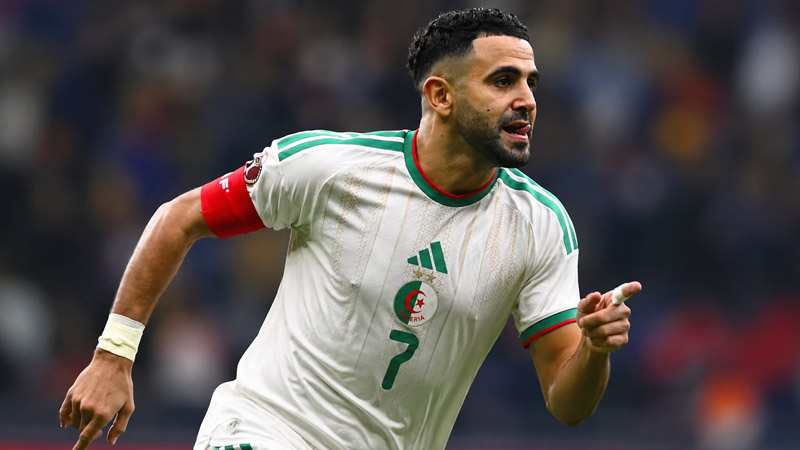
Riyad Mahrez stands as one of the most decorated footballers of his generation, having conquered the Premier League and established himself as a clinical presence on the global stage.
However, while his professional accolades at the club level are widely recognized, his international journey tells a far more personal and poignant story.
Born in the French suburb of Sarcelles, Mahrez faced a choice that many dual-nationality athletes encounter: representing the country of their birth or their ancestral homeland.
For Mahrez, the decision to play for Algeria was never merely about footballing strategy; it was a profound act of honoring his roots and a silent tribute to his father.
The Heart of the Decision: Why Mahrez Chose Algeria
The narrative of why a player of Mahrez’s caliber would choose an African nation over a powerhouse like France is often simplified into a matter of “finding a spot.” For Mahrez, this could not be further from the truth.
His decision was rooted in an emotional identity that superseded the tactical advantages of the European ecosystem.
To understand this choice, one must look at the intersection of FIFA eligibility, personal heritage, and the cultural landscape of his upbringing in Sarcelles.
A Legacy of Heritage and Honor
Though he was born and raised in Sarcelles, France, Mahrez’s domestic life was steeped in Algerian culture. FIFA eligibility rules provided the framework for him to choose the Algeria national team because his father, Ahmed Mahrez, was Algerian.
This connection was not just a legal technicality; it was a fundamental part of his upbringing.
Mahrez has consistently maintained that his heart always belonged to Algeria, feeling a profound emotional tie to his ancestral home despite spending his formative years in the French football system.
The FIFA Eligibility Framework
In 2014, while playing for Leicester City in the English Championship, Mahrez formally declared his allegiance to the “Desert Warriors”. This declaration came at a pivotal time when he was just beginning to rise to global prominence.
By choosing Algeria, he bypassed the potential of a French call-up, a decision that many at the time found surprising given the prestige of the French national team.
However, for Mahrez, the opportunity to represent his father’s homeland was the ultimate goal, leading to his international debut just ahead of the 2014 FIFA World Cup.
The Influence of Ahmed Mahrez: A Promise Fulfilled
Every great athlete has a catalyst—a driving force that propels them through the inevitable hardships of a professional career. For Riyad Mahrez, that force was his father, Ahmed.
The elder Mahrez was not just a parent; he was the primary architect of Riyad’s early footballing development, fostering a love for the game and a deep respect for their Algerian roots.
This relationship formed the bedrock of Riyad’s identity, making his eventual choice of national team an inevitability rather than a calculation.
A Father’s Lasting Impact
Ahmed Mahrez was a massive influence on Riyad’s early football development. During Riyad’s childhood, Ahmed frequently took him on youth holidays back to Algeria, ensuring that the boy remained connected to his heritage.
These trips were more than just vacations; they were immersions into the culture and spirit of the nation he would one day lead.
Ahmed was one of his son’s biggest supporters, providing the encouragement necessary to keep the young winger focused on his dreams.
Tragedy into Motivation
The trajectory of Mahrez’s life changed forever in 2006 when Ahmed passed away suddenly from a heart attack.
Riyad was only 15 years old at the time, a vulnerable age for any aspiring athlete. His elder brother, Wahid, noted that this tragedy gave Riyad the “force” to succeed, as he felt he was playing for his father, for himself, and for the entire family.
Wahid later revealed that choosing the Algerian national football team over France was a direct tribute to their father’s memory and final wishes.
From Sarcelles to Global Stardom: Overcoming the Odds
The path to the top was never guaranteed for Mahrez. Long before he was lifting trophies in England, he was a “sinewy” teenager in the Paris suburbs, fighting against a scouting system that often prioritizes physical stature over technical brilliance.
His journey is a testament to the power of self-belief and the “hard-ground” resilience required to transition from amateur football to the elite tiers of the sport.
Challenging the Physical Stigma
At a height of 1.78 meters and weighing just 70 kilograms, Mahrez was frequently dismissed by scouts who considered him “too small” for the rigors of professional football.
In Sarcelles, nobody imagined he could reach the heady professional heights he eventually attained. Despite these doubts, Mahrez possessed a relentless determination.
At 18, while many of his teammates were signing professional contracts and he was still waiting for his chance, he remained undeterred.
The Vow of Success
Hayel Mbemba, a teaching assistant at Mahrez’s school in Sarcelles, recalls the young player swearing on his life and the life of his mother that he would one day become a professional.
This was not mere bravado; it was a deeply held conviction that saw him through unsuccessful trials in Scotland and the grueling lower leagues of French football.
He played for Quimper and later Le Havre in the French second division before being spotted by Leicester City scouts. His childhood friend, Sofiane Seghiri, remembers that Mahrez always had a ball at his feet, choosing practice over the typical distractions of youth.
Leadership and Continental Glory with the Desert Warriors
Choosing Algeria was only the beginning of the story. Once he donned the green and white jersey, Mahrez transitioned from a talented winger to a national icon and leader.
His impact on the national team has been transformative, moving beyond individual skill to foster a winning culture that has resonated across the African continent and the global Algerian diaspora.
Captaining a Golden Generation
The pinnacle of Mahrez’s international career came in 2019 when he captained Algeria to victory in the Africa Cup of Nations (AFCON). His leadership on the pitch was matched by his clinical execution, most notably his iconic last-minute free-kick in the semi-final.
This victory was not just a sporting achievement; it was a moment of national pride that solidified his status as a “Desert Warrior” in the truest sense.
A Legacy of Consistency and Longevity
Mahrez has not merely been a flash in the pan for the national team. He has earned “Centurion Status,” accumulating over 100 caps for his country. This longevity is a testament to his dedication and physical conditioning.
Furthermore, he has continued to lead the squad through the challenges of CAF qualification, successfully securing a spot for Algeria in the FIFA World Cup 2026™.
The “Mahrez Effect”: Inspiring a New Generation
The influence of a player like Mahrez extends far beyond the stadium walls. His success has fundamentally changed the perception of his hometown and has inspired a shift in how young players in both France and Algeria approach the game.
This cultural impact, often referred to as the “Mahrez Effect,” has created tangible opportunities for the next generation of talent.
Transforming the Image of Sarcelles
Sarcelles, a poor suburb north of Paris, often struggles with a negative stigma. Mahrez’s rise to the world stage has brought a sense of pride to the town.
Mohamed Coulibaly, a senior coach in Sarcelles, noted that seeing one of their own shine globally is a massive boost for the community.
The “Mahrez Effect” has even attracted international scouts to the area, with many looking for the next hidden gem in the streets where Riyad once played.
A Technical Blueprint for Youth
In the youth teams of AAS Sarcelles, the impact is visible on the pitch. Many young players have transitioned to becoming left-footers, attempting to emulate Mahrez’s signature dribbling and nutmegs.
Faysal Abdelwahbi, a childhood friend and coach, noted that English scouts are now regular visitors to the suburb, directly because of the path Mahrez blazed.
He has become a role model for perseverance, showing that technical skill and “hunger” can overcome physical disadvantages.
Key Career Milestones and Achievements
To understand the scale of Mahrez’s success, one must look at the sheer volume of his accolades. The following data highlights his transition from an undervalued prospect to an elite global star.
| Milestone | Year | Achievement/Status |
|---|---|---|
| International Debut | 2014 | Debuted for Algeria ahead of the World Cup |
| Premier League Title | 2016 | Historic win with Leicester City |
| Africa’s Player of the Year | 2016 | Named the best player on the continent |
| AFCON Champion | 2019 | Captained Algeria to the continental title |
| Centurion Status | Ongoing | Surpassed 100 caps for the national team |
| World Cup Qualification | 2026 | Secured Algeria’s spot for the 2026 tournament |
Major Individual Honors:
- Premier League Player of the Season (2016)
- 7th place in the Ballon d’Or (2016)
- CAF African Footballer of the Year (2016)
- Multiple Premier League titles with Manchester City
Enhanced FAQ: Understanding the Mahrez Narrative
Why did Riyad Mahrez choose to play for Algeria instead of France?
The primary reason was a deep emotional connection to his Algerian heritage and a desire to honor the memory and final wishes of his late father, Ahmed Mahrez.
What role did his father play in his football career?
His father was his biggest supporter and early coach, taking him to Algeria frequently as a child to ensure he remained connected to his roots. His sudden death when Riyad was 15 became a major motivational “force” for his career.
What were the early criticisms of Mahrez’s playing style?
Early in his career, many scouts and coaches in Sarcelles were pessimistic about his future because they felt he was too small and “sinewy” for professional football.
How has Mahrez impacted his hometown of Sarcelles?
His success has helped remove the stigma associated with the suburb and has drawn international scouts to the area, creating new pathways for local youth.
Conclusion: A Legacy Beyond the Pitch
Riyad Mahrez’s decision to represent Algeria was a defining moment that shaped the course of African football history. It was a choice born of grief, love, and an unshakeable sense of identity.
By choosing the “Desert Warriors,” he did more than just play for a national team; he fulfilled a promise made in the quiet streets of Sarcelles to a father who believed in him when few others did.
Today, as a centurion and a champion, Mahrez stands as a symbol of what can be achieved when talent is met with relentless determination.
His legacy is not just the trophies in his cabinet, but the inspiration he provides to every “too small” kid with a ball at their feet, proving that the heart often knows the best path to greatness.
Whether he is leading his team in the 2026 World Cup or inspiring the next left-footer in Sarcelles, Riyad Mahrez remains the ultimate embodiment of heritage and honor.