The demanding landscape of professional sports requires athletes to constantly seek physical improvement and physical durability.
In a league dominated by high-tech gear, customized orthotics, and advanced protective equipment, one professional athlete has taken a radically different approach to lower-body health.
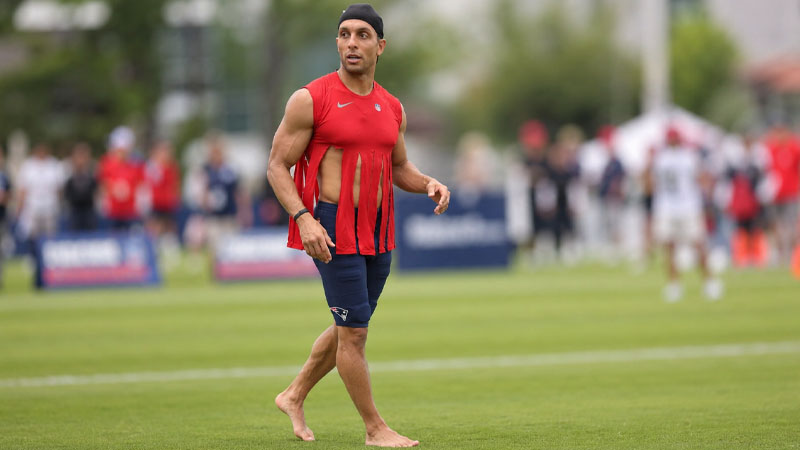
Mack Hollins, a professional wide receiver, has captured widespread attention for his decision to live and train barefoot. Far from a simple eccentricity, this lifestyle choice represents a calculated, scientifically minded methodology aimed at resolving deep-seated physical issues and building long-term durability.
At its core, this approach challenges the conventional wisdom of modern athletic wear. By examining the physical recovery, biomechanical foundations, and psychological discipline behind this practice, we can understand why an elite competitor chooses to navigate the world without shoes.
This analysis provides a comprehensive exploration of the philosophy, science, and lifestyle integration of his barefoot pursuit.
The Catalyst: Overcoming Career-Threatening Injury
To understand the decision to transition to a barefoot lifestyle, one must first look at the physical limitations that threatened to cut Hollins’ athletic career short.
Early in his professional career, while playing for the Philadelphia Eagles, he faced severe physical challenges. He struggled with career-threatening groin tears and experienced severe difficulties with basic daily movements, including walking.
Traditional recovery methods often focus on isolated treatments at the site of the pain. However, when standard protocols fail to provide lasting relief, athletes are forced to look deeper into the mechanics of human movement.
Facing the potential end of his athletic career, Hollins began searching for alternative solutions that addressed the root causes of his physical breakdown.
His search led him to connect with alternative therapists and holistic trainers from Australia.
These specialists presented a different perspective: instead of viewing his groin injuries as isolated muscular failures, they identified them as symptoms of larger, underlying kinetic chain issues.
The solution they proposed was both simple and radical: drop conventional footwear to restore the natural function of the lower body.
The Scientific Experiment: Rebuilding the “Root System”
Transitioning to barefoot living was not a decision made on a whim; rather, Hollins approached it as a systematic scientific experiment designed to test the limits of human adaptation.
At the heart of this experiment is a fundamental biological analogy: the human body is compared to a tree, and the feet serve as its “root system”.
In nature, a tree’s height, stability, and resistance to external forces depend entirely on the strength and depth of its roots. If the roots are weak, the entire structure is vulnerable to collapsing under stress.
Applying this concept to human anatomy, the feet are the only contact point between the body and the ground. Every movement, stride, and impact begins at the feet.
According to the holistic philosophy Hollins adopted, modern athletic training often neglects this foundation:
- The Foundation: The muscles, tendons, and joints of the feet form the primary structural support for the entire body.
- The Kinetic Chain: When these foot muscles are active and strong, they provide a stable base that absorbs and distributes impact forces.
- Joint Protection: A strong foundation actively protects the connected joints higher up the chain—specifically the ankles, knees, and hips—from the extreme high-impact stress of professional sports.
By dropping shoes, the feet are forced to engage directly with the ground. Every tiny muscle in the foot must contract, balance, and stabilize.
Over time, this active engagement transforms the foot from a passive, weakened structure into an active, powerful anchor, establishing a stronger foundation capable of supporting the high-intensity demands of professional athletics.
Redefining Footwear: Shoes as Tools, Not Necessities
A central pillar of this lifestyle is a complete reevaluation of the role that footwear plays in modern society.
For most people, putting on shoes is an automatic, unquestioned part of daily life. However, under the barefoot training philosophy, conventional shoes are viewed in a completely different light.
Rather than treating shoes as daily necessities, they are viewed as highly restrictive “tools”. Just as a hammer or a wrench is a tool designed for a specific task and then put away, shoes are treated as specialized equipment to be used only when necessary.
This perspective highlights several key ideas:
- The Restrictive Nature of Footwear: Conventional shoes, with their tight toe boxes, stiff soles, and heavy cushioning, limit the natural movement and flexibility of the foot. They act like a cast, keeping the foot immobilized and causing the natural stabilizing muscles to weaken over time.
- Selective Use: Because shoes restrict natural foot function, they are reserved only for specific, mandatory situations. For a professional football player, this means wearing shoes during mandatory game-day cleats or during periods of extreme cold weather.
- Consistency Across Environments: Outside of these strict professional and environmental requirements, the commitment to natural movement is absolute. Whether traveling, training, or running daily errands, the preference is to remain entirely without shoes or to utilize highly minimalist footwear that allows the foot to move naturally.
By treating shoes as temporary tools rather than permanent fixtures, the body is allowed to remain in its natural state for the vast majority of the day, reinforcing the strength of the physical foundation.
The Mental Dimension: Embracing Discomfort to Build Discipline
While the physical benefits of barefoot training are a major driving force, the lifestyle also carries a profound psychological component.
Physical health and mental health are deeply connected, and the physical choices we make daily shape our mental resilience.
The philosophy behind going shoeless suggests that modern society’s obsession with constant comfort has negative consequences:
- The Cushion of Comfort: Constantly wearing soft, highly cushioned shoes protects the feet from the natural textures and challenges of the environment. This constant shielding is believed to make people physically and mentally soft.
- Daily Discipline: Choosing to go shoeless is a simple, highly consistent way to embrace a disciplined, harder daily habit. Walking barefoot forces an individual to be fully aware of their surroundings, to feel the varying textures of the ground, and to tolerate minor physical discomforts.
- Building Resilience: By voluntarily choosing a harder path in a small, daily routine, an individual builds a mindset of discipline and mental toughness. This mental grit directly translates to the high-pressure environment of professional sports, where physical discomfort must be managed and overcome to perform at the highest level.
Shedding shoes is more than a physical therapy technique; it is a daily practice in mindfulness, discipline, and the voluntary pursuit of challenge over comfort.
The Barefoot Lifestyle: Consistency Across Daily Life
A common misconception is that barefoot training is limited to controlled environments, such as a gym or a recovery clinic.
However, for Hollins, the true value of the practice lies in its absolute consistency across all areas of life.
Integrating this philosophy into a daily routine requires a commitment that extends far beyond training sessions:
- Daily Errands: Navigating everyday public spaces, stores, and streets entirely without shoes or in minimalist footwear.
- Travel: Maintaining the commitment to foot freedom while navigating airports, hotels, and unfamiliar environments.
- Training: Performing rigorous athletic training barefoot to maximize muscle engagement and ground feedback.
This continuous integration ensures that the feet are constantly adapting, strengthening, and receiving sensory input throughout the day.
It prevents the regression that occurs when an athlete trains barefoot for an hour but then spends the remaining twenty-three hours of the day with their feet locked in restrictive shoes.
Conclusion: Lessons from the Barefoot Experiment
Mack Hollins’ decision to navigate his professional and personal life barefoot is a powerful example of biomechanical and psychological discipline.
By treating his body as an interconnected system and his feet as the essential “root system,” he successfully addressed career-threatening injuries and built a foundation of physical durability.
This journey offers valuable insights for anyone looking to improve their physical health and mental resilience.
It challenges us to look beyond immediate symptoms, to question the unquestioned comforts of modern life, and to recognize that true strength starts from the ground up.