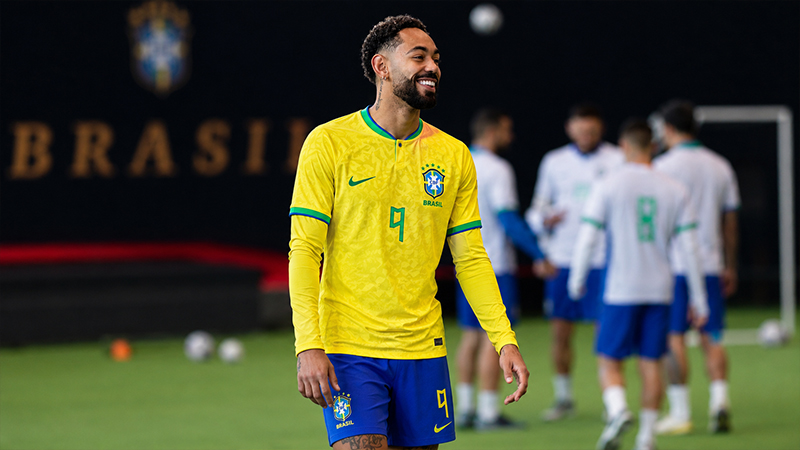
Matheus Cunha has emerged as one of the most intriguing tactical assets in the Premier League. Since his high-profile move to Manchester United, fans and analysts alike have debated his optimal role within a demanding system.
Standing at 183 cm and weighing 76 kg, the Brazilian international possesses a rare blend of physical power and technical grace. Is he a traditional striker, a creative playmaker, or a dynamic winger?
This analysis explores the data-driven reality of Cunha’s positioning, his specialized skill set, and how his unique “three-quarter pace” is revolutionizing the attacking third at Old Trafford.
Statistical Overview of Cunha’s Utility and Performance
To understand where a player of this caliber fits, we must first examine the hard data from his most recent professional outings. Over his last 50 matches, his deployment has been remarkably diverse, reflecting a player who refuses to be pigeonholed into a single zone of the pitch.
The following table provides a comprehensive breakdown of his appearances and effectiveness across various roles:
| Positions | Appearances | Average Match Rating |
|---|---|---|
| Attacking Midfielder (Centre) | 26 | 7.2 |
| Attacking Midfielder (Left) | 13 | 6.9 |
| Forward (Centre) | 10 | 6.6 |
| Attacking Midfielder (Right) | 1 | 6.5 |
The data clearly indicates that while he is capable of playing across the front line, his highest level of consistency and impact occurs when operating centrally behind a main striker.
With an average rating of 7.2 as a central attacking midfielder (AM Centre), he demonstrates a superior ability to influence the game through creative passing and decisive movement in the “Number 10” pocket.
The Dominant Role: Why the Number 10 Suits Him Best
Expert tactical analysis suggests that the “Number 10” role is not just a preference but a necessity for maximizing Cunha’s output. Unlike a traditional “stay-at-home” forward, the Brazilian thrives when granted the tactical freedom to drop deep and interact with the midfield.
Creative Freedom and Ball Progression
When deployed as a central attacking midfielder, he is often encouraged to move off the frontline to receive the ball between the opponent’s defensive and midfield lines. This allows him to turn and drive directly at defenders, a phase of play where he is arguably most dangerous.
His rating of 7.2 in this position reflects his ability to link play and create high-value chances for teammates, acting as the primary creative engine in the final third.
The “Three-Quarter Pace” Phenomenon
Analysts have identified a unique attribute in his game described as “three-quarter pace”. It is not necessarily raw, explosive sprinting speed, but rather a deceptive “gliding” movement that allows him to bypass defenders with ease while maintaining perfect control of the ball.
This specific type of athleticism makes him an elite ball-carrier, capable of picking up the ball near his own box and bursting forward to initiate transitions.
Exploring the Flanks: Cunha as a Dynamic Left Attacker
While his primary influence is central, he has spent significant time operating as an Attacking Midfielder on the Left (AM Left), recording 13 appearances with a respectable 6.9 rating. This role utilizes his natural tendencies as a right-footed player to create goal-scoring opportunities.
The Inside Forward Archetype
Operating from the left flank allows him to function as an “inside forward”. Because his preferred foot is his right, he naturally drifts inward, dragging full-backs out of position and opening up space for overlapping teammates.
This positioning also places him in prime territory to unleash long-range shots or provide incisive diagonal through-balls, leveraging his 183 cm frame to shield the ball while cutting inside.
Strategic Utility on the Wing
His versatility on the wing is bolstered by his quick bursts of speed and tactical intelligence. When the central channels are congested, moving him to the left provides a different tactical dimension.
It forces the opposition to account for a wide player who can suddenly become a central playmaker, making the team’s offensive structure significantly harder to predict.
Leading the Line: The Challenges of the Center-Forward Role
There is frequent discussion regarding his ability to lead the line as a primary striker. While he has 10 appearances as a Center-Forward, his average rating drops to 6.6, suggesting this may not be the role that utilizes his full potential.
Why He Isn’t a Traditional Target Man
Tactical experts note that he is not a “stay up front” center-forward who simply pins defenders and waits for service in the box. Instead, his instinct is to roam, meaning that if he is the lone striker, the team can sometimes lack a focal point in the penalty area.
He is more of a “False Nine” or a supporting striker who creates space through movement rather than through static physical battles.
Physical Presence and Aerial Capability
Despite the drop in rating as a pure striker, he still possesses the physical profile required for the role. At 76 kg and 183 cm, he has the “sharp finishing and aerial capability” needed to lead the line when tactical shifts are required mid-match.
His ability to fill this role effectively, even if it is not his “best” position, highlights the tactical flexibility that makes him a “top player”.
Strategic Integration at Manchester United
His arrival at Manchester United places him within a squad rich in creative and defensive talent. Understanding his position requires looking at the teammates he collaborates with to form a cohesive unit.
The following list highlights key teammates and their primary roles, illustrating how his versatility complements the squad:
- Bruno Fernandes (AM, DM Centre): Often the primary creative force, Fernandes’ ability to drop deeper allows Cunha to occupy the central attacking zones.
- Bryan Mbeumo (AM Right/Centre): Provides a wide threat that balances his tendency to drift centrally.
- Kobbie Mainoo & Manuel Ugarte (DM, M Centre): These defensive pillars provide the security needed for him to embark on his trademark runs from deep.
- Casemiro (DM Centre): Offers veteran stability in the midfield, ensuring that the transition from defense to his “gliding” runs is seamless.
Physical Profile and Professional Pedigree
His tactical adaptability is a result of both his physical attributes and his extensive experience in Europe’s most competitive leagues. Before joining Manchester United, he honed his skills at clubs like RB Leipzig, Atletico Madrid, and Wolves.
This journey has exposed him to various tactical philosophies—from the high-pressing systems of the Bundesliga to the defensive discipline of La Liga—resulting in a highly “tactically versatile” player.
His preferred right foot and height of 183 cm give him a physical advantage in aerial duels, while his weight and agility profile (76 kg) allow him to maintain the balance required for elite ball-carrying. This combination of “gliding” speed and physical robustness is precisely what was missing from the United attack.
Frequently Asked Questions: Decoding Cunha’s Role
What is officially considered Matheus Cunha’s best position?
Based on both match data and expert analysis, his best position is Attacking Midfielder (Centre), commonly known as the Number 10 role. He averages a 7.2 rating here, significantly higher than his performances as a winger or a lone striker.
Can he play as a primary striker for Manchester United?
Yes, he can lead the line as a center-forward or a false nine, but it limits his ability to “make something happen” from deep. His rating as a forward (6.6) suggests he is more effective when he has the freedom to drop off the front line.
How does his playing style benefit the team’s transitions?
He is celebrated for his ability to pick up the ball near his own penalty area and drive forward with “three-quarter pace”. This allows the team to transition from defense to attack instantly, bypassing the opposition’s midfield through his superior ball-carrying skills.
Is he primarily a right-footed or left-footed player?
He is a right-footed player. This preference often influences his positioning on the left wing, where he can cut inside to his stronger foot to shoot or create chances.
Conclusion: The Elite Tactical Utility Asset
In the modern era of fluid football, players who can master multiple roles are invaluable. Matheus Cunha is the personification of this tactical evolution.
While the data and expert consensus point toward the “Number 10” role as his most productive home, his true value to Manchester United lies in his “freedom” to fill any gap across the attacking line.
Whether he is gliding past defenders from a central position, cutting in from the left as an inside forward, or providing a mobile presence as a false nine, his impact is undeniable.
He provides the creative spark and ball progression that the team has previously lacked, making him one of the most versatile and dangerous attackers in the world today.
As he continues to mature at Old Trafford, his ability to adapt to any tactical requirement will remain his greatest strength.