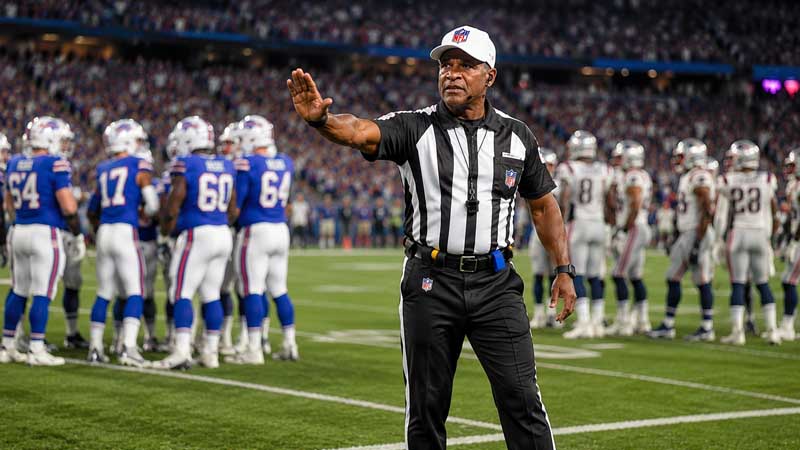
When you watch a game of American football, the flash of a bright yellow penalty flag hitting the turf instantly draws the attention of everyone in the stadium and at home.
You brace yourself for the referee to step up to the microphone, announce a foul, and march off the yardage. Yet, every so often, the referee announces something that catches casual fans off guard: “The penalty is declined. The play stands.”
For newcomers to the sport, hearing a team turn down free yardage or a chance to punish their opponent feels entirely counterintuitive. Why would any team pass up an opportunity to move closer to the end zone or push their rival backward?
Understanding this concept unlocks a deeper layer of appreciation for football strategy. Gridiron football is a game of calculated risks, field position chess, and down-and-distance management. Choosing to reject an infraction marker is often the smartest tactical decision a coach or team captain can make.
The Core Concept: How Penalty Decisions Work
When an infraction occurs during a live play, the team that did not commit the foul (the offended team) holds all the cards. The rules of football grant them the right to choose between two distinct options:
- Accept the Penalty: The referee enforces the yardage consequence, and the down is usually replayed (with specific exceptions depending on the type of foul).
- Decline the Penalty: The infraction is completely ignored, wiped away as if it never happened, and the actual outcome of the play stands.
Crucially, teams do not look at penalties in a vacuum. They weigh the fixed yardage or down replay against what they actually achieved during the play itself.
If the physical play resulted in a gain greater than what the rulebook would award via the penalty, refusing the flag becomes the obvious choice.
Primary Scenarios: Why Teams Walk Away from Free Yards
To understand how frequent and vital these choices are, let us break down the most common game situations where teams intentionally reject an opponent’s mistake.
1. Capitalizing on Explosive Gains
Imagine an offense faces a standard second-down situation. The quarterback drops back and fires a deep pass downfield, completing a spectacular 35-yard reception.
However, right as the play begins, a defensive lineman jumps across the line of scrimmage, committing an offsides foul.
If the offense accepts the penalty, the referee brings the ball back to the original line of scrimmage and awards a modest 5-yard advance.
That means the team would trade a thrilling 35-yard gain for a pedestrian 5-yard bump. By waving off the flag, the offense keeps their massive 35-yard advance and secures a fresh set of downs.
2. Protecting a Touchdown or Scoring Play
Few moments match the excitement of a player breaking free for a long touchdown run. Sometimes, a trailing defender might commit a minor holding infraction near the line of scrimmage far away from the actual play.
If the scoring team accepted the infraction, the touchdown would be completely nullified, forcing them to resume the drive from a different spot on the field.
Unless a major personal foul compromises player safety, teams will almost always reject the marker to ensure the scoreboard lights up with six points.
3. Creating Defensive Turnovers and Field Position Advantage
Strategic rejection is not restricted to the offense; defensive units use it to their absolute advantage, too. Suppose an opposing offense commits a holding foul during a play that results in a heavy loss or a short gain.
- The Trap of Replaying Downs: If the defense accepts the holding infraction, the penalty yards are marked off, but the opponent gets to replay the down.
- The Power of the Decline: If the defense recognizes that the play ended in a disastrous 4th-down-and-long situation for the opponent, they will decline the infraction. By doing so, they force a turnover on downs or compel the opponent to punt the ball away, capturing superior field position rather than letting their rival try again.
Tactical Decision-Making: The Chess Match Behind the Flag
Coaches, quarterbacks, and team captains do not make these choices on a whim. On the sidelines, analytical staffs track probabilities in real-time. Choosing whether to accept or reject an infraction involves weighing several dynamic variables:
Down and Distance Math
Teams calculate the “line of indifference”—the exact yardage threshold where accepting a penalty yields a mathematically better expected value than keeping the current field position.
Clock Management
In late-game scenarios, keeping the clock running is paramount. Accepting a penalty often stops the game clock momentarily, whereas declining it allows the game flow to continue uninterrupted.
Psychological Momentum
Leaving a successful play on the board demoralizes the opposing defense far more than taking a routine 5-yard administrative step forward.
Frequently Asked Questions
Can a team reverse its decision after choosing to decline?
No. Once the team captain or head coach communicates their choice to the referee and the decision is signaled to the stadium, it is final. Teams must make these rapid-fire assessments within seconds.
Are all penalties eligible to be declined?
The vast majority of infractions can be rejected. However, exceptions exist. For instance, “double fouls”—where both teams commit infractions on the same play—typically offset one another automatically rather than giving a clean choice of acceptance or refusal.
Additionally, administrative stoppages or dead-ball fouls behave differently because no live play occurred to yield an alternative outcome.
Who actually makes the call on the field?
The head coach dictates overall game management, but quarterbacks and defensive captains often relay instructions directly to the officiating crew based on immediate field conditions.
Conclusion
Ultimately, watching football involves much more than tracking the movement of a ball; it requires understanding a continuous stream of tactical choices.
Recognizing why a team willingly walks away from free yardage transforms a confusing referee announcement into a clear display of high-level gridiron strategy.
Whether it involves preserving a spectacular long pass, locking in a crucial scoring drive, or trapping an opponent in a difficult fourth-down predicament, rejecting an infraction marker showcases the analytical depth that defines America’s favorite sport.