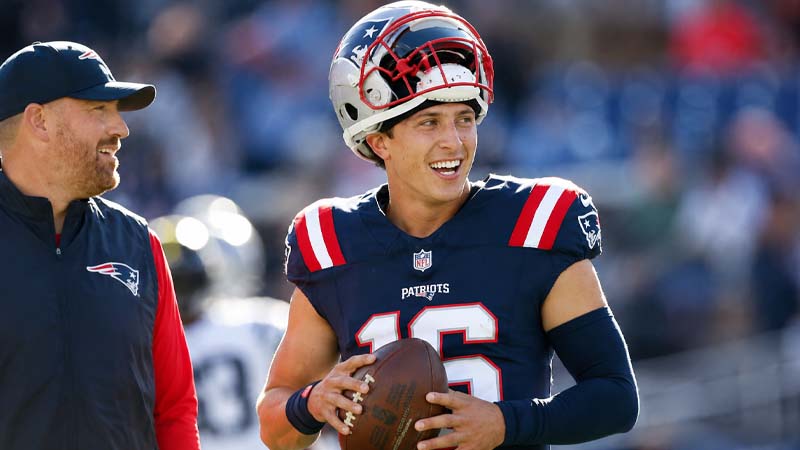
The relationship between professional athletes and their supporters has changed dramatically. Supporters no longer just look at statistics, yardage, or game-winning plays.
Instead, they look for identity, relatability, and a sense of real-world connection. In an era where many public profiles are carefully managed by corporate public relations teams, the figures who stand out most are those who remain unapologetically themselves.
NFL quarterback Tommy DeVito represents a perfect example of this cultural shift.
Throughout his professional journey, he has managed to capture public attention not just through his performance on the field, but through his distinct personal branding. Specifically, DeVito has become the subject of two highly memorable nicknames: “Tommy Cutlets” and “Two Chains”.
These monikers are not the result of corporate focus groups. Instead, they emerged naturally from his everyday habits, family heritage, and personal style.
By looking closely at how these names came to be, we can understand how authentic narratives create a powerful connection between professional athletes and their audience.
The Value of Relatability in Modern Sports Branding
To understand why these names caught on so quickly, it is helpful to look at how identity operates in professional sports. For decades, athletes were viewed as distant heroes.
They were highly skilled performers who existed behind helmet visors and uniform numbers. However, the rise of digital media and round-the-clock sports coverage has shifted what people value.
Today, supporters look for personal elements. They want to know what an athlete eats, where they live, how they dress, and how they stay connected to their roots.
When an athlete’s public identity is built on real, unscripted elements of their life, it creates an immediate sense of familiarity.
This familiarity turns casual viewers into loyal supporters. It builds a community around the player that extends far beyond the stadium walls. This is the exact dynamic that fueled the rapid rise of Tommy DeVito’s public profile.
The First Chapter: The Story of “Tommy Cutlets”
The first moniker to capture the public imagination was “Tommy Cutlets”. This nickname was earned during DeVito’s breakout stint with the New York Giants.
At the time, he was stepping into a major spotlight, yet instead of presenting a highly polished, distant persona, DeVito shared details of a remarkably grounded lifestyle.
The moniker itself is rooted in two distinct elements: his Italian heritage and his living situation. During his 2023 run with the Giants, DeVito famously shared that he still lived at home with his parents.
In a professional league where young athletes often move into luxury homes as soon as they sign a contract, the image of a starting quarterback choosing to stay in his childhood bedroom was incredibly unique and relatable.
To make the story even more charming, DeVito noted that one of the primary benefits of living at home was his mother’s home-cooked chicken cutlets.
He famously mentioned that these fresh, homemade meals were literally waiting for him when he returned home after long, exhausting team practices.
This simple admission struck a major chord with the public. It connected his Italian heritage to a universal experience: the comfort of family, home-cooked food, and the support of parents. The name “Tommy Cutlets” quickly became a cultural phenomenon.
It was embraced by teammates, celebrated by fans, and became a defining feature of his time with the Giants. It showed that sometimes, the most effective way to stand out in a major professional league is to simply talk about your mother’s dinner table.
The Second Chapter: The Shift to “Two Chains” in New England
As professional careers evolve, so do the narratives that surround them. After his time with the Giants, DeVito’s journey took him to a new franchise: the New England Patriots.
A change in team often means a clean slate, and for DeVito, it also meant the birth of an entirely new moniker.
Upon joining the Patriots, DeVito picked up his second nickname: “Two Chains”. Unlike “Tommy Cutlets,” which was born from his home life and shared by the player himself, this new moniker was bestowed upon him by his coach.
The name was coined by New England Patriots coach Mike Vrabel. Coaches are known for their sharp observation skills, both on and off the field.
In this case, Vrabel noticed a consistent detail in DeVito’s daily appearance during team activities. He observed that DeVito was constantly wearing two gold chains (necklaces) during practice every single day.
The gold necklaces became a staple of his practice uniform, serving as a subtle nod to his personal style and cultural background. Rather than discouraging the jewelry, Coach Vrabel leaned into the unique habit, giving him the “Two Chains” title.
This transition represents an interesting shift in his public identity. While “Tommy Cutlets” highlighted his role as a son returning home to his family’s kitchen, “Two Chains” highlights his personal style and daily presence on the professional practice field.
It shows that his authentic approach to self-expression did not change when he moved to a new team; instead, it simply adapted to his new surroundings.
Analyzing the Contrast: Home-Cooked Comfort vs. Field-Side Style
When we compare these two identities, we see a fascinating contrast that highlights different aspects of the same individual:
| Characteristic | “Tommy Cutlets” | “Two Chains” |
|---|---|---|
| Team Context | New York Giants (2023 Run) | New England Patriots |
| Originator | Self-revealed during interviews | Coined by Coach Mike Vrabel |
| Primary Theme | Italian heritage, family, and home-cooked meals | Personal style, daily habits, and practice field fashion |
| Key Symbol | Mother’s chicken cutlets waiting after practice | Two gold necklaces worn during practice every day |
Both of these monikers share a crucial underlying trait: they are entirely unmanufactured.
Many modern athletes attempt to create public identities through highly calculated marketing campaigns, custom logos, and scripted social media posts. These efforts often feel forced because they lack a genuine connection to the player’s daily reality.
In contrast, DeVito’s names are built entirely on observable facts. He really did live with his parents and eat chicken cutlets.
He really does wear two gold necklaces to practice every single day. Because these details are true, they carry an organic appeal that corporate marketing simply cannot replicate.
The Strategic Power of Authentic Athlete Brands
Ultimately, the story of Tommy DeVito’s dual monikers provides a valuable lesson in modern sports communication.
In a landscape saturated with predictable statements and manufactured images, authenticity remains the most valuable asset.
Whether celebrating his family’s home-cooked meals in New York or showcasing his personal style on the practice fields of New England, DeVito has demonstrated that staying true to oneself is the ultimate way to build an enduring public connection.
As his career continues to unfold, his dual identities stand as a testament to the power of a genuinely memorable name.