Roster construction in the modern league is a delicate balance of salary cap management, tactical depth, and locker-room culture.
While major offseason headlines typically focus on blockbuster trades and record-breaking starter contracts, the true foundation of sustainable franchise health is often built on quieter, highly strategic moves.
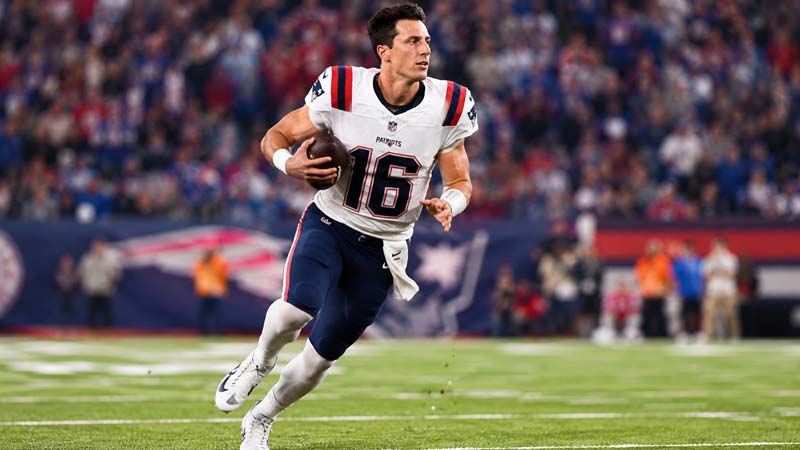
The decision by New England to sign quarterback Tommy DeVito to a two-year contract extension represents one of these quiet, highly calculated transactions.
By securing the 27-year-old signal-caller through a multi-year deal, New England’s front office has navigated the complex rules of restricted free agency, locked in critical developmental continuity, and maintained a highly favorable financial structure.
This analysis provides a comprehensive, professional breakdown of the transaction, exploring the financial mechanics, the restricted free agency landscape, the cultural impact of DeVito within the locker room, and how this move solidifies the environment around franchise cornerstone Drake Maye.
Deconstructing the Financial Architecture of the Contract
At first glance, the contract headlines announced a maximum potential payout of $7.4 million over two years.
However, a professional evaluation of the deal requires looking past the maximum incentive-based ceiling to examine the core base values, guaranteed structures, and immediate salary cap implications.
The agreement is designed to protect the team’s financial flexibility while providing the player with meaningful security.
The base value of the contract sits at $4.4 million over the two-year term, yielding an average annual salary of $2.2 million.
The structural distribution of the money is highly favorable for a reliable depth quarterback:
- Total Guaranteed Money: The contract includes $2 million in total guarantees, protecting the player against roster volatility and establishing a firm financial commitment from the organization.
- Signing Bonus: DeVito receives an immediate signing bonus of $650,000, which allows the team to prorate that cost over the length of the deal, keeping the immediate cap impact low.
- 2026 Salary Cap Hit: For the upcoming season, DeVito will count just $1.55 million against the team’s salary cap, preserving valuable space for other roster needs.
To understand why this is an efficient use of cap space, we must analyze the contract in relation to the entire quarterback room.
The team is carrying veteran backup Joshua Dobbs, who is entering the final year of his contract. The financial contrast between the veteran backup and the developmental third-stringer highlights the team’s long-term planning.
2026 Quarterback Room Financial Landscape
The table below illustrates the financial hierarchy of the depth chart, contrasting the veteran presence of Dobbs with the cost-effective security of DeVito.
| Quarterback | Depth Chart Position | Contract Status | 2026 Base Salary | 2026 Salary Cap Hit | Guaranteed Money |
|---|---|---|---|---|---|
| Drake Maye | Starter | Under Rookie Contract | Rookie Scale | Rookie Scale | Fully Guaranteed |
| Joshua Dobbs | Primary Backup | Final Year of Deal | $3,200,000 | $4,750,000 | Expiring Vet Deal |
| Tommy DeVito | Developmental Backup | Year 1 of New Deal | $2,200,000 (Avg.) | $1,550,000 | $2,000,000 |
This financial structure allows New England to carry a highly stable three-man quarterback room without over-allocating cap resources.
While Dobbs represents a larger, short-term cap hit of $4.75 million in his final year, DeVito’s highly manageable $1.55 million cap charge balances the position group’s total budget.
The Restricted Free Agency Chess Match
To appreciate the strategic timing of this extension, one must understand the alternative paths the team could have taken under league rules. DeVito was entering the offseason as a restricted free agent (RFA).
Under standard league guidelines, if the front office wanted to retain his rights without a long-term contract, they would have been forced to place a one-year RFA tender on him.
The cost of tender offers is established annually by the league, and the financial requirements are substantial. Had the team utilized these standard tenders, they would have faced the following options:
- Right of First Refusal Tender: This baseline tender would have cost $3.52 million for a single season, giving the team the right to match any contract offer sheet signed with another club, but providing no draft pick compensation if they chose not to match.
- Second-Round Tender: This option would have cost $5.7 million for one year, requiring any acquiring team to surrender a second-round draft choice to New England.
- First-Round Tender: The most secure and expensive option, costing $8 million for a single season, requiring a first-round pick in compensation.
By bypassing the formal tender process and negotiating a direct, two-year contract extension, the front office completed a highly efficient negotiation.
Financial Comparison — RFA Tenders vs. Negotiated Deal
This comparative breakdown highlights the clear financial advantages of negotiating a direct contract extension over utilizing standard league tender offers.
| Retention Mechanism | One-Year Cost / Base Value | Two-Year Projected Cost | Draft Pick Compensation | UFA Status Transition |
|---|---|---|---|---|
| First-Round Tender | $8,000,000 | N/A (One-year deal) | First-Round Pick | Unrestricted Free Agent in 2027 |
| Second-Round Tender | $5,700,000 | N/A (One-year deal) | Second-Round Pick | Unrestricted Free Agent in 2027 |
| Right of First Refusal Tender | $3,520,000 | N/A (One-year deal) | None | Unrestricted Free Agent in 2027 |
| Negotiated 2-Year Contract (Actual) | $4.4 million base value | $4.4 million total base | None Required | Retained through 2027 |
Negotiating this deal yielded several major advantages:
- Lower Average Annual Cost: The base average annual salary of $2.2 million is significantly lower than even the lowest RFA tender of $3.52 million. The team effectively secured two years of control for only slightly more than a single-year Right of First Refusal tender would have cost.
- Forgoing Unrestricted Free Agency: Under a standard one-year tender, DeVito would have had a direct path to becoming an unrestricted free agent in 2027. This negotiated deal ensures that the team maintains cost-controlled depth for two full seasons, taking him off the open market.
- Guaranteed Security for the Player: While tenders are non-guaranteed until signed and offer no multi-year security, DeVito secured $2 million in guaranteed money and an immediate signing bonus, creating a win-win scenario for both the player and the franchise.
The Intangible Value: System Acclimation and Locker-Room Culture
An analytical assessment of a backup quarterback cannot rely solely on game-day statistics. This is especially true for DeVito, who did not take a game snap during the 2025 season.
His value to the organization is rooted in his work ethic, rapid system integration, and behind-the-scenes leadership.
DeVito’s journey with the team began under challenging circumstances. He was claimed on waivers from the New York Giants in late August, right at the conclusion of training camp.
Entering a complex franchise at that stage of the calendar is one of the most difficult assignments an offensive player can face, requiring immediate immersion into a completely foreign playbook.
Despite these hurdles, DeVito’s integration was remarkably smooth:
- Mastering McDaniels’ Offense: DeVito dedicated himself to learning the intricate details of coordinator Josh McDaniels’ offensive system. He expressed public enthusiasm for the mental challenges of the playbook, rapidly positioning himself as a reliable asset in the quarterback meeting rooms.
- Earning Coaching Staff Praise: In late January, head coach Mike Vrabel publicly acknowledged DeVito’s impressive development. Vrabel noted: “I think that’s a tough proposition to have, coming in at the end of training camp and trying to get acclimated offensively. So to his credit, he’s done a really nice job.”
- Investing in the Practice Squad: One of the most telling indicators of DeVito’s leadership was his self-initiated routine on off-days. Vrabel highlighted that DeVito voluntarily spent extra time each Monday working on the field with the team’s younger pass-catchers, particularly those on the practice squad. This extra work helped accelerate the development of young depth players who do not receive reps during standard mid-week practices.
This level of dedication establishes a professional standard. In a modern franchise, a third-string quarterback must act as an additional coach, a scout-team leader, and a culture setter. DeVito has fulfilled all of these roles, making him a highly valued member of the roster.
Roster Continuity and the Development of Drake Maye
The primary objective of the organization is the successful development of starting quarterback Drake Maye.
The history of the league is filled with examples of highly drafted quarterbacks whose development was hindered by constant turnover, unstable locker rooms, or a lack of support in the film room.
By extending DeVito and returning the identical quarterback room for the upcoming season, the team is prioritizing stability.
[Drake Maye (Starter)] ──> Supported by ──> [Joshua Dobbs (Primary Vet Backup)]
                                 │
                                 └──> Pushed & Assisted by ──> [Tommy DeVito (Developmental Depth)]
This deliberate developmental environment offers several key advantages:
- A Consistent Support Network: Drake Maye benefits from working alongside the same minds daily. Joshua Dobbs provides the perspective of a seasoned journeyman who has prepared for games under various coaching staffs. Meanwhile, DeVito offers the perspective of a young player who has successfully navigated complex transitions and mastered McDaniels’ system from scratch.
- Playbook Mastery: Rather than introducing new voices, the coaching staff can build directly on the foundation laid during the prior season. DeVito’s familiarity with the offense means he can run the scout team with high efficiency, giving the starting defense realistic looks during weekly preparations.
- Insulation Against Injury: NFL history confirms that backup quarterback depth will eventually be tested. Carrying a third-string option who is fully integrated into the culture and playbook ensures that the offense can maintain its operational standards even if injuries strike the position group.
Summary: A Benchmark Move in Modern Roster Building
The contract extension for Tommy DeVito is a clear reflection of the front office’s long-term plan.
By avoiding the high costs of restricted free agent tenders, securing valuable multi-year depth, and rewarding a player who has shown exceptional commitment to the team’s culture, the organization has constructed a stable, supportive environment for its quarterbacks.
This transaction proves that successful roster building is not just about signing star players; it is about managing the salary cap intelligently, building a strong culture behind the scenes, and establishing the structural stability required to win over the long term.