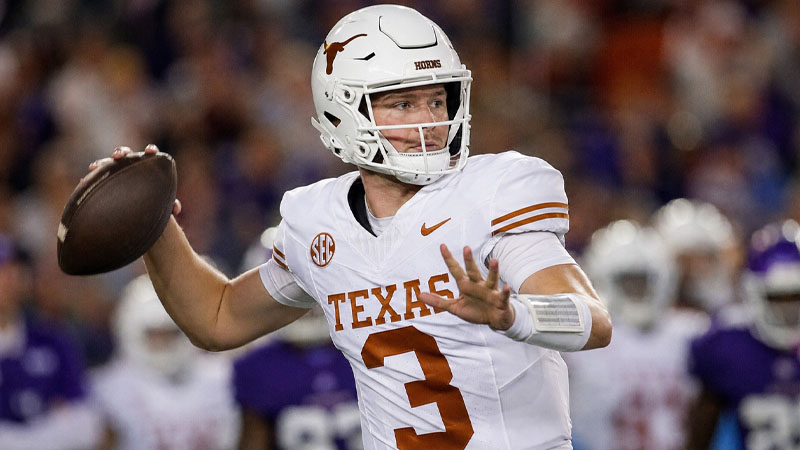
The professional trajectory of a high-pedigree collegiate athlete entering the professional ranks is rarely a linear progression.
For Quinn Ewers, the journey from a celebrated starter at the University of Texas to a developmental quarterback for the Miami Dolphins offers a compelling case study in professional adaptation, statistical efficiency, and the rigors of the modern game.
As the 2026 season commences, the data accumulated during his initial outings provides a clear framework for evaluating his current standing and future potential within the organization.
The Professional Transition: From Austin to Miami
Quinn Ewers entered the professional landscape as a notable figure, largely due to his high-profile tenure as a Longhorn.
Standing at 6′ 2″ and weighing 209 lbs, Ewers possesses the prototypical frame desired for the modern pocket passer who can navigate the complexities of professional defensive schemes.
His transition was solidified during the 2025 NFL Draft, where he was selected in the 7th round with the 231st overall pick by the Miami Dolphins.
While a late-round selection often implies a long-term developmental path, Ewers saw active regular-season participation during his rookie year, appearing in four games.
This early exposure is critical for a player of his age—currently 23 years old—as it bridges the gap between collegiate theory and professional reality.
2025 Statistical Performance
To understand Ewers’ impact, one must look closely at the quantitative data from his 2025 campaign.
The following table summarizes his primary passing metrics, which illustrate a player with high accuracy but emerging situational awareness.
| Metric | 2025 Regular Season Value |
|---|---|
| Games Played (GP) | 4 |
| Completions (CMP) | 55 |
| Attempts (ATT) | 83 |
| Completion Percentage (CMP%) | 66.3% |
| Passing Yards (YDS) | 622 |
| Average Yards Per Attempt (AVG) | 7.5 |
| Touchdowns (TD) | 3 |
| Interceptions (INT) | 3 |
| Longest Completion (LNG) | 63 |
| Sacks Taken (SACK) | 8 |
| Passer Rating (RTG) | 85.5 |
| Total Quarterback Rating (QBR) | 32.8 |
Analyzing Passing Efficiency vs. Impact
The most striking figure in Ewers’ profile is his 66.3% completion rate. For a rookie quarterback, particularly one selected in the late rounds, maintaining a completion percentage above 65% suggests a high level of comfort with short-to-intermediate timing routes and a disciplined approach to the offensive system.
However, this efficiency is contrasted by a Total QBR of 32.8, which indicates that while completions are being made, they are not consistently translating into high-leverage winning play.
The 3:3 touchdown-to-interception ratio further emphasizes this developmental stage.
While he has shown the ability to find the end zone, the equal number of turnovers suggests a need for improved post-snap processing and better recognition of professional-level closing speeds by defensive secondaries.
His 85.5 passer rating remains a respectable baseline, placing him in a category of viable backup or “bridge” talent as he continues to refine his mechanics.
Versatility and Physicality: Rushing and Receiving Metrics
Modern professional offenses demand a level of mobility from the quarterback position. While Ewers is primarily a pocket-oriented passer, his 2025 data shows a willingness to use his legs when the primary read is unavailable.
| Rushing Metric | 2025 Value |
|---|---|
| Carries (CAR) | 8 |
| Rushing Yards (YDS) | 19 |
| Average Per Carry (AVG) | 2.4 |
| Longest Rush (LNG) | 9 |
| First Downs (FD) | 1 |
| Fumbles (FUM) | 2 |
Ewers recorded eight carries for 19 yards, averaging 2.4 yards per attempt. While these are not elite rushing numbers, they demonstrate his ability to secure at least one first down with his feet.
A point of concern for the coaching staff, however, will be the two fumbles recorded in just four games, highlighting a need for improved ball security when the quarterback becomes a runner.
Additionally, his statistical profile contains a rare anomaly for a quarterback: one reception for a loss of 6 yards.
This likely stems from a batted pass that Ewers caught himself to avoid a turnover, a split-second decision that, while negative in yardage, reflects his reactive instincts on the field.
The 2026 Landscape: Current Standings and Schedule
As of mid-August 2026, the Miami Dolphins find themselves in a challenging position within the AFC East.
The team is currently 0-1, placing them at the bottom of the division alongside the New York Jets, while the Buffalo Bills and New England Patriots have already established early leads in the standings.
AFC East Standings (August 2026):
- Buffalo Bills: 1-0-0 (1.000)
- New England Patriots: 0-0-1 (.500)
- New York Jets: 0-1-0 (.000)
- Miami Dolphins: 0-1-0 (.000)
For a player like Ewers, the upcoming schedule represents a critical window for evaluation. The Dolphins are scheduled to face the New York Giants at Hard Rock Stadium on Saturday, August 22, 2026.
These preseason and early-season matchups are the primary laboratory where a 7th-round pick can prove his value and move up the depth chart.
The Path Forward: Developmental Goals for Ewers
To transition from a “status active” depth player to a consistent contributor, several key areas must be addressed in Ewers’ game.
- Pocket Presence and Sack Reduction: Ewers was sacked 8 times in only four games. This high frequency of sacks relative to his attempts suggests a need for faster decision-making or improved coordination with the offensive line to identify blitz packages.
- Exploiting the Deep Ball: His 63-yard long completion indicates that the arm talent showcased at Texas remains a viable weapon. Increasing the frequency of these high-yardage plays could help improve his overall QBR.
- Consistency in Scoring Drives: With only three touchdowns in 83 attempts, increasing the efficiency of the offense in the red zone will be paramount for his longevity in the Miami system.
Strategic Outlook
The data surrounding Quinn Ewers suggests a player with significant technical upside but one who is still acclimatizing to the speed and complexity of professional football.
His high completion percentage provides a sturdy foundation, but the low QBR and sack totals indicate that the next stage of his development must focus on situational awareness and high-leverage execution.
As the Dolphins look to rebound from an early 0-1 start in 2026, the progress of their young #14 will be a storyline of significant interest for analysts and fans alike.