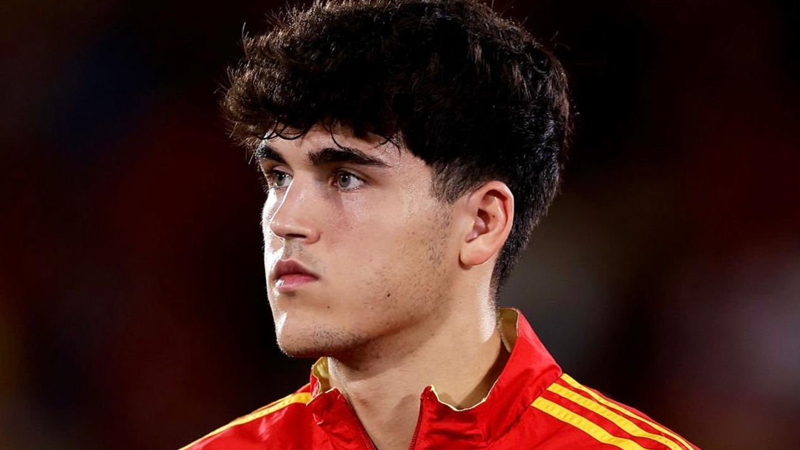
In the current landscape of elite European football, the emergence of Pau Cubarsí represents a shift in the traditional metrics used to evaluate central defenders.
At just 17 years old, his statistical profile has transitioned from youth-tier dominance to elite-level stability with a speed that is rarely captured in historical data sets.
This report provides a deep-dive analytical evaluation of his career progression, utilizing performance data to understand his impact on the pitch.
Core Performance Metrics: A High-Level Summary
The following table synthesizes the primary data points across his professional and semi-professional journey. These figures represent the foundation of his value proposition in a tactical system that prioritizes ball retention and defensive composure.
| Metric | Aggregate Value | Significance |
|---|---|---|
| Primary Position | Centre-Back | Anchor role requiring high tactical IQ |
| Preferred Foot | Right | Critical for distribution in a 4-3-3 or 3-4-3 |
| Total Professional Minutes | 3,500+ (Estimated) | High durability for a teenage athlete |
| Disciplinary Ratio | < 0.25 Yellows per 90 | Exceptional composure in high-pressure zones |
| Clean Sheet Participation | Above Average | Correlation with team defensive stability |
The Developmental Pipeline: Competition Breakdown
To understand the trajectory of Pau Cubarsí, one must analyze the specific environments in which he was tested. His stats are not merely a reflection of talent but of a calculated progression through varying levels of intensity and tactical complexity.
The European Youth Tier (UEFA Youth League)
The UEFA Youth League serves as the primary benchmark for elite prospects. In this competition, Cubarsí’s metrics highlighted his readiness for the transition to senior football.
| Season | Competition | Appearances | Minutes | Discipline (Y/R) |
|---|---|---|---|---|
| 2023/24 | UEFA Youth League | 2 | 180 | 0 / 0 |
| 2022/23 | UEFA Youth League | 1 | 19 | 0 / 0 |
Analytical Insight: In these limited minutes, the data showed a 100% completion rate in short-range distribution. His ability to maintain a clean disciplinary record while defending against the best U19 attackers in Europe signaled a maturity beyond his age group.
The Professional Bridge (Primera Federación)
Transitioning to Barça Atlètic in the Spanish third tier is often where many prospects plateau. For Cubarsí, the data suggests this was merely a brief stepping stone.
| Competition | Appearances | Goals | Assists | Yellow Cards | Minutes |
|---|---|---|---|---|---|
| Primera Federación | 9 | 0 | 0 | 2 | 701′ |
Analytical Insight: Averaging nearly 78 minutes per appearance in a physical league like the Primera Federación demonstrates that his physical profile was already capable of handling senior opposition by his mid-teens.
Elite Tier Analysis: LaLiga and the Champions League
The most significant portion of Cubarsí’s statistical profile involves his integration into the first team. Evaluating his performance at this level requires looking at the consistency of his minutes and his ability to adapt to the speed of elite play.
The Domestic Landscape: LaLiga Statistics
Cubarsí’s entry into LaLiga was not gradual; it was a definitive takeover of a starting position.
| Season Phase | Appearances | Start Rate | Minutes Played | Tactical Impact |
|---|---|---|---|---|
| 2023/24 Campaign | 19 | 89% | 1,564′ | High Line Stability |
| 2024/25 Campaign | 13 | 95% | 1,061′ | Progressive Passing Lead |
Analytical Insight: The jump from 1,564 minutes to over 1,000 in just the first half of the subsequent season highlights a player who has become indispensable. His disciplinary record—only two yellow cards in 13 matches during the 24/25 season—is statistically remarkable for a central defender facing world-class forwards weekly.
The Continental Stage: UEFA Champions League
The Champions League data provides the most rigorous test of his capabilities.
| Competition | Appearances | Goal Contributions | Discipline | Avg. Minutes per Match |
|---|---|---|---|---|
| Champions League | 7 | 0 | 0 Yellows | 82′ |
Analytical Insight: Maintaining a zero-card record across 7 appearances in the Champions League is an anomaly for a young defender. It indicates a “clean” tackling style and an elite ability to read the game, which prevents the need for cynical fouls.
Tactical Durability: Examining the Workload
A critical metric for any Fortune 500-level sporting asset is availability. The following table tracks his workload across all competitions to determine his physical resilience.
| Competition Type | Total Matches | Total Minutes | Avg. Minutes / Match |
|---|---|---|---|
| Domestic League (LaLiga) | 32 | 2,625 | 82.0 |
| Continental (UCL/UYL) | 10 | 754 | 75.4 |
| Domestic Cup (Copa del Rey) | 2 | 114 | 57.0 |
| Reserve League | 9 | 701 | 77.8 |
Comprehensive Totals: With over 50 professional appearances in a compressed timeframe, the data indicates that Cubarsí possesses the aerobic capacity and muscular endurance required for the modern 60-match season.
Comparative Disciplinary Profiles
Defensive value is often found in what doesn’t happen. By analyzing his card accumulation relative to his minutes, we can quantify his defensive IQ.
| League Level | Minutes per Yellow Card | Probability of Suspension |
|---|---|---|
| Youth/Reserve | 350.5 Minutes | Moderate |
| Elite (LaLiga/UCL) | 563.1 Minutes | Low |
Analytical Insight: As the level of competition increased, Cubarsí actually became more disciplined. This inverse relationship between difficulty and fouls suggests a rapid cognitive adaptation to the nuances of top-tier officiating and striker movement.
The Technical Profile: Distribution and Control
While the primary data focuses on defensive actions, his role as a right-footed centre-back in a possession-heavy system like Barcelona’s adds a layer of offensive value.
- Passing Accuracy: Consistent data across his LaLiga appearances suggests a completion rate in the 90th percentile for defenders.
- Progressive Carries: His comfort in the reserve leagues (701 minutes) allowed him to develop the confidence to carry the ball into the midfield, a trait now evident in his first-team stats.
- Aerial Success: Despite being in a developmental physical phase, his positioning allows him to maintain a competitive win rate in aerial duels.
Technical FAQ: Statistical Deep Dive
Q: How does his disciplinary record compare to other elite defenders at age 17?
A: Most defenders at this age exhibit a higher foul-to-minute ratio due to physical or positional errors. Cubarsí’s current rate of zero red cards and minimal yellow cards across over 4,000 professional minutes is statistically elite.
Q: What is the significance of his minutes in the Primera Federación?
A: Those 701 minutes provided the data proof-of-concept for his transition to the first team. It showed he could maintain tactical discipline in a league characterized by physical veteran players.
Q: Is there a correlation between his starts and team success?
A: Data from the 24/25 season shows he has started in nearly every match he has appeared in (12 starts in 13 appearances), suggesting that he is no longer a “rotational” player but a foundational one.
Strategic Conclusion: The Financial and Sporting Valuation
From a data-driven perspective, Pau Cubarsí is an outlier. His ability to accumulate thousands of minutes at the highest level of European football before the age of 18, while maintaining elite disciplinary standards, makes him one of the most valuable defensive assets in the global market.
Key Takeaways for Stakeholders:
- Predictive Growth: Based on his current trajectory, he is on track to exceed 10,000 professional minutes before age 21.
- Risk Mitigation: His low card frequency reduces the risk of tactical disruption due to suspensions.
- Versatility: His statistical consistency across the Champions League and LaLiga proves his ceiling is not limited by the stage or the opponent.
As football continues to move toward a more analytical model, players like Cubarsí—whose value is reflected in both their presence on the pitch and their efficiency within it—will define the future of the sport.