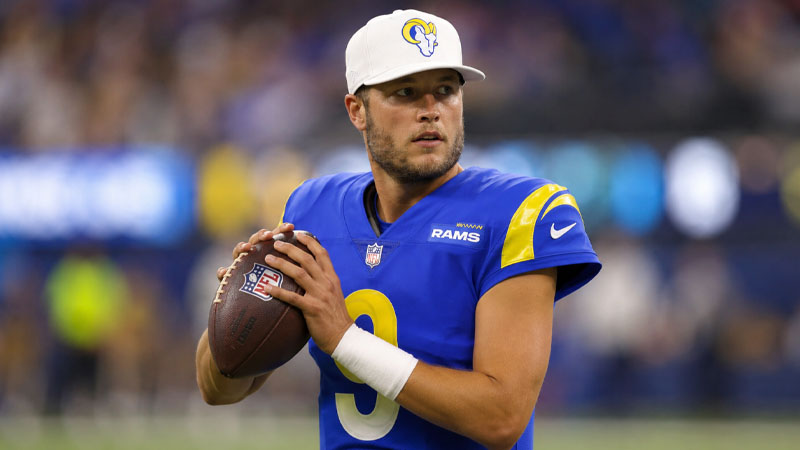
The modern sports landscape demands that organizations balance two conflicting goals: maximizing a championship window in the present while securing the franchise’s future.
In professional football, no position exemplifies this challenge more than the quarterback. The Los Angeles Rams find themselves at this exact strategic crossroads.
Following an award-winning campaign, the organization has chosen a dual-timeline strategy that secures their elite, veteran leadership while proactively establishing a contingency plan.
This analysis examines the mechanics of this strategy, looking at the financial commitments, developmental timelines, and long-term planning of the franchise.
The Financial Commitment: Stafford’s Extension and the Cost of Championship Contention
To understand the trajectory of the franchise, one must first analyze the financial architecture of Matthew Stafford’s presence.
Following his highly successful 2025 campaign, which culminated in winning the league’s Most Valuable Player award, speculation regarding his potential exit or retirement began to circulate.
This speculation was officially addressed in May 2026, when Stafford and the front office finalized a one-year, $55 million contract extension.
This agreement extends Stafford’s commitment to the franchise through the 2027 season, ensuring he remains the foundation of the offense. The financial details of the revised contract illustrate a deliberate, year-by-year planning structure:
- 2026 Compensation: $45 million
- 2027 Compensation: $50 million
From an organizational standpoint, committing $95 million over a two-year span to a single player is a significant investment. However, this capital allocation is justified by Stafford’s elite performance and the stability he provides.
Rather than locking the team into a rigid, long-term financial position that could hinder future roster construction, the extension establishes a clear, manageable horizon. It provides the team with immediate high-level stability while maintaining flexibility as they monitor Stafford’s longevity.
The Present: Sustaining Elite Play in a Year-to-Year Window
As Stafford enters his 18th league season in 2026, his approach to his career has transitioned into a highly calculated, year-to-year evaluation.
Elite quarterbacks approaching age 40 must constantly balance physical demands with competitive drive.
Stafford has noted that his future remains a year-to-year decision, a perspective shaped by observing late-career models of longevity.
Specifically, he has drawn inspiration from the career arcs of Drew Brees and Tom Brady, both of whom maintained elite performance late in their careers by modifying their physical preparation and mental execution.
                     [ Elite Veteran: Matthew Stafford ]
                               (Ages 38–40)
                                    |
                     +--------------+--------------+
                     |                             |
             [ 2026 Season ]               [ 2027 Season ]
             - Comp: $45M                  - Comp: $50M
             - Status: Active Starter      - Status: Contracted Starter
                     |                             |
                     +--------------+--------------+
                                    |
                    [ Transition & Mentorship Phase ]
                                    |
                                    v
                     [ Rookie Successor: Ty Simpson ]
                     (2026 First-Round Draft Choice)
The success of this year-to-year approach depends on the team’s overall competitiveness. Analysts like ESPN’s Dan Graziano have pointed out that Stafford is highly likely to continue playing beyond the 2026 season, provided the organization remains a legitimate contender.
The contract structure supports this view, offering a high-reward framework for 2027 if the team’s competitive window remains open.
The Durability Debate: Managing Risk and Fan Expectations
While the front office and coaching staff have expressed complete confidence in Stafford’s immediate outlook, public sentiment remains divided.
On community platforms such as Reddit, discussions regarding his long-term outlook are highly mixed.
This skepticism is primarily centered around his extensive physical history and the natural deceleration that typically affects pocket passers as they approach age 40.
For a franchise, managing this public uncertainty requires clear communication and visible risk mitigation. The organization cannot simply rely on optimism; they must implement practical safeguards.
By structuring Stafford’s extension with clear parameters and securing a high-potential backup option, the front office has addressed public concerns without undermining their starting quarterback’s authority.
Stafford remains the unquestioned leader of the team, yet the organization is prepared for any sudden changes in his availability.
The Future: Implementing the Successor Plan with Ty Simpson
The most definitive evidence of the organization’s dual-timeline planning arrived during the first round of the 2026 draft.
Rather than utilizing their premier draft capital to add immediate support pieces for their veteran starter, the front office selected quarterback Ty Simpson.
This decision represents a classic corporate transition strategy: hiring the successor well before the incumbent plans to step down.
This selection offers several strategic advantages:
- Immediate Insurance: Simpson provides high-quality backup support, addressing concerns regarding Stafford’s availability due to his physical history.
- Pressure-Free Development: Unlike rookies thrust into starting roles on struggling teams, Simpson enters a stable system. He can dedicate his early career to learning the complexities of the offense without the immediate pressure of saving a franchise.
- Mentorship Access: Developing behind a veteran player who has won both a championship and an MVP award is an invaluable developmental opportunity. Simpson can study Stafford’s preparation, decision-making, and pre-snap adjustments firsthand.
- Financial Alignment: Securing a quarterback on a rookie contract provides the team with significant financial relief in the future, helping balance the cap space required for Stafford’s near-term salary commitments.
Conclusion: A Case Study in Proactive Sports Leadership
The organization’s quarterback strategy is a clear example of forward-thinking roster construction. By extending Stafford’s contract, they have capitalized on his MVP-caliber play and kept their immediate championship window open.
Simultaneously, by draft-selecting Ty Simpson in the first round, they have prepared for the inevitable transition without disrupting their current chemistry.
This dual-path approach protects the team against sudden regression or injury while respecting the legacy and capability of their starting quarterback.
Regardless of when Stafford decides to step away, the franchise has built a foundation designed to maintain competitive stability for years to come.