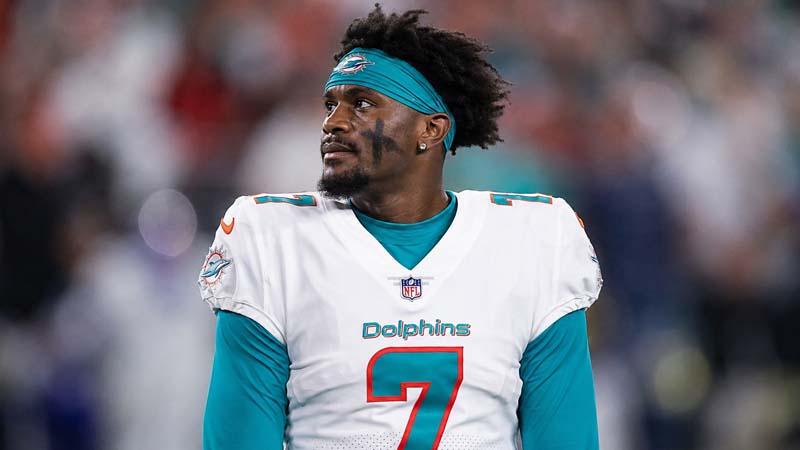
The financial commitment made by the Miami Dolphins to quarterback Malik Willis represents a significant transaction in the landscape of professional football finance.
By securing Willis on a three-year agreement valued at a total of $67.5 million, the organization has established a clear valuation framework for his role on the roster.
This contract carries an average annual salary of $22.5 million, a figure that places Willis within a specific tier of quarterback compensation.
To fully understand the leverage, risk distribution, and long-term planning of both the player and the franchise, one must look beyond the headline numbers.
A contract’s true impact is dictated by its underlying architecture: the timing of cash disbursements, the nature of the guarantees, the distribution of the signing bonus, and the specific yearly cap hits that the team must navigate.
This analysis provides an exhaustive breakdown of the documented contract terms, dissecting the mathematical relationships within the deal and examining how the structure provides immediate fiscal relief in the short term while requiring substantial budget allocation in the latter years.
Key Financial Indicators: The Headline Metrics
At the foundation of this contract are four primary financial pillars: the total contract value, the total guaranteed money, the upfront signing bonus, and the average annual salary.
Understanding how these four metrics interact is critical to evaluating the agreement’s overall balance.
| Financial Parameter | Contract Value | Percentage of Total Value |
|---|---|---|
| Total Contract Value | $67,500,000 | 100.00% |
| Total Guaranteed Money | $45,000,000 | 66.67% |
| Signing Bonus (Upfront Cash) | $22,250,000 | 32.96% |
| Average Annual Salary | $22,500,000 | 33.33% |
As illustrated in the data above, the contract allocates exactly two-thirds (66.67%) of its total value to guaranteed compensation.
This is a substantial guarantee ratio, ensuring that a significant portion of the contract remains secure regardless of future roster decisions or performance variables.
The upfront signing bonus of $22.25 million constitutes nearly one-third (32.96%) of the total agreement, providing the player with immediate liquidity upon execution of the contract.
Year-by-Year Financial Ledger
The overall contract is highly structured, with cash flows and salary cap hits shifting dramatically from the first year to the final year.
The following table provides the comprehensive year-by-year distribution of base salaries, bonuses, and cap hits as documented in the transaction terms.
| Year | Base Salary | Roster Bonus | Cap Hit | Guarantee Status |
|---|---|---|---|---|
| 2026 | $1,215,000 | $0 | $5,670,000 | Unspecified / Partial |
| 2027 | $21,500,000 | $0 | Unspecified | Fully Guaranteed |
| 2028 | $20,500,000 | $2,000,000 | Unspecified | Non-Guaranteed (Base) |
| Total | $43,215,000 | $2,000,000 | N/A | N/A |
Analysis of the 2026 Fiscal Year
The first year of the contract, 2026, is structured as a highly team-friendly entry period. Willis receives a base salary of $1.215 million, which represents a minimal cash outlay for a starting-tier quarterback. The salary cap hit for 2026 is established at $5.67 million.
The mathematical relationship between the 2026 base salary and the 2026 cap hit is of particular analytical interest. The difference between the cap hit ($5.67 million) and the base salary ($1.215 million) is exactly $4.455 million.
In professional football contract accounting, the cap hit is typically calculated by adding the base salary for that year to the portion of the signing bonus that is prorated over the length of the contract.
If we examine a standard equal proration of the $22.25 million signing bonus over the three-year duration of the contract, the yearly proration would equal approximately $7.417 million ($22.25 million divided by 3).
However, a cap hit of $5.67 million against a base salary of $1.215 million indicates that the allocation of the signing bonus to the 2026 cap is specifically designed at $4.455 million.
This structure allows the Dolphins to minimize the immediate cap impact of the transaction during the first year, preserving valuable financial resources for the surrounding roster.
Analysis of the 2027 Fiscal Year
In 2027, the contract undergoes a massive transition. The base salary skyrockets from $1.215 million to $21.5 million. Furthermore, this entire $21.5 million base salary is fully guaranteed.
This transition represents the core risk period for the organization and the core security period for the player.
By fully guaranteeing the $21.5 million base salary in the second year, the organization has effectively locked itself into Willis for at least the first two seasons of the agreement.
The base salary alone in 2027 exceeds the entire salary cap hit of the 2026 season by $15.83 million, illustrating the backloaded nature of the cash commitments.
Analysis of the 2028 Fiscal Year
The final year of the contract, 2028, features a base salary of $20.5 million. While this is a slight decrease of $1 million from the 2027 base salary, the contract introduces an additional financial mechanism: a $2 million roster bonus due in March 2028.
The total cash allocation scheduled for 2028 is therefore $22.5 million (comprising the $20.5 million base salary and the $2 million roster bonus). Because the 2028 base salary of $20.5 million is not documented as fully guaranteed, this final year represents a critical decision point for the franchise.
The inclusion of a roster bonus due in March ensures that the team must make an early-season determination regarding Willis’s status on the team before the league year begins, as the $2 million bonus would be triggered upon him remaining on the roster past the specified March deadline.
Mathematical Deconstruction of the Guarantee Structure
To evaluate the contract’s protective mechanisms for the player, we must dissect the components of the $45 million in total guaranteed money.
We know from the documented terms that:
- The total guaranteed amount is $45,000,000.
- The upfront signing bonus is $22,250,000.
- The 2027 base salary of $21,500,000 is fully guaranteed.
Let us examine the mathematical sum of these two confirmed guaranteed components: Signing Bonus + 2027 Guaranteed Base Salary = $22,250,000 + $21,500,000 = $43,750,000
This leaves a difference of exactly $1,250,000 to reach the total guaranteed figure of $45,000,000.
Total Guaranteed Money – Sum of Documented Guarantees = $45,000,000 – $43,750,000 = $1,250,000
This mathematical analysis suggests two primary possibilities under standard contract structures:
- Scenario A: The 2026 base salary of $1.215 million is fully guaranteed at signing, with the remaining $35,000 allocated to fully guaranteed minor bonuses or incentives.
- Scenario B: A specific portion of the 2028 base salary or roster bonus ($1.25 million) is guaranteed for injury or becomes fully guaranteed early in the contract life cycle.
The following table outlines the allocation of these guaranteed funds across the different categories of the contract:
| Guarantee Component | Amount | Percentage of Total Guarantees ($45M) | Percentage of Total Contract ($67.5M) |
|---|---|---|---|
| Signing Bonus | $22,250,000 | 49.44% | 32.96% |
| 2027 Base Salary | $21,500,000 | 47.78% | 31.85% |
| Unallocated Guarantees | $1,250,000 | 2.78% | 1.85% |
| Total Guaranteed Money | $45,000,000 | 100.00% | 66.67% |
Nearly half of the total guaranteed money (49.44%) is delivered immediately in the form of the signing bonus, while nearly the other half (47.78%) is tied to the 2027 season.
This ensures that Willis has a highly secure financial foundation over the first two years of the three-year term.
Strategic Implications for Franchise Roster Construction
The specific timing and structure of this contract highlight a deliberate fiscal strategy by the organization. By evaluating the year-by-year allocations, we can analyze the competitive advantages and potential challenges this structure creates.
1. Maximizing the 2026 Competitive Window
By establishing a low cap hit of $5.67 million in 2026, the organization has avoided the immediate financial strain that often accompanies high-value quarterback contracts.
This low cap hit provides the front office with the flexibility to allocate significant cap space to other positions, reinforcing the offensive line, defense, and skill positions to build a complete roster around Willis.
2. The 2027 Financial Commitment
The transition to 2027 represents a major step up in cap and cash commitments. With a fully guaranteed base salary of $21.5 million, Willis’s position on the roster is locked in.
Even if the franchise encounters roster changes or performance adjustments, the financial penalty for moving on from the contract prior to or during the 2027 season would be highly restrictive due to the fully guaranteed nature of the salary and the remaining dead money from the prorated signing bonus.
3. The March 2028 Decision Point
The inclusion of a $2 million roster bonus due in March 2028 serves as an intentional financial trigger. Roster bonuses due early in the league year are standard tools used by front offices to force decision-making.
By placing this deadline in March, the contract ensures that the organization must decide whether to retain Willis for the final year of the deal (at a cash cost of $22.5 million) or execute a trade or release before the roster bonus becomes active.
This provides the franchise with an exit path or a renegotiation window before committing the final year’s cash.
Detailed Comparison: Contractual Cash Flow vs. Cap Allocation
An effective way to visualize the mechanics of professional football contracts is to compare the actual cash received by the player against the accounting cap hit recorded by the franchise.
- Cash Flow: The actual money paid out by the organization to the player’s bank account within a specific calendar year.
- Cap Allocation: The accounting figure applied against the team’s total salary cap limit for that year.
The table below contrasts these two elements across the three-year term:
| Year | Actual Cash Flow to Player | Salary Cap Hit to Team | Difference (Cash vs. Cap) | Strategic Purpose of Difference |
|---|---|---|---|---|
| 2026 | $23,465,000 | $5,670,000 | +$17,795,000 | Minimizes immediate cap impact while delivering substantial upfront cash to secure the player’s commitment. |
| 2027 | $21,500,000 | Unspecified | N/A | Year of maximum commitment; base salary is fully guaranteed. |
| 2028 | $22,500,000 | Unspecified | N/A | High-value final year with early decision trigger via March roster bonus. |
| Total | $67,465,000 | N/A | N/A | Matches the total documented value of the three-year deal (excluding $35,000 in unallocated incentives). |
As the table shows, the cash flow is heavily frontloaded in 2026 due to the $22.25 million signing bonus being paid upfront, even though the cap hit for that year is kept remarkably low at $5.67 million.
This is a classic “cap smoothing” technique used by sophisticated front offices to remain competitive in the short term.
Conclusion: A Balanced, Strategic Transaction
The three-year, $67.5 million contract secured by Malik Willis with the Miami Dolphins is a textbook example of modern professional football contract design.
It successfully balances the immediate cash-flow needs of the player with the short-term salary cap requirements of the franchise.
By structuring 2026 with a low base salary of $1.215 million and a cap hit of $5.67 million, the Dolphins’ front office preserved the financial flexibility necessary to maintain a competitive roster around their quarterback.
However, this flexibility comes at the cost of high guaranteed commitments in the outer years, specifically the fully guaranteed $21.5 million base salary in 2027.
Ultimately, the contract establishes a clear timeline for evaluation. The franchise has a highly affordable window in 2026, a firm commitment in 2027, and a flexible exit or renewal point in March 2028 before the $2 million roster bonus is triggered.
This structure ensures that both player and team have clear financial protections and logical decision points throughout the life of the agreement.