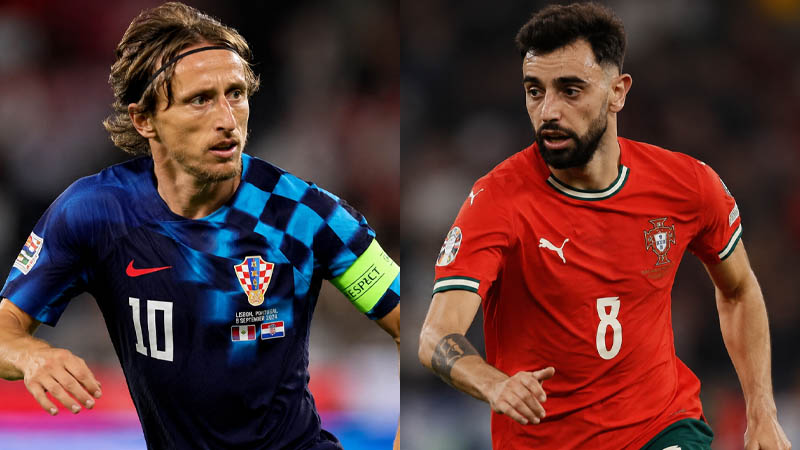
Luka Modrić and Bruno Fernandes represent the pinnacle of modern midfield play, yet they operate on opposite ends of the tactical spectrum.
Modrić, often hailed as “The Maestro,” is a deep-lying tempo controller who manages the game’s rhythm through unparalleled structural awareness and elite press resistance.
In contrast, Bruno Fernandes is “The Maverick,” an aggressive attacking midfielder who thrives on final-third chaos and high-risk, high-reward creativity.
This comprehensive analysis explores their tactical nuances, career-defining statistics, and the distinct legacies they have carved into football history to determine how their different styles influence the beautiful game.
Decoding the Tactical Archetypes: Maestro vs. Maverick
Understanding the comparison between Luka Modrić and Bruno Fernandes requires a departure from traditional goal-and-assist metrics to look at the fundamental roles they inhabit on the pitch.
While both are classified as midfielders, their heat maps and tactical responsibilities reveal two entirely different approaches to the sport.
Luka Modrić: The Art of Structural Control
As a “Maestro,” Luka Modrić functions primarily as a central midfielder (No. 8), acting as the bridge between defense and attack. His game is built on precision, positional play, and the ability to navigate high-pressure situations with ease.
Modrić is famous for his “trivela”—an outside-of-the-foot pass—which he uses to bypass defensive blocks and progress the ball out of dangerous areas.
His value lies in his ability to dictate the tempo of a match, ensuring his team maintains possession and structural integrity even against the world’s most aggressive pressing systems.
Bruno Fernandes: The High-Volume Creative Catalyst
Bruno Fernandes operates as a “Maverick,” typically positioned as an advanced attacking midfielder (No. 10) or even a second striker.
His primary objective is to create immediate goal-scoring opportunities, often opting for high-tariff passes that have a lower completion rate but a higher impact.
While Modrić values the safety and rhythm of a 90% pass accuracy, Fernandes accepts an 83% accuracy because his missed passes are often ambitious through-balls meant to break a defensive line.
He is a volume-based player, meaning the more he touches the ball, the more likely his team is to score, regardless of how many times possession is lost in the process.
Statistical Deep-Dive: Raw Production and Efficiency
When comparing the careers of these two icons, the data reveals a stark contrast between Modrić’s longevity and control versus Fernandes’ explosive offensive output.
The numbers illustrate that while Fernandes is the more “productive” player in terms of direct goal contributions, Modrić’s influence is often found in the “unseen” metrics of football.
All-Time Career Metrics Comparison
The following data reflects their senior career breakdown, incorporating all official club competitions and senior international matches through the 2025–26 season:
| Statistical Category | Luka Modrić (Age 40) | Bruno Fernandes (Age 31) |
|---|---|---|
| Total Senior Appearances | 1,130 | 694 |
| Total Career Goals | 128 | 219 |
| Total Career Assists | 174 | 198 |
| Total Goal Contributions (G+A) | 302 | 417 |
| Goal Contribution per Game | 0.27 | 0.60 |
This data highlights that Fernandes averages a goal or assist roughly every 150 minutes across his entire career, a rate that rivals elite forwards.
Modrić, by contrast, produces a lower volume of direct contributions because his mastery is measured in “hockey-assists”—the crucial pass before the assist—and the ability to transition the team from a defensive state to an offensive one.
Comparing the 2025–26 Campaign: Milan vs. Manchester
The 2025–26 season provided a unique snapshot of these two players at different stages of their careers.
Modrić, at age 40, completed a successful debut season in Serie A with AC Milan, while Fernandes continued his role as the talismanic captain for Manchester United in the Premier League.
| Stat (League Totals) | Luka Modrić (AC Milan) | Bruno Fernandes (Man Utd) |
|---|---|---|
| Appearances (Minutes) | 34 (2,821) | 35 (3,068) |
| Goals | 2 | 9 |
| Assists | 3 | 21 |
| Chances Created | 45 | 117 |
| Pass Accuracy % | 90% | 83% |
| Successful Long Passes | 61 | 65 |
Analysis of Seasonal Impact
During this campaign, Fernandes showcased his status as the primary creative hub for United, leading Europe in several playmaking metrics with 117 chances created.
Modrić, meanwhile, provided the structural backbone for AC Milan, maintaining a elite 90% pass accuracy while attempting more total passes (2,029) than Fernandes (1,701), proving that even at 40, his ability to control the ball remains world-class.
International Impact and Leadership
Both players are the heartbeat of their respective nations, but their international legacies are defined by different milestones.
Modrić is a legendary figure who has redefined what is possible for a small nation like Croatia, while Fernandes is a central pillar of Portugal’s modern “Golden Generation”.
Modrić’s Croatian Legacy
Luka Modrić is arguably the greatest player in Croatian history, having earned 176 appearances and scoring 26 goals. His leadership was the driving force behind Croatia’s historic run to the 2018 World Cup Final and their third-place finish in 2022.
His ability to lead through exhaustion and high-stakes penalty shootouts has cemented his status as one of the most respected captains in the history of international football.
Fernandes’ Role in the Portugal Era
For Portugal, Bruno Fernandes has become the chief orchestrator, recording 24 goals and 22 assists in just 66 appearances. His efficiency on the international stage is remarkably high, often acting as the bridge between a star-studded midfield and a clinical frontline.
He was also a key member of the squad that won the UEFA Nations League, further adding to his international pedigree.
Trophies and Individual Accolades
A player’s greatness is often measured by the silverware they bring to their clubs. In this category, Modrić possesses one of the most decorated trophy cabinets in the history of the sport, largely due to his twelve-year orchestration at Real Madrid.
The Modrić Trophy Cabinet
Luka Modrić’s career is defined by team success at the highest level. His achievements include:
- 6x UEFA Champions League Titles
- 1x Ballon d’Or (2018)
- The Best FIFA Men’s Player (2018)
- 5x Croatia Player of the Year
- Multiple La Liga and Copa del Rey titles
Modrić is often credited with “giving more titles” to his teams because his style of play elevates the performance of everyone around him, creating a cohesive unit that is difficult to beat in knockout competitions.
The Fernandes Individual Standard
While Fernandes lacks the extensive Champions League collection of Modrić, his individual impact at Manchester United has been historic. His accolades include:
- 4x Sir Matt Busby Player of the Year
- UEFA Nations League Winner
- Europa League Top Scorer (2019/20)
- 2x Footballer of the Year (Portugal)
Fernandes has been the “carrying force” for Manchester United during a period of transition, consistently putting up numbers that make him the most dangerous attacking midfielder in the Premier League.
The Final Verdict: Control or Chaos?
Choosing between Luka Modrić and Bruno Fernandes is not a matter of who is “better,” but rather what a team requires to win.
The “Maestro” provides the stability and rhythm needed to dominate possession, while the “Maverick” provides the spark of genius needed to break a deadlock.
When to Choose the Maestro
If a manager wants to control the game from start to finish, minimize turnovers, and build a team around structural integrity, Modrić is the ultimate choice.
His 90% pass accuracy and press resistance make him the perfect general for a team that values technical superiority and game management.
When to Choose the Maverick
If a team struggles to score and needs a player who can produce a moment of magic out of nothing, Fernandes is the ideal candidate.
His high-volume chance creation and 0.60 goal contribution per game ensure that the opposition is constantly under pressure, even if it means sacrificing some defensive stability.
Frequently Asked Questions
Who has more goals and assists in their career?
Bruno Fernandes has significantly more direct goal contributions. Despite having played fewer matches (694 vs 1,130), Fernandes has 219 goals and 198 assists, compared to Modrić’s 128 goals and 174 assists.
How does Modrić’s age affect his performance?
Remarkably, at age 40, Modrić continues to perform at an elite level. In the 2025–26 season, he completed over 2,000 passes with a 90% accuracy rate for AC Milan, proving that his technical skill and fitness allow him to remain a top-tier “Maestro” long after most midfielders have retired.
Why is Fernandes’ pass accuracy lower than Modrić’s?
This is due to their tactical roles. Fernandes plays as a No. 10 and attempts high-risk passes to create goals, which are naturally intercepted more often. Modrić plays as a No. 8, where maintaining possession and recycling the ball is the primary objective.
Which player has won more international honors?
Luka Modrić has reached a World Cup Final (2018) and a third-place finish (2022). Bruno Fernandes won the UEFA Nations League with Portugal in 2019.