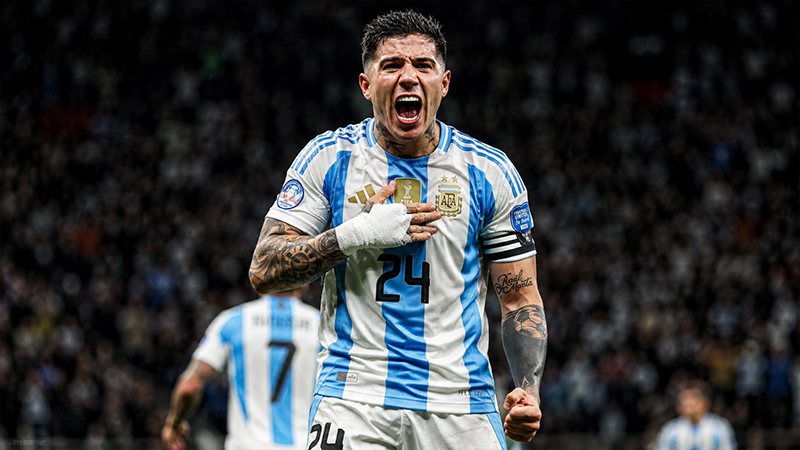
In the modern landscape of elite football, few players have sparked as much debate and fascination as Enzo Fernández. At 25 years old, the Argentine international has ascended to the captaincy of Chelsea FC.
This role demands more than just technical skill—it requires a level of consistency, leadership, and tactical intelligence that few possess at such an age.
To answer whether he is “good” is to look past the surface-level noise of transfer fees and instead examine the objective data and tactical shifts that define his career as of 2026.
This analysis explores the multifaceted nature of his game, his evolution under different tactical systems, and the underlying metrics that solidify his status as one of the world’s premier midfielders.
The Engine Room: Elite Passing and Tempo Control
At the heart of his game lies a technical proficiency that few can replicate. He is not merely a passer of the football; he is a director of play. His primary strength is an elite passing range that allows him to dictate the rhythm of a match from the deepest areas of the pitch.
His statistical profile consistently places him among the global elite for progressive passes and total touches.
In a modern system, a “progressive pass” is a critical metric; it measures the ability to move the ball significantly toward the opponent’s goal, bypassing defensive lines and accelerating the transition from defense to attack. For the Argentine, this isn’t just about distance—it’s about precision and timing.
By maintaining a high volume of touches, he ensures that his team remains in control. This technical security is a stabilizer for his teammates.
When the opposition applies high-intensity pressure, he serves as the primary outlet, using his vision to find teammates in space that others might not even see.
This ability to “dictate play from deep” has been a hallmark of his profile since his emergence on the global stage.
Tactical Versatility: The Evolution to a Modern Number 10
One of the most compelling arguments for his quality is his adaptability. Initially recognized as a traditional deep-lying playmaker, or regista, his role has undergone a significant transformation under the guidance of Chelsea manager Enzo Maresca.
During the 2024-2025 season, a deliberate shift was made to push him further forward into an attacking midfield role, often referred to as a “number 10”. The results were immediate and measurable.
By operating closer to the final third, he has seen an “increasing contribution to goals and assists”. This evolution proves that he is not a one-dimensional player confined to the base of a midfield.
His skillset allows him to thrive in these advanced positions because his vision—honed in deeper roles—translates perfectly into identifying gaps in a crowded penalty area.
Whether it is a weighted through-ball or a late run into the box, his impact on goal-scoring sequences has become a vital component of the team’s offensive strategy.
The Defensive Profile: Intensity and Ground Coverage
While his elegance on the ball often takes the spotlight, his defensive contributions are equally significant. He is characterized by a “high work rate” and a relentless intensity when it comes to winning the ball back.
In the high-stakes environment of the Premier League, a midfielder cannot survive on technical ability alone. They must be athletes capable of covering immense ground.
He excels in this regard, consistently demonstrating the stamina and “intensity” required to disrupt opposition play and regain possession for his side.
This defensive grit is what makes him such a valuable asset in a double-pivot system. He provides the necessary physical presence to shield the defense while simultaneously possessing the technical tools to immediately launch a counter-attack once the ball is won.
He is a rare “complete” midfielder who refuses to compromise on either side of the ball.
Synergistic Impact: The Importance of System and Partners
The question of whether a player is “good” often depends on their environment. Analysis shows that his performance is significantly “enhanced when playing alongside comfortable midfield partners”.
This was most evident in the Argentine national team, where a balanced midfield allowed him to express his full range of abilities.
The 2024-2025 season at Chelsea mirrored this success. By utilizing a system that encouraged him to advance and take risks, his statistical output reached new heights. This highlights a crucial point: he is an “accelerant” for a team.
In a well-structured system, he elevates everyone around him. His proven pedigree, most notably as a “crucial part of Argentina’s 2022 World Cup-winning squad,” serves as a testament to his ability to perform at the absolute highest level when the stakes are at their peak.
Leadership and Intangibles: The 25-Year-Old Captain
Leadership is often the most difficult quality to quantify, yet it is perhaps the most visible in his current career phase. Being named captain of a club with the stature of Chelsea at age 25 is no small feat. It speaks to a maturity and tactical understanding that transcends his years.
On the pitch, this leadership manifests as tactical discipline. He is the coach’s voice on the field, organizing the shape of the midfield and ensuring that the team remains compact.
This intangible quality, combined with his “proven pedigree,” makes him an indispensable pillar of the club’s long-term project.
Frequently Asked Questions (FAQ)
Is Enzo Fernández better as a defensive or attacking midfielder?
He is a versatile asset who excels in both roles. While he rose to prominence as a deep-lying playmaker capable of dictating tempo, his recent shift into a more advanced “number 10” role has seen him become a major threat in terms of goals and assists.
His best position is often within a double-pivot that allows him the freedom to roam and advance into the final third.
What are his most significant statistical strengths?
He consistently ranks among the top midfielders globally for touches and progressive passes. This indicates that he is central to his team’s build-up play and is highly effective at moving the ball into dangerous attacking positions.
How does his work rate compare to other elite midfielders?
He is known for a “high work rate” and “intensity in winning the ball back”. Unlike some creative players who may be less active defensively, he is willing to cover significant ground and contribute to the team’s defensive structure.
What role did he play in Argentina’s World Cup success?
He was a “crucial part” of the 2022 World Cup-winning squad. His ability to provide technical control and defensive stability on the world’s biggest stage was a major factor in Argentina’s victory and established his reputation as a world-class talent.
Conclusion: The Verdict
To judge his quality, one must look at the totality of his impact. He is a player who offers “elite passing range,” “tactical versatility,” and a “high work rate”.
Whether he is controlling the tempo from the base of the midfield or creating goal-scoring opportunities as an attacking threat, his influence is undeniable.
As of 2026, he has moved beyond the label of a “talented youngster” and has firmly established himself as a world-class leader and a tactical cornerstone for both club and country. He is not just “good”—he is the benchmark for what a modern, complete midfielder should be.