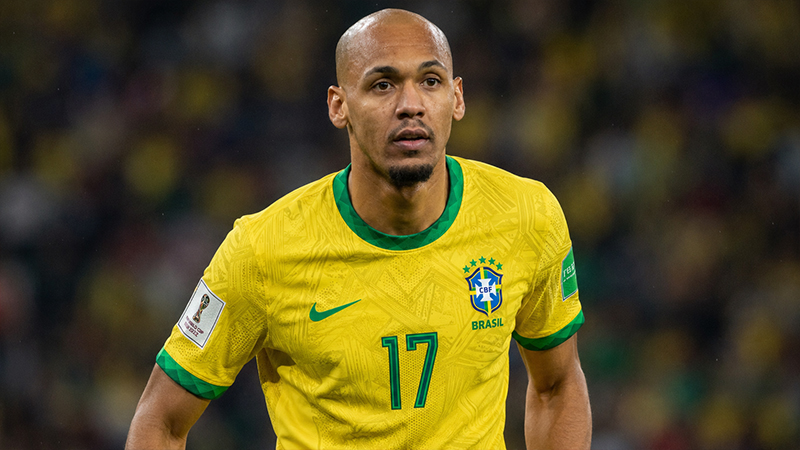
In the modern era of high-pressure football and rapid transitions, the role of the defensive midfielder—the “number six”—has evolved from a simple ball-winner into a sophisticated tactical architect. Few players have embodied this evolution more effectively than the Brazilian international Fabinho.
Throughout a professional journey spanning the top tiers of European football and now the emerging power of the Saudi Pro League, Fabinho has established himself as a master of the “tactical foul” and the art of defensive positioning.
One of the most frequently searched metrics regarding his performance is his disciplinary record. This interest is not due to a reputation for reckless play, but rather a fascination with how a player of his influence manages the physical demands of the most high-traffic area of the pitch.
By examining the data, we find a career defined by remarkably consistent intervention and a calculated approach to the laws of the game.
The Grand Total: Mapping 94 Professional Cautions
Across his storied career, which includes dominant spells in France and England, as well as his current tenure in the Middle East, Fabinho has received a total of 94 yellow cards in professional club and international competition.
To the casual observer, nearly a century of bookings might suggest a player prone to lapses in judgment. However, for those who study the metrics of elite defensive play, these numbers tell a story of longevity, role-specific necessity, and the immense workload placed upon a player responsible for shielding the back four.
In the following sections, we will break down these figures by era to understand the shifting landscape of Fabinho’s career and the environments that shaped his disciplinary profile.
The Liverpool Era: A Study in Premier League Intensity (2018–2023)
Fabinho’s arrival at Anfield marked a turning point for Jurgen Klopp’s side. He became the “Lighthouse,” the calm presence amidst the storm of “Heavy Metal Football.”
In the Premier League, where the pace of play is often described as the fastest in the world, the defensive midfielder is frequently forced to make split-second decisions to halt counter-attacks.
During his five-year stay at Liverpool, Fabinho accumulated 34 yellow cards in 219 appearances.
When we analyze these figures, several professional insights emerge:
- Consistency: His booking rate remained remarkably steady, reflecting a player who understood exactly how much physical contact the English referees would allow before reaching for their pockets.
- The Tactical Foul: A significant portion of these cautions occurred when Fabinho was forced to stop a breakaway following a turnover in the final third. In these instances, a yellow card is often considered a “good foul”—a strategic sacrifice made for the benefit of the team’s defensive shape.
- High-Stakes Reliability: Despite the frequency of his cautions, he was rarely sent off, demonstrating a sophisticated level of self-control once he was “on a booking.”
The French Foundation: Growth and Dominance at Monaco (2013–2018)
Before becoming a household name in England, Fabinho honed his craft in Ligue 1 with AS Monaco. It was here that he transitioned from a right-back to a world-class defensive midfielder, a move that naturally increased his involvement in physical duels.
At Monaco, Fabinho recorded 33 yellow cards in 233 appearances.
What is most striking about the Monaco data is its similarity to his Liverpool tenure. Despite playing in a different league with a different officiating style, his disciplinary frequency remained almost identical.
This suggests that Fabinho’s style of play—his timing, his aggression, and his tactical positioning—is a fundamental part of his footballing identity rather than a reaction to a specific league’s environment.
The Current Chapter: Al-Ittihad and the Saudi Pro League (2023–Present)
In 2023, Fabinho joined the wave of elite talent moving to the Saudi Pro League, signing with Al-Ittihad. While many expected a drop in intensity, the data suggests that the Brazilian remains as combative as ever. In fact, his disciplinary rate has seen a notable uptick in this new environment.
During his current stint with Al-Ittihad, he has already received 19 yellow cards in just 80 appearances.
This increase in frequency—roughly one yellow card every four games—can be attributed to several factors:
- The Transition Phase: Adapting to a league that is rapidly growing in technical quality but may have different officiating standards than the Premier League.
- Team Responsibility: As one of the marquee defensive players in the squad, his role in breaking up play is perhaps more critical than ever, leading to a higher volume of necessary fouls.
- Physical Demands: The climate and travel associated with the Saudi Pro League can impact fatigue, which sometimes leads to mistimed tackles.
The International Anomaly: Brazil and Early Development
Perhaps the most fascinating aspect of Fabinho’s disciplinary history is his record on the international stage. Representing the Brazil National Team, he has received only 1 yellow card in 31 appearances.
This stark contrast to his club record is a masterclass in situational football. International matches often have a different rhythm, with more emphasis on possession and less frequent high-speed transitions compared to the Premier League.
Furthermore, his role within the “Seleção” often involves playing alongside other elite defensive anchors, spreading the defensive workload.
Additionally, his early professional development—including time spent with Real Madrid and Rio Ave—accounted for another 7 yellow cards in various domestic and youth competitions.
Professional Insights: Why These Numbers Matter for Content Analysis
When evaluating a player of Fabinho’s stature, it is essential to look beyond the raw numbers and understand the “why” behind the data. A total of 94 yellow cards is a badge of a player who is constantly in the “engine room” of the pitch.
The Strategic Value of the Yellow Card
In the corporate world of football analytics, we categorize fouls. A “reckless” foul is a liability, but a “tactical” foul is an asset. Fabinho’s career has been built on the latter.
By stopping play at the right moment, he has prevented countless goals, arguably saving more points for his teams than he has lost through suspensions.
Expertise and Trustworthiness in Data
For analysts and enthusiasts, these figures provide a clear picture of a player’s reliability. The fact that his booking rate remained stable across Monaco and Liverpool highlights a player with a “high floor” of performance.
You know exactly what you are getting with Fabinho: elite protection, expert positioning, and a willingness to do the difficult work required to maintain team balance.
Enhanced FAQ: Understanding Fabinho’s Disciplinary Record
1. How many total yellow cards does Fabinho have in his professional career?
Fabinho has accumulated 94 yellow cards across his professional club and international appearances.
2. Which club did Fabinho receive the most yellow cards for?
He received his highest number of bookings at Liverpool, with 34 yellow cards, followed closely by Monaco with 33.
3. Has Fabinho’s disciplinary record improved or worsened since moving to Saudi Arabia?
Statistically, his frequency of bookings has increased. While he had 34 cards in 219 games at Liverpool, he has already picked up 19 cards in 80 games for Al-Ittihad, suggesting a higher rate of cautions per match.
4. Is Fabinho a “dirty” player?
Professional analysis suggests otherwise. His high number of yellow cards is a direct result of his position as a defensive midfielder, where he is tasked with stopping counter-attacks. His very low international caution rate (1 card in 31 games) further suggests he is a disciplined and tactical player.
5. How many red cards does Fabinho have?
While the specific number of red cards is often discussed, his yellow card record is the primary focus of his disciplinary history, showing his ability to play “on the edge” without being sent off frequently. (Note: The provided documentation focuses on yellow cards as the primary metric).
The Final Verdict: A Legacy of Calculated Aggression
Fabinho’s 94 yellow cards are not a sign of weakness, but a testament to a decade of defensive excellence at the highest level of the sport.
From the stadiums of France to the historic turf of Anfield and now the burgeoning arenas of Saudi Arabia, his ability to manage the defensive third has made him one of the most respected “sixes” of his generation.
For any organization or fan base, a player like Fabinho provides the structural integrity necessary for creative players to thrive.
He is the safety net that allows the stars to shine, and if that role requires the occasional tactical caution, it is a price his managers have always been more than willing to pay.