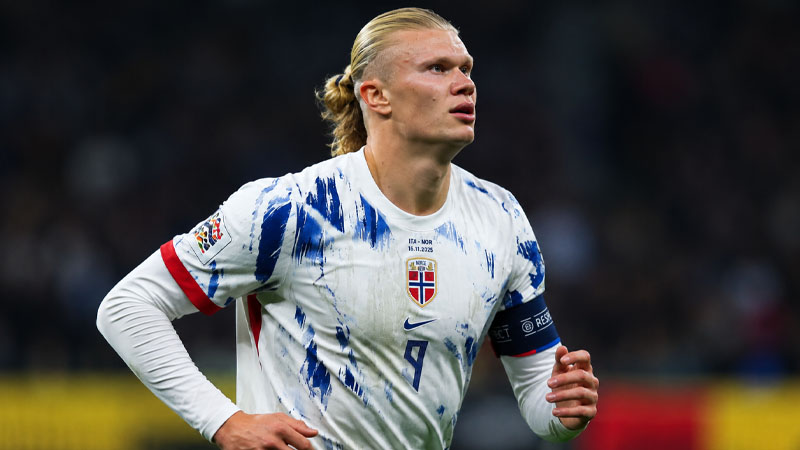
Erling Haaland has redefined the modern striker, combining physical dominance with clinical precision. While he is synonymous with the Norwegian flag, his origins are a frequent topic of debate among fans and analysts alike.
Born in the heart of West Yorkshire, the Manchester City talisman possesses a background that technically allowed him to represent one of football’s most storied nations: England. However, his heart and sporting allegiance belong elsewhere.
This article explores the complex layers of Haaland’s nationality, the technicalities of his eligibility, and the personal reasons behind his unwavering commitment to the Norwegian national team.
The Birthplace Technicality: Born in Leeds
The geographical origin of Erling Haaland is often a point of surprise for casual football observers.
While he is the face of Norwegian football, his entry into the world took place in England, creating a unique dual-eligibility scenario that could have altered the landscape of international football.
The Yorkshire Connection
Erling Haaland was born on July 21, 2000, in Leeds, England. This occurred during his father Alf-Inge Haaland’s tenure at Leeds United.
Because he was born on English soil, Haaland possessed the “Birthplace Eligibility” profile category, which technically made him eligible to play for the English national team.
This legal standing is a common occurrence in professional football, where the children of expatriate athletes often find themselves with multiple national options.
The Window of Opportunity for England
For a brief period during his meteoric rise at Red Bull Salzburg, there was quiet speculation regarding whether the Football Association (FA) would approach the young striker.
Under FIFA rules, a player with multiple nationalities can choose which country to represent at the senior level, provided they have not played a competitive senior match for another nation.
Given England’s vast scouting network, the prospect of Haaland leading the line alongside Harry Kane was a tantalizing “what-if” for English supporters.
Why Haaland Chose Norway Over England
Despite the technical possibility of wearing the Three Lions jersey, Haaland’s decision to represent Norway was never truly in doubt. His choice was rooted in a deep sense of national identity and a familial legacy that spanned generations.
A Return to His Roots
Although born in England, Haaland’s residency there was relatively short-lived. His family moved back to Norway when he was only four years old. Those formative years are critical for developing a sense of cultural belonging and national pride.
Growing up in Bryne, Norway, he was immersed in the Norwegian sporting culture, which prioritizes community and grassroots development.
Familial Legacy and Identity
The decision was also influenced by his father’s career. Alf-Inge Haaland was a stalwart for the Norway National Football Team, earning 34 caps during his career. For the younger Haaland, following in his father’s footsteps was a natural progression.
By the time he reached the age where international scouts were watching, his primary nationality was firmly established as Norwegian. He had already begun representing Norway at various youth levels, cementing his path toward the senior squad.
Analyzing the International Eligibility Framework
To understand how a player like Haaland navigates these choices, it is essential to look at the regulatory environment established by football’s governing bodies. The criteria for nationality in football are more nuanced than simple citizenship.
| Eligibility Factor | Erling Haaland’s Status |
|---|---|
| Primary Nationality | Norwegian |
| Place of Birth | Leeds, England |
| Residency | Norway (since age 4) |
| International Allegiance | Norway National Football Team |
The Role of FIFA Statutes
FIFA’s regulations regarding player eligibility are designed to prevent “mercenary” behavior while respecting genuine ties to a nation.
A player can generally represent a country if they meet one of four criteria: they were born in the territory, their biological parents were born there, their grandparents were born there, or they have lived there for at least five years after the age of 18.
In Haaland’s case, his birth in Leeds met the first criterion for England, but his heritage and upbringing met all criteria for Norway.
The Impact of Haaland on Norwegian Football
By choosing Norway, Haaland has not only stayed true to his identity but has also fundamentally shifted the prestige of Norwegian football on the global stage.
He has become a symbol of hope for a nation that has historically struggled to qualify for major tournaments.
Elevating the National Team Profile
Since making his debut, Haaland has been the cornerstone of the Norway National Football Team. His presence alone draws international attention to Norway’s fixtures, increasing broadcast revenue and sponsorship interest.
He is more than just a player; he is a sporting ambassador who has put Norwegian football back on the map, proving that world-class talent can emerge from smaller footballing nations.
Inspiring the Next Generation
The “Haaland Effect” is visible in the youth academies across Norway. Young players no longer feel the need to move to major European academies at age 10 to find success. Haaland’s journey from Bryne to the pinnacle of world football serves as a blueprint.
His commitment to the national team also sets a precedent for other dual-nationality players in the Norwegian system, encouraging them to choose their home nation over more traditionally dominant footballing powers.
The “What If” Scenario: Haaland in an England Shirt
It is impossible to discuss Haaland’s nationality without acknowledging the strategic impact he would have had on the England squad. Analysts often debate how his inclusion would have changed the tactical approach of manager Gareth Southgate.
Tactical Synergy with English Talent
Imagine a frontline featuring the creative output of Bukayo Saka, the playmaking of Jude Bellingham, and the finishing of Erling Haaland. While England has no shortage of talent, a striker of Haaland’s archetype—a pure, physical “number nine”—is a rarity.
His presence would have provided England with a different dimension, particularly in high-stakes knockout matches where a clinical edge is the difference between victory and exit.
The Competitive Balance of International Football
Haaland’s choice highlights a healthy aspect of the modern game: the distribution of elite talent.
If every dual-nationality player chose the highest-ranked nation available to them, the gap between the “giants” and the rest of the world would become insurmountable.
Haaland playing for Norway maintains a level of competitive unpredictability in European football, making the UEFA Nations League and Euro Qualifiers more compelling for global audiences.
Strategic Comparison: Haaland vs. Other Dual-Nationality Stars
Haaland is not the only modern superstar to face a difficult choice regarding his international allegiance. Comparing his path to others provides a broader context for how nationality is navigated in the 21st century.
- Declan Rice & Jack Grealish: Both players represented Ireland at youth levels before switching to England. Unlike Haaland, who felt a primary connection to Norway, these players felt their professional and personal growth was better served by the English setup.
- Jamal Musiala: Born in Germany but raised in England, Musiala eventually chose to represent Germany. This mirrors Haaland’s situation in reverse—choosing the birth nation over the nation of upbringing.
- Zlatan Ibrahimović: Often compared to Haaland for his physical style, Ibrahimović was eligible for Bosnia and Herzegovina and Croatia but chose Sweden, his place of birth and upbringing.
Frequently Asked Questions
Is Erling Haaland English?
Technically, Erling Haaland has English eligibility because he was born in Leeds. However, he does not hold himself out as English and has never represented England at any level. He is Norwegian by nationality, culture, and sporting choice.
Why does Haaland play for Norway?
He moved to Norway at the age of four and spent his entire childhood there. His father also represented Norway, and Erling has stated in various interviews that he feels 100% Norwegian.
His commitment to the Norway National Football Team is a reflection of his personal identity.
Could Haaland still switch to England?
No. Under current FIFA rules, once a player has participated in a competitive senior international match (such as a World Cup qualifier or a Nations League game), they are tied to that nation.
Haaland has played numerous competitive matches for Norway, making his allegiance permanent.
Where was Haaland’s father playing when he was born?
His father, Alf-Inge Haaland, was playing as a defender/midfielder for Leeds United in the Premier League at the time of Erling’s birth in 2000.
Does Haaland speak English fluently?
Yes, Haaland is exceptionally fluent in English. This is partly due to his birth in England and partly due to the high standard of English education in Norway, as well as his time playing in the Premier League with Manchester City.
Conclusion: A Legacy Defined by Choice
Erling Haaland’s nationality is a fascinating study of how birthplace, heritage, and personal choice intersect in the modern world.
While the “English (Born in Leeds)” tag remains a permanent fixture on his biographical profile, his legacy will forever be draped in the red, white, and blue of Norway.
His story serves as a reminder that in an increasingly globalized sport, nationality is often about more than just a passport; it is about where a player feels they truly belong. For Haaland, that place has always been Norway.
As he continues to break records and redefine what is possible for a striker, he does so as a proud Norwegian, proving that you don’t need to play for a traditional “powerhouse” nation to be the best in the world.