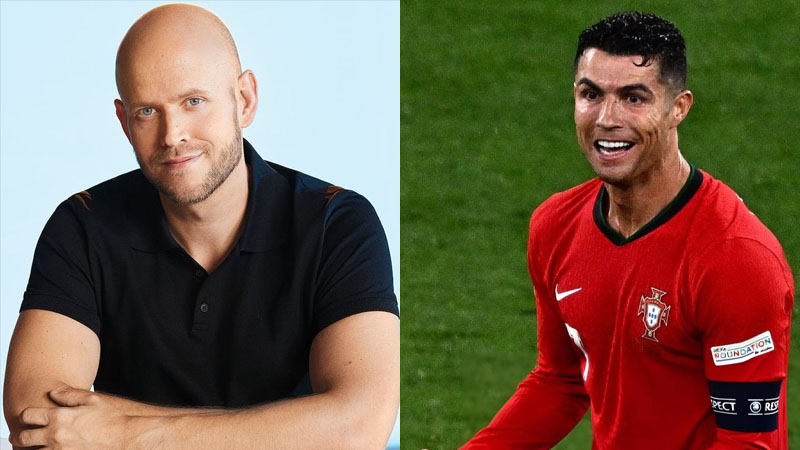
In the modern landscape of global influence, few figures loom as large as Daniel Ek and Cristiano Ronaldo.
One represents the architectural backbone of the digital audio revolution, while the other embodies the pinnacle of physical performance and personal branding.
Although they occupy different spheres—tech-driven streaming and elite professional football—their paths have come surprisingly close through shared business circles and philosophies.
This analysis explores how these two titans leverage data, discipline, and digital ecosystems to dominate their respective industries, offering a blueprint for high-frequency success that transcends the pitch and the playlist.
The Arsenal Takeover: A Strategic Intersection of Tech and Sport
The intersection of high-level technology and traditional sports management was nearly realized in 2021 when Daniel Ek set his sights on the Premier League.
This move highlighted a significant shift in how tech entrepreneurs view the value of legacy sports brands and their global reach.
The £2 Billion Ambition
Daniel Ek, a lifelong supporter of Arsenal, moved beyond fandom to active pursuit when he launched a £2 billion takeover bid for the club.
To ensure the bid carried cultural weight and institutional knowledge, he enlisted the support of legendary figures Thierry Henry and Dennis Bergkamp.
This attempt was more than a financial transaction; it was an effort to apply the data-driven, user-centric principles of Spotify to one of the world’s most storied football clubs.
Had the bid succeeded, Ek would have entered the same elite European football circle that Cristiano Ronaldo has dominated for over two decades.
Bridging the Gap Between Platforms and Pitches
While the bid was ultimately unsuccessful, the intent revealed a deep parallel in how Ek and Ronaldo view market dominance. For Ronaldo, dominance is achieved through goals and trophies; for Ek, it is achieved through market share and platform engagement.
The crossover of a tech visionary into the territory of a football icon signals a new era where the “product” is no longer just the game on the field, but the digital experience surrounding it.
This convergence suggests that the future of sports will be increasingly defined by the technological infrastructure that supports it.
Performance Parallels: The Elite Athlete Mentality
One of the most compelling links between Daniel Ek and Cristiano Ronaldo is the way Ek uses the athlete’s lifestyle as a framework for the creative industry. This philosophy has sparked significant discussion regarding the expectations placed on modern creators.
High-Frequency Creativity
Ek famously sparked controversy by suggesting that the music industry should mirror the professional sports world. He argued that modern musicians, much like elite athletes such as Ronaldo, cannot afford to be intermittent in their output.
According to Ek, the era of recording an album every three to four years and expecting to remain relevant is over. Instead, he advocates for a high-frequency work ethic, suggesting that continuous engagement is the only way to maintain a modern audience.
The Discipline of Consistency
This analogy draws directly from the legendary work ethic of Cristiano Ronaldo. Ronaldo is renowned for a “first in, last out” approach to training, a mindset that has allowed him to maintain peak performance into his late thirties.
By holding artists to this same standard, Ek is essentially treating the Spotify platform as a digital stadium where only those with “match-fit” consistency can thrive.
While this comparison has been met with resistance from those who view art as a slow, deliberative process, it reflects the reality of the attention economy that both Ek and Ronaldo navigate daily.
Comparing the Empires: A Data-Driven Breakdown
To understand the scale at which these two individuals operate, it is necessary to look at the hard data. While one manages a platform and the other manages a brand, the reach of both is truly global.
The following table provides a direct comparison of their primary roles, nationalities, and the massive ventures they have built beyond their initial success.
| Feature | Daniel Ek | Cristiano Ronaldo |
|---|---|---|
| Primary Field | Tech & Music Streaming | Professional Football |
| Key Role | Executive Chairman of Spotify | Forward for Al Nassr / Portugal |
| Nationality | Swedish | Portuguese |
| Global Reach Metric | 761 Million Active Users | Most-Followed Individual on Social Media |
| Major Venture 1 | Spotify | CR7 Brand (Hotels, Fitness, Apparel) |
| Major Venture 2 | Prima Materia (AI/Defense) | Ursu9 (Mineral Water) |
This comparison highlights that both men have moved far beyond their original “jobs.” They have become entities that influence lifestyle, health, and how we consume media on a minute-by-minute basis.
Digital Ecosystems and Global Reach
The relationship between Ek’s platform and Ronaldo’s brand is a symbiotic one, even without a formal partnership. The digital infrastructure provided by Spotify serves as a critical channel for the narrative surrounding Ronaldo’s career.
The Infrastructure of Sound
Daniel Ek has built a global utility. With over 761 million active users, Spotify is the primary medium through which the world consumes audio. This infrastructure does not just host music; it hosts the conversation.
When Ronaldo gives a viral interview or experiences a career milestone, the resulting analysis frequently drives top-charting sports podcasts and curated playlists directly on Ek’s platform.
In this way, Ronaldo’s physical actions on the pitch are converted into digital data and audio content that fuels Spotify’s engagement metrics.
The Power of Personal Branding
On the other side of the equation, Cristiano Ronaldo represents the peak of personal branding. He is currently the most-followed individual on social media platforms worldwide.
While Ek owns the “stadium” (the platform), Ronaldo is the “main event” who brings the crowd. This dynamic illustrates the shift in the modern economy: individuals with massive followings can now rival the influence of entire corporations.
However, as Ek’s analogy suggests, maintaining that following requires a level of output that mirrors the relentless nature of a tech algorithm.
Beyond the Core: Diversification Strategies
A hallmark of high-level success is the ability to diversify. Both Ek and Ronaldo have used their primary platforms to launch ventures that address global challenges and lifestyle needs.
Ek and the Future of AI
Daniel Ek’s interests extend far beyond the next hit song. Through his investment firm, Prima Materia, he is focusing on “moonshot” projects that involve artificial intelligence and European defense technology.
This represents a move toward solving complex, long-term societal problems. Ek is positioning himself not just as a music mogul, but as a strategic architect of the future’s technological landscape.
This pivot reflects a desire to create a legacy that is durable and foundational to society.
The CR7 Lifestyle Portfolio
Similarly, Cristiano Ronaldo has meticulously built the CR7 brand to ensure his relevance after his playing days conclude.
His portfolio includes a successful chain of hotels (Pestana CR7), fitness centers, apparel lines, and even a mineral water brand. Ronaldo is not just an athlete; he is a lifestyle curator.
By diversifying into tangible assets like real estate and consumer goods, he is insulating his wealth and influence from the inevitable decline of his athletic career.
Both men show that true mastery involves building systems that work even when you aren’t the one “on the field.”
Lessons for Modern Leadership and Entrepreneurship
The parallels between Daniel Ek and Cristiano Ronaldo offer valuable insights for leaders in any industry. Their success is not accidental; it is the result of specific, repeatable strategies centered on data and discipline.
Data-Informed Decision Making
For Ek, data is the lifeblood of Spotify’s recommendation engines and business strategies. For Ronaldo, data-informed recovery, nutrition, and performance tracking have extended his career significantly.
Both leaders demonstrate that intuition must be backed by hard evidence. Whether you are scaling a startup or optimizing your own health, the ability to interpret and act on data is a non-negotiable skill in the 21st century.
Building Global Scalability
Both figures have mastered the art of “going global.” Spotify was designed to be borderless from its inception in Sweden. Ronaldo has maintained his status while moving across leagues in Portugal, England, Spain, Italy, and Saudi Arabia.
Their careers teach us that to reach the highest levels, one must build a brand or a product that translates across cultures and languages. They focus on universal needs: the need for connection through music and the need for inspiration through sport.
Frequently Asked Questions
Are Daniel Ek and Cristiano Ronaldo business partners?
No, they do not have any direct personal relationship or collaborative business partnerships. Their connection lies in their shared dominance of the digital media and sports landscapes.
Why did Daniel Ek try to buy Arsenal?
As a lifelong fan, Ek wanted to bring his technological expertise and passion to the club. He felt his leadership could modernize the organization, and he enlisted the help of Arsenal legends to ensure he had the right footballing perspective.
What was the “Sports Analogy” controversy?
Daniel Ek argued that musicians should work at the same frequency as elite athletes like Ronaldo, releasing content much more frequently to stay relevant in the streaming era. This was controversial because many artists felt it prioritized quantity over quality.
How does Ronaldo influence Spotify if he doesn’t own it?
Ronaldo’s massive cultural presence means that his interviews, career news, and viral moments are the primary subjects of the most popular sports podcasts on Spotify. He provides the content that keeps the platform’s sports category active.
Final Thoughts: The Blueprint of the High-Frequency Leader
The comparison between Daniel Ek and Cristiano Ronaldo reveals a fundamental truth about modern greatness: it requires an architectural mind and an iconic work ethic.
Whether you are building the world’s largest audio platform or becoming the world’s most famous athlete, the requirements are the same—consistency, data-driven optimization, and a refusal to be limited by a single industry.
As we move further into a digital-first world, the lines between tech moguls and sporting icons will continue to blur. Leaders like Ek will look to the field for lessons in performance, while icons like Ronaldo will use tech to scale their influence.
By studying their paths, we can see that the road to global mastery is paved with high-frequency effort and a relentless drive to innovate.