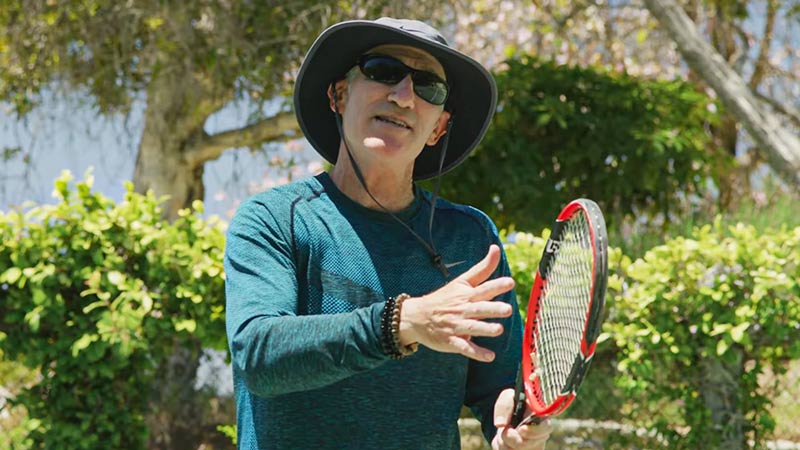
Brad Gilbert is not currently inducted into the International Tennis Hall of Fame.
Despite establishing a legendary status as a player, championship-level coach, and prominent media personality, he remains on the outside due to specific structural criteria and performance-based eligibility limitations.
While Gilbert reached a career-high of World No. 4 and secured 20 ATP titles alongside an Olympic bronze medal, he did not capture the required Grand Slam singles titles for modern player induction.
However, his multifaceted impact as the author of the tactical manual “Winning Ugly” and his transformative coaching of superstars ensures his candidacy remains a major point of discussion.
Why Brad Gilbert Is Not Currently in the International Tennis Hall of Fame
The primary reason Brad Gilbert has not been inducted into the International Tennis Hall of Fame (ITHF) in Newport involves the rigid eligibility requirements established for the Player Category.
The governing body utilizes a data-driven threshold that prioritizes major titles and historical rankings over general career longevity or consistency.
While Gilbert was undoubtedly one of the most dangerous players of his era, his resume does not align with the specific statistical benchmarks required for an automatic or traditional athlete induction.
The Strict Singles Player Eligibility Standards
To enter the International Tennis Hall of Fame as a singles player, a candidate must meet high-performance milestones.
Under the current rules, a player must have won at least three Grand Slam singles titles and spent at least 13 weeks at World No. 1, or alternatively, have won at least five Grand Slam singles titles.
These criteria are designed to honor only the most dominant forces in the history of the sport, creating a barrier for players who were elite but lacked a Major trophy.
Because Gilbert never captured a Grand Slam title during his thirteen-year professional career, he remains technically ineligible under these specific player-focused mandates.
Analyzing Gilbert’s Professional Playing Record
Despite lacking a Major, Gilbert’s career was characterized by exceptional achievements that many believe warrant consideration.
He reached a career-high ranking of World No. 4 on January 1, 1990, and maintained a position within the global top 10 for much of his prime. Over his career, he compiled a win-loss record of 519–288, resulting in a 64.3% win percentage.
His trophy cabinet includes 20 ATP singles titles and an Olympic bronze medal from the 1988 Seoul Games.
While he reached the quarterfinals at both the US Open in 1987 and Wimbledon in 1990, the absence of a semifinal or final appearance at a Major tournament keeps him outside the athlete-only induction path.
The Coaching Resume: A Blueprint for Hall of Fame Success
If the International Tennis Hall of Fame were to judge candidates solely on their ability to mentor and develop champions, Brad Gilbert would be considered a first-ballot inductee.
His transition from a top-tier player to a “Kingmaker” coach is almost unparalleled in modern tennis history. Gilbert possesses a unique ability to diagnose a player’s mental hurdles and provide a tactical roadmap to the top of the rankings.
Transforming Andre Agassi into a World Number One
The most famous example of Gilbert’s coaching prowess is his eight-year partnership with Andre Agassi, which lasted from 1994 to 2002.
When the two first met for dinner in 1994, Agassi was struggling with his form, recovering from wrist surgery, and had seen his ranking drop to World No. 30.
Gilbert famously overhauled Agassi’s entire approach to the game, teaching him to stop overcomplicating his tactics and instead focus on forcing his opponents into making unforced errors.
Under Gilbert’s guidance, Agassi achieved the World No. 1 ranking for the first time and won six of his eight career Grand Slam titles.
Guiding the Next Generation from Andy Roddick to Coco Gauff
Gilbert’s coaching success was not limited to a single player, as he proved his methods were adaptable to different styles and eras.
He guided Andy Roddick to the 2003 US Open title and the World No. 1 ranking, and later helped a young Andy Murray break into the top 10 of the ATP rankings.
More recently, Gilbert was instrumental in Coco Gauff’s 2023 summer surge, which culminated in her first Grand Slam title at the US Open.
Although they parted ways in September 2024 following a dip in Gauff’s form and serving mechanics, Gilbert’s impact on her mental toughness during her championship run remains a highlight of his recent career.
| Player Coached | Key Achievement Under Gilbert | Partnership Impact |
|---|---|---|
| Andre Agassi | 6 Grand Slam Titles & World No. 1 | Career resurrection from No. 30 to No. 1. |
| Andy Roddick | 2003 US Open Title & World No. 1 | Secured Roddick’s only career Major. |
| Andy Murray | Top 10 World Ranking | Early career tactical development. |
| Coco Gauff | 2023 US Open Title | Guided her to her first Grand Slam victory. |
The “Winning Ugly” Philosophy and Technical Legacy
Brad Gilbert’s influence on tennis extends far beyond the wins and losses recorded in his personal biography. He is credited with popularizing a specific brand of tactical awareness that shifted the focus from raw power to psychological intelligence.
This philosophy, often referred to as “Winning Ugly,” has become a foundational concept for competitive players at every level of the sport.
Mastering Psychological Warfare on the ATP Tour
During his playing days, Gilbert was renowned for his ability to defeat opponents who possessed superior physical weapons.
Lacking a dominant serve or a devastating groundstroke, he relied on movement, extreme consistency, and psychological warfare to outmaneuver his rivals.
His strategy centered on identifying an opponent’s mental flaws and changing ball paces to disrupt their rhythm. His most legendary victory occurred in 1986 when he upset World No. 2 John McEnroe.
The loss was so frustrating for McEnroe that he famously took a six-month hiatus from the sport, a testament to the effectiveness of Gilbert’s disruptive style.
Why “Winning Ugly” is the Sport’s Tactical Bible
Gilbert codified his strategic insights in his best-selling book, Winning Ugly, which remains one of the most influential tactical manuals in tennis history.
The book teaches players how to win matches by playing smarter rather than harder, emphasizing the importance of mental preparation and match management.
This contribution to the sport’s literature is a key pillar of his legacy. Many tennis historians argue that the book’s global success and its role in shaping the strategic minds of future generations elevate Gilbert from a mere player to a visionary of the game.
Exploring the Contributor Category for Future Induction
Given that the performance-based player criteria remain out of reach, the most realistic path for Brad Gilbert to enter the International Tennis Hall of Fame is through the Contributor Category.
This category is reserved for individuals who have made a multi-faceted and visionary impact on the growth and prestige of tennis.
Gilbert’s supporters argue that his combined resume as a top-5 player, a legendary coach, a best-selling author, and a veteran broadcaster makes him an ideal candidate for this honor.
A Visionary Voice in the Modern Broadcasting Booth
In addition to his playing and coaching, Gilbert has spent 23 years as a leading analyst and commentator, primarily with ESPN.
He is currently a prominent voice for the Tennis Channel and hosts The Big T Podcast, where he continues to offer deep strategic breakdowns of the modern game.
His ability to translate complex tactical concepts for a global audience has made him an essential part of the tennis media landscape.
He remains active in the sport, frequently providing public advice and analysis for contemporary stars like Jannik Sinner, Alexander Zverev, and Ben Shelton.
Correcting the Systemic “Coaching Flaw” in Newport
Gilbert himself has been vocal about the lack of recognition for coaches within the International Tennis Hall of Fame structure. He has publicly described the absence of a dedicated coaching category as a “ridiculous flaw” in the system.
He argues that elite coaches who fundamentally change the trajectories of multiple Hall of Fame players should have a direct path to enshrinement.
If such a category were established, Gilbert’s record of guiding three different players to the No. 1 ranking and helping them win a combined eight Grand Slam titles would likely make him a premier candidate.
Other Hall of Fame Recognitions for Brad Gilbert
While the International Tennis Hall of Fame has yet to nominate him, several other prestigious institutions have already recognized Gilbert’s immense contributions to the game.
These inductions serve as a formal acknowledgment of his total impact on regional and collegiate tennis.
- Bay Area Sports Hall of Fame (BASHOF): Inducted in 2019 for his global and regional contributions.
- ITA Men’s Collegiate Tennis Hall of Fame: Inducted in 2001 following his standout years at Pepperdine University.
- Northern California Tennis Hall of Fame: Inducted in 2001.
- Pepperdine University Athletics Hall of Fame: Inducted in 1989.
Frequently Asked Questions About Brad Gilbert’s Status
Did Brad Gilbert ever win a Grand Slam title?
No, he never won a Grand Slam title as a singles or doubles player. His best finishes were quarterfinal appearances at the 1987 US Open and 1990 Wimbledon. However, as a coach, he has been part of eight Grand Slam championship victories.
Why did Coco Gauff and Brad Gilbert stop working together?
The pair split in September 2024 after Gauff experienced a significant decline in form during the summer hard-court season.
While Gilbert provided exceptional mental strategy, Gauff struggled with technical serving mechanics and double faults, necessitating a coach who could focus on fundamental technical rebuilding.
Who are the most famous players Brad Gilbert coached?
His most notable pupils include Andre Agassi, Andy Roddick, Andy Murray, and Coco Gauff. He also coached several other top professionals throughout his multi-decade coaching career.
What is Brad Gilbert doing now?
After his split with Gauff, Gilbert has focused on his roles as a tactical analyst and media personality. He is a mainstay on the Tennis Channel and continues to provide expert commentary on major tournaments and player development.
The Future of the Newport Debate
The question of whether Brad Gilbert belongs in the International Tennis Hall of Fame often sparks debate between those who favor strict statistical standards and those who value overall impact.
As a player, he proved that intelligence can overcome power; as a coach, he proved that a change in mindset can create a champion; and as a broadcaster, he has educated a generation of fans.
Whether or not he receives a formal induction in Newport, his legacy as the master of “Winning Ugly” is permanently etched into the history of tennis. For many, his influence on the sport is already hall-of-fame worthy, regardless of an official plaque.