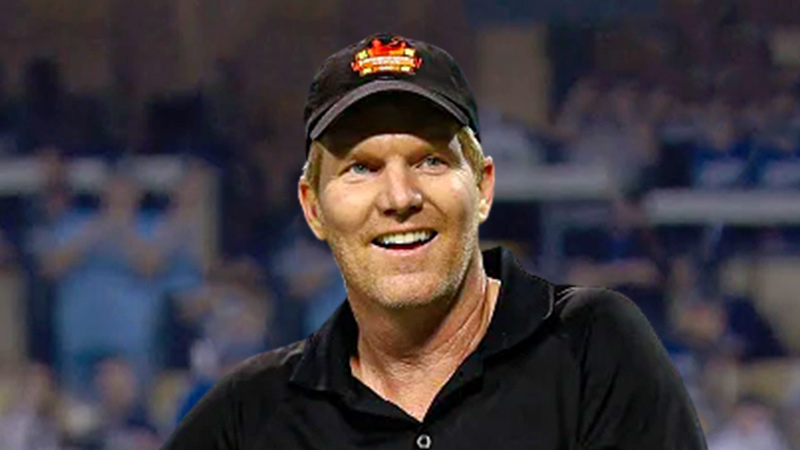
Jim Courier is a legendary figure in tennis history, known for his relentless baseline power and competitive grit. However, despite his immense success on other surfaces, Jim Courier never won the Wimbledon singles title.
While he captured four Grand Slam trophies at the Australian Open and Roland Garros, the grass of the All England Club remained his final unconquered frontier.
His closest brush with the Gentlemen’s Singles Trophy came in 1993, when he reached the final only to be defeated by Pete Sampras in a high-stakes, four-set battle on Independence Day.
Why Jim Courier’s 1993 Final Run Was Historic
The 1993 championships marked the absolute pinnacle of Courier’s career on the lawns of London.
Although he was primarily viewed as a specialist on slower surfaces, his performance that fortnight proved he could adapt his high-octane game to the quickest conditions in the sport.
This run was not just a personal best but a record-shattering achievement that etched his name into the history books for decades.
Becoming the Youngest to Reach All Four Major Finals
By defeating his opponents to reach the 1993 final at the age of 22 years and 11 months, Courier achieved a feat of remarkable consistency across all playing environments.
He became the youngest man in the Open Era to reach the singles finals of all four Grand Slam tournaments.
This milestone served as a testament to his versatility and durability, remaining an unbroken record for over thirty years. It was only recently surpassed in 2026 when Carlos Alcaraz reached the final of the Australian Open.
The Semifinal Masterclass Against Stefan Edberg
Courier’s path to the final was anything but easy, requiring him to go through one of the greatest grass-court players in history.
As the tournament’s third seed, he faced Stefan Edberg in a semifinal match that many experts consider some of the finest tennis Courier ever produced on turf.
He managed to dismantle Edberg’s legendary serve-and-volley game with a brilliant 4-6, 6-4, 6-2, 6-4 victory. This win gave fans and analysts alike the impression that Courier had finally decoded the secrets of winning on grass.
The Independence Day Showdown with Pete Sampras
The final, held on July 4th, 1993, featured an all-American clash between Courier and his fierce rival, Pete Sampras. Courier pushed Sampras to the absolute limit, engaging in a tactical battle characterized by two grueling opening-set tiebreaks.
Despite playing what he felt was the highest level of tennis of his life, Courier ultimately fell 7-6, 7-6, 3-6, 6-3.
This specific defeat was a turning point in tennis history, as it allowed Sampras to dethrone Courier as the World No. 1 later that year, signaling a major shift in the sport’s hierarchy.
Technical Challenges: Why Grass Was Courier’s Achilles’ Heel
To understand why a player of Courier’s caliber never lifted the trophy at SW19, one must look at the physical and technical demands of 1990s tennis.
During this era, the grass was notoriously soft, low-bouncing, and incredibly slick, which stood in direct opposition to the conditions where Courier’s game flourished.
He famously described the surface as feeling “awkward and uncomfortable” compared to the predictable bounces of hard courts or clay.
The Conflict of the Western Grip Forehand
Courier’s primary weapon was a heavy, western-grip forehand designed to crush high-bouncing balls on clay and hard courts.
On the slick grass of Wimbledon, however, the ball often stayed low and skidded through the court, forcing Courier to adjust his swing path significantly.
This technical misalignment meant he could not always dictate points from the baseline with the same authority he displayed in Paris or Melbourne, leaving him vulnerable to specialists who preferred the low bounce.
Adapting the Serve Ritual for Spongy Turf
One of the most unique insights into Courier’s struggle involves his meticulous pre-serve routine. He was famous for a ritual of bouncing the ball repeatedly before every serve to find his rhythm.
At Wimbledon, he was forced to actively alter this habit because the spongy, uneven nature of the grass made the ball bounce unpredictably.
This small but significant disruption to his muscle memory highlighted the mental and physical toll of competing on a surface that felt alien to his natural style.
Tactical Forgery: Abandoning the Baseline Comfort Zone
Perhaps the most impressive aspect of Courier’s 1993 run was his willingness to undergo a “tactical forgery.”
Recognizing that his baseline preference would not suffice on the slickest courts, he completely stepped out of his comfort zone to adopt a serve-and-volley strategy.
By constantly charging the net—a style he did not use frequently on other surfaces—he managed to survive the draw, though it was a style he was forced into by necessity rather than choice.
Jim Courier’s Year-by-Year Wimbledon Singles Performance
Despite the challenges of the surface, Courier maintained a respectable 19–11 singles record across 11 appearances at the All England Club.
While he reached the second week on several occasions, he was often susceptible to “giant killers” and grass specialists in the early rounds.
| Year | Seed | Result | Eliminating Opponent |
|---|---|---|---|
| 1989 | Unseeded | First Round | Bob Seguso |
| 1990 | #9 | Third Round | Mark Woodforde |
| 1991 | #4 | Quarterfinals | Michael Stich |
| 1992 | #1 | Third Round | Andrei Olhovskiy |
| 1993 | #3 | Runner-up | Pete Sampras |
| 1994 | #2 | Second Round | Guy Forget |
| 1995 | #12 | Second Round | Cédric Pioline |
| 1996 | #15 | First Round | Jonathan Stark |
| 1997 | Unseeded | First Round | Richey Reneberg |
| 1998 | Unseeded | First Round | Wayne Black |
| 1999 | Unseeded | Fourth Round | Tim Henman |
The data shows that apart from his 1993 masterpiece, his most consistent years were 1991, where he reached the quarterfinals before losing to eventual champion Michael Stich, and a late-career resurgence in 1999.
In 1999, an unseeded Courier battled through to the fourth round, eventually falling to British hero Tim Henman in a five-set heartbreaker.
Comparing Courier to Other Greats Who Never Won Wimbledon
Courier is part of an elite group of legendary champions who dominated the sport but could never quite find the winning formula on the lawns of London.
This group consists of players whose games were often optimized for different speeds and bounce heights, making the transition to the All England Club a perennial challenge.
The Elite Club of Multi-Slam Non-Winners
Several multiple-Grand Slam champions share Courier’s fate of never capturing the Wimbledon title. Notable names include Ivan Lendl and Mats Wilander, both of whom won every other Major but fell short on grass.
In the women’s game, legends such as Monica Seles and Justine Henin also found the Wimbledon trophy elusive despite their dominance elsewhere.
Courier’s presence in this group reinforces the idea that grass-court tennis requires a highly specific set of skills that even the most talented all-court players struggle to master.
Impact on the Quest for the Career Grand Slam
The inability to win Wimbledon is often the only factor preventing these legends from achieving the prestigious Career Grand Slam. For Courier, his 1993 final appearance was his one true opportunity to join the most exclusive circle in tennis history.
While he fell one match short, his ability to reach the finals of all four Majors remains a defining characteristic of his legacy, showcasing a level of competitive versatility that few modern players can replicate.
From the Baseline to the Broadcast Booth
After retiring from professional tennis in 2000, Courier did not distance himself from the sport. Instead, he immediately transitioned into a second career that allowed him to maintain his connection to the All England Club from a different perspective.
His transition from player to analyst was seamless, as he brought the same tactical intensity to the commentary booth that he once brought to the court.
Debut as a Premier Television Analyst
Courier made his grand debut as a television analyst at Wimbledon shortly after his retirement. His deep understanding of the game’s mechanics and his personal experience of the grass-court struggle made him an instant hit with audiences.
Over the decades, he has become a staple of the broadcasting landscape, providing expert analysis for major networks and the Tennis Channel.
Analyzing the Next Generation of Grass-Court Masters
One of the highlights of Courier’s broadcasting career was calling the matches of the next generation of icons.
He was famously in the booth to call Roger Federer’s very first Wimbledon triumph, witnessing the start of an era that would redefine grass-court dominance.
By breaking down modern tactics and explaining the nuances of the surface, Courier has helped educate a new generation of fans on why Wimbledon remains the most difficult and prestigious test in professional tennis.
Frequently Asked Questions About Jim Courier’s Wimbledon Career
How many Grand Slam titles did Jim Courier win in total?
Jim Courier won a total of four Grand Slam singles titles during his career. He captured two titles at the Australian Open (1992, 1993) and two titles at the French Open (1991, 1992).
What was Jim Courier’s best result at Wimbledon?
His best result was reaching the final in 1993. He also reached the quarterfinals in 1991 and the fourth round in 1999.
Who beat Jim Courier in his only Wimbledon final?
He was defeated by fellow American and long-time rival Pete Sampras. The match was a highly competitive four-set affair that ended 7-6, 7-6, 3-6, 6-3 in favor of Sampras.
Why did Jim Courier find grass courts difficult?
Courier’s game was built on heavy topspin and flat groundstrokes that required a consistent, higher bounce. The low-skidding and sometimes unpredictable nature of the 1990s grass courts neutralized his power and forced him to play an unfamiliar serve-and-volley style.
Did Jim Courier ever hold the World No. 1 ranking?
Yes, Courier was the World No. 1 for much of the early 1990s. However, his loss to Sampras in the 1993 Wimbledon final played a significant role in Sampras eventually taking over the top spot later that year.
Conclusion: A Legacy of Versatility and Grit
In conclusion, while Jim Courier never won Wimbledon, his journey at the All England Club is a story of grit and adaptation as he fought to overcome technical limitations on a surface he once described as “awkward and uncomfortable”.
His 1993 run remains one of the most impressive feats of the 1990s, making him the youngest man at the time to reach the finals of all four Grand Slam events and proving that even a specialist could challenge the very best on grass.
Today, he remains a vital part of the tournament’s history, lending his expert voice as a prominent broadcaster and analyst to the matches that continue to define the sport.