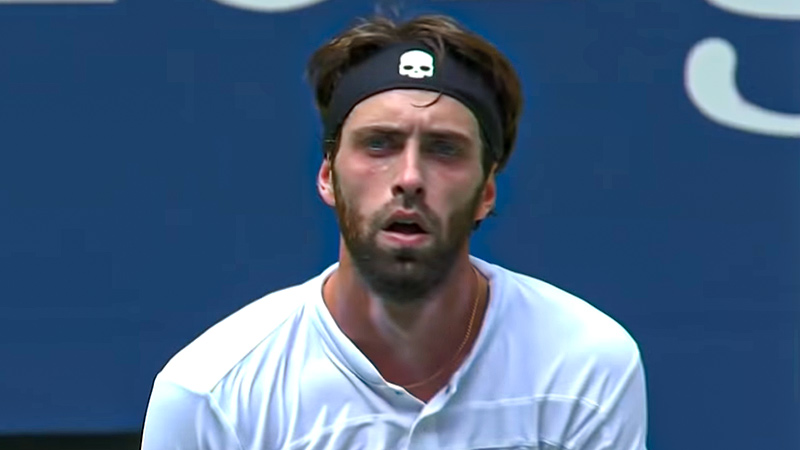
Nikoloz Basilashvili is not playing in mainstream ATP Tour events primarily due to a dramatic drop in world ranking caused by a severe right elbow injury and subsequent surgeries.
While he has not retired, a nine-month competitive hiatus between May 2023 and February 2024 saw his ranking plummet from World No. 16 to outside the top 500. This collapse forced him out of automatic qualification for Grand Slams and Masters 1000 tournaments.
Currently, he is actively competing but must navigate the grueling ATP Challenger Tour and qualifying rounds to rebuild his standing and return to tennis’s biggest stages.
What Happened to Nikoloz Basilashvili’s Tennis Career?
The trajectory of Nikoloz Basilashvili’s career provides a stark illustration of how quickly physical adversity can derail an elite athlete’s standing in a global sport.
At his peak in 2019, he reached a career-high ranking of World No. 16, known for a high-octane game built on aggressive baseline hitting and immense power.
However, his sudden disappearance from major television coverage and high-stakes tournament draws was the result of a cumulative physical breakdown that reached a critical mass in early 2023.
His absence from the mainstream circuit was not a voluntary retirement but a forced retreat necessitated by the loss of his competitive edge and ranking points.
Because the professional tennis system relies on a rolling 52-week points logic, his inability to defend his previous successes led to a rapid descent down the ladder.
This fall effectively locked him out of the events where he was once a seeded player, moving him from the center courts of Grand Slams to the qualifying backcourts of lower-tier events.
The Medical Reality: Three Elbow Surgeries and Pain Management
The core reason for Basilashvili’s reduced visibility is a catastrophic injury to his right elbow, an ailment that is particularly devastating for a player whose game is centered on high-velocity groundstrokes.
The Right Elbow Crisis and Structural Repair
Basilashvili’s ultra-aggressive game style relies heavily on the torque and power generated through his dominant arm. Over years of repetitive stress, his right elbow deteriorated to the point where it could no longer sustain the mechanics of professional play.
To address this, he underwent three separate surgeries during 2023 alone. These procedures were essential to structurally repair the joint, but they required extensive rehabilitation periods that kept him away from the court for most of the season.
The Danger of Masking Pain with Medication
Before he finally committed to surgical intervention, Basilashvili attempted to prolong his stay at the top of the game through dangerous means. He admitted to taking heavy painkillers every single week to numb the agonizing pain in his arm.
While this allowed him to continue appearing in draws, it significantly exacerbated the underlying physical damage and shattered his on-court confidence.
During this period, he was often competing at only 50% of his true capability, which led to a series of early-round exits and a loss of the fearsome reputation he once held on the tour.
The 2023-2024 Hiatus Timeline and Tournament Impact
To understand why he is “not playing” in the sense that fans expect, one must look at the specific timeframe where he was completely removed from professional competition.
| Milestone | Data and Details |
|---|---|
| Primary Hiatus Duration | Approximately 9 months (May 2023 to February 2024). |
| The Breaking Point | Retired while trailing 5-2 at the 2023 Rome Masters qualifying round due to pain. |
| Grand Slams Missed | 2023 French Open, Wimbledon, US Open, and the 2024 Australian Open. |
| Ranking Impact | Dropped from the world’s elite top 20 to a position outside the top 500. |
| Current Objective | Rebuilding points through the ATP Challenger Tour and qualifying draws. |
Mental Health and the Burden of Public Legal Battles
The physical injuries were only one part of the equation that led to Basilashvili’s decline. Professional tennis is a mentally taxing sport that requires absolute focus, and several external factors compromised his ability to compete at 100% capacity.
The Psychological Toll of Burnout
Basilashvili has been remarkably candid about the mental strain of the professional circuit. He has spoken openly about feeling “burned out” and has even admitted to considering retirement during his darkest periods.
The relentless cycle of travel, training, and the pressure to maintain a top ranking took a significant toll on his motivation and overall mental well-being. This exhaustion often made the grueling process of injury recovery feel even more insurmountable.
The Weight of Personal and Legal Turmoil
Compounding his professional struggles was a highly publicized and exhausting legal dispute with his ex-wife. This off-court distress heavily impacted his mental health and focus during what should have been the peak years of his career.
Navigating complex legal proceedings while trying to perform as a top-20 athlete created a level of stress that few competitors have to endure, further explaining the dip in his performance and his eventual need to step away from the game to regroup.
The Hard Grind: Why Re-entering the Top 100 is Difficult
Once a player’s ranking falls as precipitously as Basilashvili’s did, the path back to the elite level is fraught with logistical and financial obstacles that are often hidden from the casual viewer.
The Difficulty of Securing Tournament Entry
With a ranking outside the top 500, a player loses the right to enter almost any ATP-level tournament directly. Basilashvili has had to rely heavily on tournament invitations, or wildcards, to get back into the fold.
This has led to public moments of frustration, such as when he lashed out on social media after being denied a wildcard at the Doha Qatar Open—an event where he was a former champion.
Without these invitations, he is forced to play through multiple rounds of qualifying just to reach the main draw of small events.
The Financial Strain of the Lower Tiers
The economics of professional tennis are unforgiving for those outside the top 100. Basilashvili has noted that traveling for lower-level Challenger events has often cost him more than he has earned in prize money.
This has resulted in massive net financial losses as he pays for coaching, travel, and lodging while playing for much smaller purses than those offered at the Masters 1000 level.
This financial pressure adds another layer of difficulty to an already challenging comeback attempt.
Recent Progress: Tracking the 2026 Comeback
It is important to clarify that as of July 2026, the narrative that Basilashvili is “not playing” is no longer strictly accurate; rather, he is playing in a different capacity than before.
- Active Competition: He has successfully returned to the professional circuit and is actively grinding through qualifying brackets to improve his standing.
- Recent Matchups: In July 2026, he was scheduled for a round of 32 match at the Nordea Open in Bastad against Jan Choinski.
- Qualifying Success: His “absence” is now more of a visibility issue, as he is frequently competing in the ATP Challenger Tour rather than the major televised events.
- Physical Status: Following his three surgeries, he is attempting to play without the heavy reliance on painkillers that characterized his decline.
- Future Outlook: His goal remains a return to the top 100, which would grant him direct entry back into the Grand Slams he missed during his hiatus.
Common Inquiries Regarding Basilashvili’s Status
Did Nikoloz Basilashvili retire from professional tennis?
No, he never officially retired. His absence was due to a nine-month break for medical reasons and a subsequent drop in ranking that removed him from mainstream tournament draws.
What was the specific injury that stopped him from playing?
The primary issue was a severe right elbow injury that required three separate surgeries in 2023 to repair structural damage caused by his high-velocity playing style.
Why don’t we see him in Grand Slam main draws anymore?
Because his ranking fell outside the top 500 during his injury hiatus, he no longer qualifies for automatic entry. He must either play through qualifying rounds or receive a wildcard to participate in Grand Slams like Wimbledon or the US Open.
Is he currently winning matches?
He is in the process of rebuilding. While he is no longer a top-20 player, he is actively competing in ATP Challenger and qualifying events, such as the Nordea Open, to earn the points necessary to climb back up the rankings.
How long was his total absence from the court?
He had a complete competitive hiatus of approximately nine months, lasting from May 2023 until February 2024, followed by a period of limited play while he worked his way back to full fitness.
Conclusion: The Resilience of a Former Champion
The story of Nikoloz Basilashvili is a reminder of the fragile nature of professional athletic success. His “absence” from the tennis world was a complex intersection of physical breakdown, medical necessity, and personal hardship.
By undergoing multiple surgeries and choosing to grind through the lower levels of the sport, he is demonstrating a level of resilience that often goes unnoticed by those who only follow the major tournaments.
Whether he can return to the top 20 remains to be seen, but his current activity proves that his career is far from over. He remains a dedicated competitor, fighting to reclaim his place among the world’s elite, one qualifying match at a time.