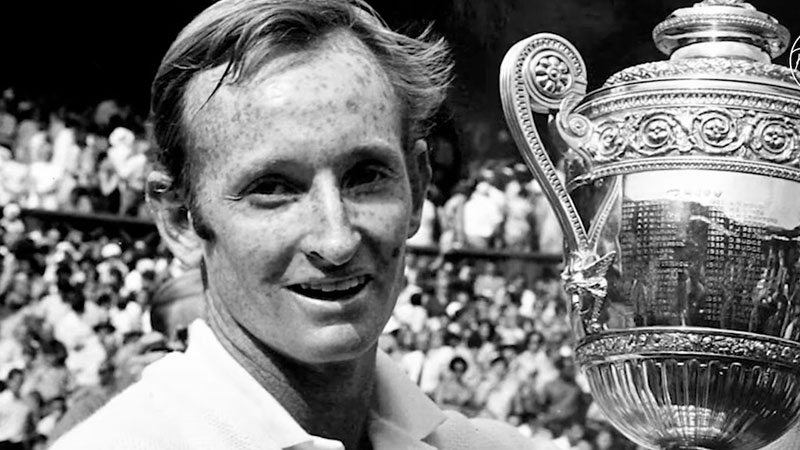
Rod Laver is no longer considered the absolute Greatest of All Time (GOAT) in men’s tennis, as Novak Djokovic, Rafael Nadal, and Roger Federer have statistically surpassed him in Grand Slam titles.
However, Laver remains an immortal icon and the strongest claimant for pre-modern greatness. His legacy is defined by achieving the only double Calendar-Year Grand Slam in history (1962 and 1969).
Despite a five-year ban during his physical peak, he amassed a record 200 career titles. While modern metrics favor the “Big Three,” Laver’s unique milestones ensure his permanent place in the pantheon of legends.
The Case for Rod Laver’s Unique Greatness
To understand why a player with 11 Grand Slam titles is constantly compared to modern giants with 20 or more, one must examine the unparalleled peaks of Rod Laver’s career.
His greatness is not merely a collection of trophies but a testament to a level of seasonal dominance that has never been replicated in the men’s game.
The Double Calendar-Year Grand Slam
The most significant argument for Laver’s supremacy is his achievement of the Calendar-Year Grand Slam—winning the Australian Open, French Open, Wimbledon, and the US Open in a single season.
While many great players have won all four majors over their careers, Laver is the only male player to do so in one year twice. He first conquered this feat as an amateur in 1962 and repeated it as a professional in 1969.
This requires mastering vastly different surfaces, from the clay of Paris to the grass of London and New York, under the immense pressure of a ticking clock.
Even at their highest peaks, Djokovic, Federer, and Nadal have never achieved a full Calendar-Year Grand Slam.
The Impact of the Five-Year Peak Ban
Perhaps the most compelling “what if” in sports history involves the five-year period between 1963 and 1967. After winning his first Grand Slam in 1962, Laver turned professional to earn a living.
At the time, professional players were strictly banned from competing in Grand Slam tournaments, which were reserved for amateurs.
Consequently, Laver was forced to miss 20 consecutive Grand Slam events during his absolute physical peak, between the ages of 24 and 29.
Despite being sidelined from the majors, he dominated the “Pro Slam” circuit against other legends like Ken Rosewall, winning 8 professional major titles.
Most tennis historians agree that without this ban, Laver would have likely surpassed 20 Grand Slam titles, which would place him in a dead heat with the modern Big Three.
Mastering Diverse Playing Surfaces
Laver’s versatility is a cornerstone of his legendary status. In 1962, three of the four Grand Slam tournaments were played on grass, with only the French Open held on clay.
By 1969, the conditions remained challenging, yet Laver adapted his aggressive style to conquer both fast and slow courts.
This adaptability proved he was not a specialist but a complete player capable of defeating any opponent on any terrain, a trait that modern players still strive to emulate today.
Why He Has Been Surpassed by the Modern Era
While Laver’s historical achievements are monumental, the modern era of tennis has introduced a level of competition and statistical volume that makes it difficult to maintain him as the absolute number one.
The transition to the Open Era and the rise of “The Big Three” have rewritten the record books entirely.
| Statistic | Novak Djokovic | Rafael Nadal | Roger Federer | Rod Laver |
|---|---|---|---|---|
| Grand Slam Singles Titles | 24 | 22 | 20 | 11 |
| Grand Slam Match Wins | 409 | 314 | 369 | 133+ |
| Weeks at World No. 1 | 428 | 209 | 310 | ~360 (Est.) |
| Total Career Titles | 99 | 92 | 103 | 200 |
As shown in the table, modern players have far eclipsed Laver in the most visible metrics. The evolution of the sport has also played a role; modern tennis features vastly improved sports science, advanced equipment, and a more globalized, deeper field of competition.
The sustained dominance of Djokovic, Nadal, and Federer over two decades is widely considered more difficult to achieve than the shorter periods of dominance seen in the 1960s.
Interestingly, even Laver himself has publicly stated that he ranks Novak Djokovic as the greatest of all time, with Roger Federer in the second spot.
The Statistical Magnitude of 200 Career Titles
While his Grand Slam count is lower due to the professional ban, Laver holds a record that may never be broken: 200 career singles titles. This number represents a level of consistency and longevity that is almost unfathomable in the modern game.
Amateur vs. Professional Dominance
Laver’s career spanned three distinct phases: his amateur years (1956–1962), his time on the professional tour (1963–1967), and the beginning of the Open Era (1968–1979).
His 200 titles were accumulated across all these phases, demonstrating that he was the man to beat regardless of the tournament’s status or the eligibility rules of the time.
This volume of winning suggests that had he been allowed to play a standard schedule of majors, his statistical lead might have been insurmountable for decades.
Comparisons with Modern Open Era Records
To put the number 200 into perspective, one must look at the modern Open Era leaders. Jimmy Connors holds the record for the most ATP titles in the modern era with 109, followed closely by Roger Federer (103) and Novak Djokovic (99).
Laver’s 200 titles nearly double the modern record, highlighting the sheer frequency with which he competed and won.
Even after turning 30 and entering the Open Era, Laver managed to win 72 ATP-sanctioned titles, which alone ranks him 7th all-time in the modern era.
How Rod Laver Revolutionized Tennis Play Styles
Beyond the trophies, Laver changed the way tennis was played. He was a technical pioneer whose influence can still be seen on the professional tour today. Before his arrival, many players stuck to rigid defensive baselining or standard serve-and-volley tactics.
The Innovation of Topspin and Wrist Power
Despite standing only 5’8″, Laver was able to generate immense power and control through a revolutionary technique. He was one of the first players to popularize hitting the ball with heavy topspin on both the forehand and backhand sides.
This was made possible by an incredibly strong left wrist, which allowed him to “flick” the ball with pace and dip, a precursor to the heavy-spin baseline game dominated by players like Rafael Nadal today.
The All-Court Serve-and-Volley Evolution
Laver utilized an aggressive, fast-paced, all-court game. He didn’t just stay at the back or just rush the net; he combined both styles seamlessly.
This “serve-and-volley” attack was his signature, but his ability to hit winners from the baseline with topspin meant that he had no weaknesses.
This tactical flexibility allowed him to dominate the 1960s and transition successfully into the Open Era when younger, more powerful players began to emerge.
Why Is Rod Laver So Famous in the 21st Century?
Even though his playing days ended decades ago, Laver remains a central figure in the tennis world. His name is synonymous with the highest honors of the sport, ensuring that every new generation of fans learns about his legend.
- Rod Laver Arena: In 2000, the centerpiece stadium of the Australian Open in Melbourne was named in his honor. It is now one of the most iconic venues in all of global sports.
- The Laver Cup: Founded in 2017, this premier international team tournament was created specifically to honor his legacy. It pits Team Europe against Team World and has become a highlight of the tennis calendar.
- Financial Pioneer: In 1971, Laver became the first tennis player in history to surpass $1 million in career prize money earnings, marking the transition of tennis into a major commercial sport.
- International Hall of Fame: He was inducted into the International Tennis Hall of Fame in 1981, cementing his status as a permanent pillar of the sport’s history.
Frequently Asked Questions About Rod Laver
Who has the most Grand Slam titles between Laver and the Big Three?
Novak Djokovic holds the record with 24 titles, followed by Rafael Nadal (22), Roger Federer (20), and Rod Laver (11).
Did Rod Laver ever play against Federer or Djokovic?
No, Rod Laver retired from professional singles in the late 1970s, long before the modern Big Three began their careers.
Why was Rod Laver banned from Grand Slams?
He was banned from 1963 to 1967 because he turned professional. At that time, Grand Slam tournaments were strictly for amateur players. This changed in 1968 with the start of the “Open Era”.
What is the “Calendar-Year Grand Slam”?
It is the feat of winning the Australian Open, French Open, Wimbledon, and the US Open all in the same calendar year. Rod Laver is the only man to do it twice.
Final Thoughts on the Laver Legacy
The debate over the greatest of all time often suffers from “recency bias,” where the accomplishments of current stars overshadow those of the past.
While Novak Djokovic may hold the statistical crown today, Rod Laver’s career remains the ultimate benchmark for seasonal dominance and versatility.
His 200 titles and two Calendar-Year Grand Slams represent a mountain that even the modern greats have struggled to climb.
Whether he is ranked first, second, or third, Laver’s impact on the technical evolution of the game and his unmatched peak performance ensure that he will always be a central figure in the conversation of tennis immortality.