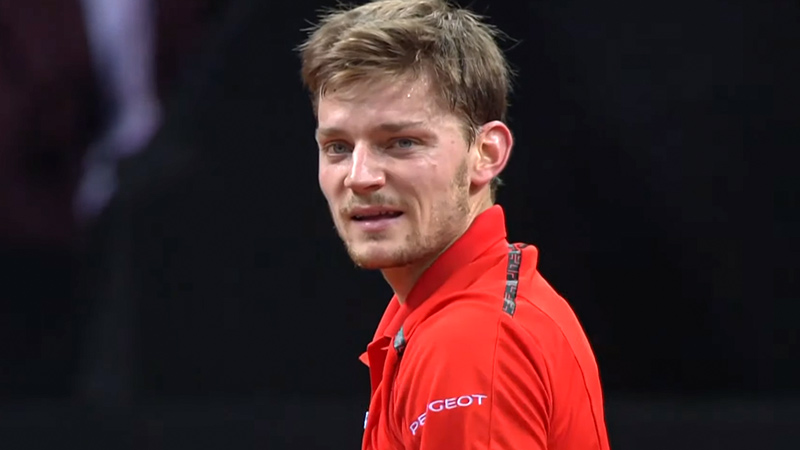
David Goffin officially withdrew from the 2026 Australian Open, marking a poignant start to his final professional season.
The 35-year-old Belgian star announced his decision in late December 2025, citing persistent knee discomfort that made the rigors of a Grand Slam impossible.
Currently ranked World No. 119, Goffin faced the prospect of playing through the qualifying rounds without a wildcard entry.
To prioritize long-term recovery and ensure he could compete in his 2026 farewell tour, he opted to bypass Melbourne entirely. This strategic withdrawal highlights the physical challenges that ultimately led to his upcoming retirement.
Understanding Why David Goffin Withdrew From the Australian Open
The decision for a veteran of Goffin’s caliber to skip the first Grand Slam of the year was not made lightly. It involved a careful calculation of his physical state and his goals for his final year on the professional circuit.
The Physical Impact of Lingering Knee Discomfort
The primary catalyst for the 2026 absence was ongoing knee pain that had hampered Goffin’s ability to train at a high intensity.
In a public statement shared via social media around December 24–25, 2025, Goffin explained that he needed to give his body “the time it needs” before returning to high-level competition.
For an athlete who built his career on elite movement and baseline consistency, even a minor knee ailment can be a significant barrier to success in the best-of-five format.
By choosing rest over participation, Goffin aimed to preserve his health for the remainder of the 2026 season.
Differentiating the 2026 Injury from the 2023 Sickness
It is essential to distinguish this withdrawal from previous setbacks at Melbourne Park to understand his career trajectory.
In 2023, Goffin was forced to exit the tournament just before his opening match due to a sudden and severe sickness, which left fans and analysts surprised.
While the 2023 incident was an acute health issue, the 2026 withdrawal was a strategic choice based on chronic physical wear and tear.
This shift from “sudden illness” to “managed injury” reflects the realities of a professional athlete in their late playing years, where recovery cycles become longer and more critical.
How an ATP Ranking of 119 Influenced the 2026 Decision
A player’s standing in the world rankings often dictates their path through a major tournament. For David Goffin, his position outside the top 100 presented a logistical hurdle that influenced his decision to withdraw.
The Grueling Path of the Qualifying Rounds
Because his ranking sat at No. 119 at the time of the tournament cutoff, Goffin did not qualify for automatic entry into the main draw.
Without a main-draw wildcard being granted, the Belgian would have been required to win three consecutive matches in the qualifying event just to earn a spot in the primary bracket.
Given his knee discomfort, the prospect of playing three high-pressure qualifying matches followed by a potential five-set first-round match was physically untenable. This reality made the choice to stay home and focus on rehabilitation a pragmatic necessity.
The Strategic Choice for Career Longevity
In his late 30s, Goffin has shifted his focus toward quality of participation rather than quantity. By skipping the Australian Open, he avoided the physical strain of international travel and the hard courts of Melbourne, which are notoriously taxing on the joints.
This decision allowed him to target a return in February 2026 through the Challenger circuit, where he could rebuild his rhythm and confidence in a more controlled environment.
This approach underscores his desire to end his career on his own terms, competing at a level he deems acceptable for a former World No. 7.
David Goffin’s Historical Career Timeline at Melbourne Park
To appreciate the weight of his absence, one must look at the consistency Goffin brought to the Australian Open over more than a decade. His history at the event is a testament to his talent and the high-quality tennis he produced during his peak.
| Tournament Year | Result Achieved | Key Match or Opponent |
|---|---|---|
| 2013 | First Round | Lost to Fernando Verdasco |
| 2015 | Second Round | Lost to Marcos Baghdatis |
| 2016 | Fourth Round | Defeated by Roger Federer |
| 2017 | Quarterfinals | Career-best run; lost to Grigor Dimitrov |
| 2018 | Second Round | Lost to Julien Benneteau |
| 2019 | Third Round | Lost to Daniil Medvedev |
| 2020 | Third Round | Lost to Andrey Rublev |
| 2021 | First Round | Lost to Alexei Popyrin |
| 2022 | First Round | Lost to Daniel Evans |
| 2023 | Withdrawal | Sudden sickness before R1 |
| 2024 | First Round | Lost to Ugo Humbert after qualifying |
| 2025 | First Round | Lost to Benjamin Bonzi (final AO match) |
| 2026 | Withdrawal | Ongoing knee discomfort |
Reflecting on the 2017 Quarterfinal Peak
The highlight of Goffin’s history in Melbourne remains his incredible run in 2017. During that fortnight, he showcased the full breadth of his skill, defeating formidable opponents including Dominic Thiem and Ivo Karlović.
His journey ended in the quarterfinals against Grigor Dimitrov, but that performance cemented his status as one of the most dangerous players on the tour.
This era saw him reach a career-high ranking of seventh in the world, reflecting a period where he was a legitimate threat to the sport’s elite.
The Transition to the Final Chapter in 2025
His final played match at Melbourne Park occurred in 2025, where he faced Benjamin Bonzi in the first round.
Although he lost the match in a hard-fought battle, it marked the end of an eleven-appearance legacy where he maintained an even record of 11 wins and 11 losses.
By the time the 2026 season arrived, the physical toll of these years had become evident, leading to the decision to step away from the Grand Slam stage to prepare for his final farewell to the fans.
The Road to Retirement: What to Expect in the 2026 Farewell Tour
The 2026 season is more than just a return from injury for David Goffin; it is the final act of a storied career. His withdrawal from the Australian Open was the first major indicator that his body could no longer handle the most demanding events.
Official Announcement and the March Milestone
Following his recovery period in early 2026, Goffin officially announced in March that the current season would be his last on the ATP Tour. He cited the heavy physical toll of his long-term knee injury as the decisive factor.
This announcement provided clarity for fans who had followed his journey from a promising young talent to a veteran mainstay of the top 10. It also set the stage for a series of emotional appearances at the tournaments that defined his career.
Rebuilding Through the Challenger Circuit
Goffin’s return to competition in February 2026 was notable for its humility and pragmatism. Rather than jumping immediately back into high-level ATP events, he utilized the Challenger circuit to find his footing. This allowed him to manage his knee workload while still engaging in competitive play.
For a player with his pedigree, competing at the Challenger level is a sign of deep respect for the game and a desire to ensure he is truly ready before taking his final bows on the world’s biggest stages.
Frequently Asked Questions About David Goffin’s Career and Absence
What was the exact reason for Goffin’s 2026 Australian Open withdrawal?
The withdrawal was due to persistent knee discomfort that required additional rest and recovery time.
How high was David Goffin’s ranking at his peak?
Goffin reached a career-high ranking of World No. 7 in November 2017.
Was the 2023 withdrawal the same as the 2026 one?
No. The 2023 withdrawal was caused by a sudden sickness/illness, whereas the 2026 withdrawal was due to a chronic knee injury.
Will David Goffin play again after the Australian Open?
Yes, he returned to competition in February 2026 via the Challenger circuit as part of his final year on the tour.
What is Goffin’s best result in a Grand Slam?
At the Australian Open, his best result was reaching the quarterfinals in 2017.
A Final Bow for a Belgian Tennis Icon
As David Goffin navigates the complexities of his final professional season, his absence from the 2026 Australian Open serves as a reminder of the immense physical demands of modern tennis.
While it was disappointing for fans not to see him in Melbourne one last time, the decision was a testament to his intelligence and his commitment to finishing his career with dignity.
Goffin’s legacy is defined by his resilience, his technical precision, and his ability to compete with much larger power-hitters through sheer timing and court craft.
As he moves through his farewell tour, the tennis community continues to celebrate the career of a man who was once the seventh-best player on the planet.
Whether competing in Challenger events or his final ATP tournaments, Goffin remains a symbol of Belgian tennis excellence, leaving behind a record of consistency that will be remembered for years to come.
His story in 2026 is not just about an injury withdrawal, but about the graceful conclusion of a top-tier athletic journey.