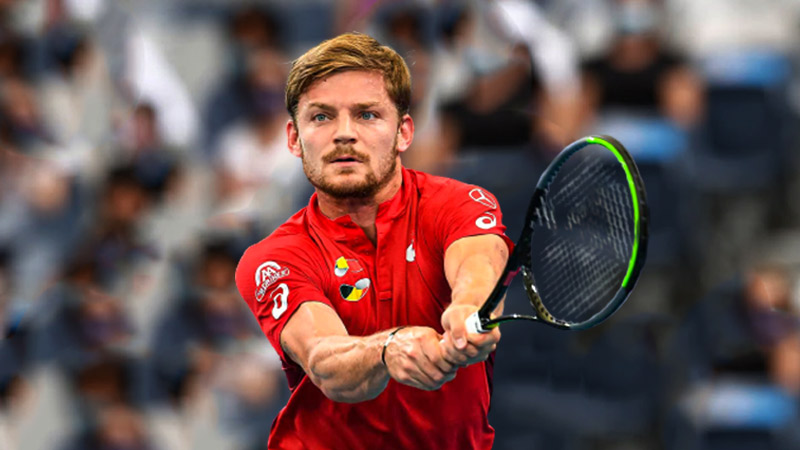
David Goffin is famous for being the most successful male tennis player in Belgian history and the first man from his country to break into the world’s Top 10.
Achieving a career-high ranking of World No. 7, he became a global sensation after defeating both Roger Federer and Rafael Nadal in the same tournament during the 2017 ATP Finals.
Known as one of the cleanest ball-strikers on the tour, Goffin’s fame stems from his tactical intelligence and ability to dismantle power-hitters despite his smaller 5’11” stature, securing six ATP titles and reaching four Grand Slam quarterfinals.
The Historic Impact of David Goffin on Belgian Tennis
As a pioneer for his nation, David Goffin transformed the landscape of men’s professional tennis in Belgium, providing a blueprint for future generations to follow on the international stage.
Before his rise, the country had seen immense success in the women’s game, but the men’s side lacked a consistent Top 10 presence until Goffin’s emergence.
The First Belgian Man in the World Top 10
David Goffin made history by becoming the first and only Belgian man to break into the ATP Top 10 rankings.
This milestone was not merely a personal achievement but a watershed moment for Belgian sports, proving that a player from a small nation could compete at the highest echelons of a global sport.
His career-high ranking of World No. 7, reached in November 2017, remains the benchmark for all Belgian male players.
A Legacy of National Representation and Pride
Beyond individual rankings, Goffin is famous for his unwavering commitment to the Belgian national team.
He practically carried the squad on his shoulders during their most successful periods in recent memory. His leadership led Belgium to two Davis Cup Finals in 2015 and 2017.
In the 2017 final against France, he demonstrated elite composure by winning both of his singles matches flawlessly, further cementing his status as a national hero who performed best when the pressure of a whole country was upon him.
Why is David Goffin Famous? Key Career Milestones
The fame of David Goffin is built upon a decade of consistency at the highest level of the ATP Tour, marked by deep runs in major tournaments and a collection of prestigious titles.
His ability to maintain a high level of play across various surfaces—from the red clay of Europe to the fast hard courts of Asia—has made him a household name among tennis enthusiasts.
| Milestone Achievement | Year / Details |
|---|---|
| Career-High Ranking | World No. 7 (November 20, 2017) |
| ATP Finals Finish | Runner-Up (2017) |
| Total ATP Titles | 6 Singles Titles |
| Grand Slam Quarterfinals | 4 (Across three different Slams) |
| Masters 1000 Finals | 2019 Cincinnati Masters |
| Career Prize Money | Over $19.15 Million |
Consistent Success in Grand Slam Championships
While many players struggle to adapt to the different demands of the four major tournaments, Goffin proved his versatility by reaching the quarterfinals of three different Grand Slams.
This level of consistency is rare and highlights his adaptability as a world-class competitor.
- French Open (2016): Reached the final eight on the demanding clay of Roland-Garros.
- Australian Open (2017): Demonstrated his hard-court prowess by reaching the quarterfinals in Melbourne.
- Wimbledon (2019, 2022): Proved his grass-court game was elite by reaching the quarterfinals twice at the All England Club.
Mastering the Game: The Unique Playing Style of David Goffin
In an era of tennis increasingly dominated by physical giants and 140mph serves, David Goffin became famous for “working differently.”
His success is a testament to the fact that technical perfection and mental acuity can still overcome raw physical advantages on the professional circuit.
Precision Over Power: The Art of Ball-Striking
Standing at 5’11” and weighing approximately 70kg, Goffin is significantly lighter and shorter than the average modern ATP pro. He compensated for this by becoming one of the “cleanest ball-strikers” in the world.
Rather than trying to out-muscle opponents, Goffin relied on immaculate timing, taking the ball early to redirect the pace of his rivals’ shots with surgical precision.
This style of play made him a fan favorite, as it showcased the more artistic and tactical side of the sport.
Elite Footwork and Tactical Intelligence
Goffin’s defensive capabilities were just as famous as his offensive timing. He possessed world-class footwork that allowed him to cover the baseline with incredible speed, turning defensive positions into attacking opportunities.
His exceptional return of serve was often cited by analysts as one of the best in the game, allowing him to neutralize the biggest servers on the tour. By using his tactical “brain” to outthink opponents, he could dismantle heavier hitters who relied solely on power.
Is David Goffin a Good Tennis Player? Analyzing the Data
To understand why Goffin is held in such high regard, one only needs to look at the statistical data from his career. His numbers place him among the elite players of his generation, particularly in terms of financial success and longevity.
| Statistic | Value / Record |
|---|---|
| Overall Singles Match Record | 357–275 |
| Career Finals Reached | 15 (6 Wins, 9 Runner-ups) |
| Win Percentage | Consistently high against non-seeded players |
| ATP All-Time Earnings Rank | Top 40 |
| Notable Titles | 2022 Marrakesh (Clay), 2017 Tokyo (Hard) |
| Estimated Net Worth | $15 Million |
The Giant-Slayer: Victories Over the Big Three
Perhaps the most significant reason David Goffin is famous globally is his membership in an elite club of players who have defeated the “Big Three”—Roger Federer, Rafael Nadal, and Novak Djokovic.
Scoring wins against these three legends is the ultimate litmus test for tennis greatness, and Goffin achieved this feat on multiple occasions.
Ending the Reign of Roger Federer
The most famous win of Goffin’s career occurred at the 2017 ATP Finals in London. In the semifinals, he faced the legendary Roger Federer, a player he had struggled against in previous meetings.
In a stunning display of baseline aggression, Goffin overcame the Swiss maestro to reach the championship match, a victory that sent shockwaves through the tennis world and proved he could beat the greatest of all time on a premier stage.
Hard-Court Triumphs Against Rafael Nadal
Goffin is one of the few players to hold a winning edge in specific high-pressure moments against Rafael Nadal. He defeated the Spaniard during that same 2017 ATP Finals run, marking a rare back-to-back triumph over the world’s two best players.
He later proved this was no fluke by logging another memorable victory against Nadal at the 2020 ATP Cup, showing that his game was perfectly suited to troubling even the most tenacious competitors.
Clay-Court Success Against Novak Djokovic
Defeating Novak Djokovic on clay is widely considered one of the hardest tasks in sports. However, Goffin achieved this during the 2017 Monte-Carlo Masters.
By utilizing his speed and ability to take the ball early, he was able to disrupt Djokovic’s rhythm on the dirt, a victory that highlights the sheer peak level Goffin was capable of reaching during his prime years.
Why Is David Goffin Retiring in 2026?
As with many great athletes, the end of David Goffin’s career has been dictated by the physical limits of the human body.
His announcement in March 2026 that he would be stepping away from the sport was an emotional moment for the Belgian public and the wider tennis community.
The Toll of Chronic Knee Injuries
The primary factor behind Goffin’s retirement is a persistent and chronic knee injury that has plagued his later seasons.
Despite his best efforts to rehabilitate and return to peak form, the injury severely derailed his 2025 season and made it clear that his body had reached its “structural limits”.
Choosing to retire at 35, Goffin acknowledged that he had given everything he possibly could to the game of tennis.
A Final Farewell Tour for the Fans
Rather than retiring immediately, Goffin opted for a farewell tour throughout the 2026 season. This has allowed him to bid an emotional goodbye to the tournaments and venues that defined his career, including final appearances at Roland-Garros and Wimbledon.
While his ranking has dipped to around No. 241/251 as he focuses on celebration over points, his presence on the tour continues to draw massive crowds who want to see the “Baseline Master” one last time.
Frequently Asked Questions About David Goffin
What is David Goffin’s most famous match?
His most famous match is undoubtedly the semifinal of the 2017 ATP Finals, where he defeated Roger Federer. This victory, combined with his win over Rafael Nadal in the same tournament, remains his crowning achievement.
How much has David Goffin earned in his career?
Goffin has earned over $19.15 million in career prize money, which places him in the Top 40 of all-time earners in tennis history. His total net worth is estimated to be approximately $15 million when including sponsorships with brands like Wilson and Asics.
Has David Goffin ever won a Grand Slam?
While he never won a Grand Slam title, he was a highly consistent performer, reaching the quarterfinals of the Australian Open, French Open, and Wimbledon a total of four times.
Is David Goffin the best Belgian tennis player?
On the men’s side, yes. He is the highest-ranked Belgian man in history (No. 7) and the only one to ever break into the Top 10.
Conclusion: The Enduring Legacy of a Tactical Genius
David Goffin’s career is a story of defying the odds through technical excellence and mental fortitude. He proved that you don’t need to be a giant to slay giants, and his status as a trailblazer for Belgian tennis is forever secure.
As he prepares to hang up his rackets at the end of 2026, he leaves behind a legacy of “clean” tennis, national pride, and the respect of every opponent who ever had to figure out how to get a ball past him.
Whether you remember him for his historic 2017 run or his tireless efforts in the Davis Cup, Goffin remains a shining example of how intelligence and speed can dominate the baseline.
His retirement marks the end of an era, but the path he blazed for smaller, tactical players will be felt for years to come.