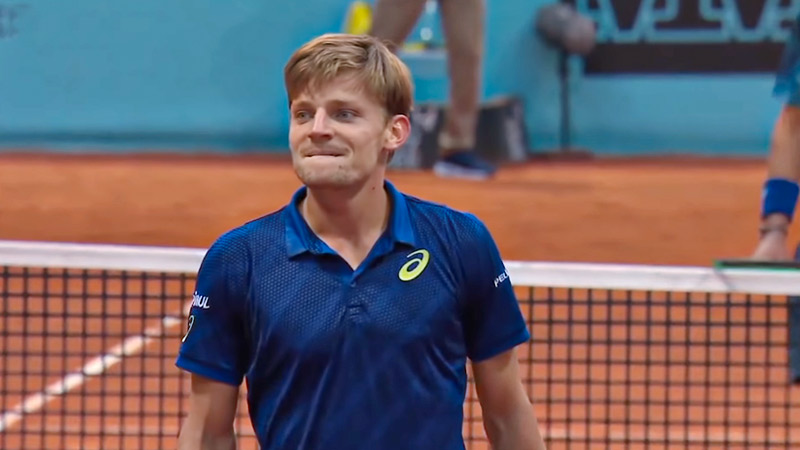
David Goffin decided to retire from professional tennis at the end of the 2026 season primarily due to persistent physical injuries and a decline in mental motivation.
The 35-year-old Belgian star cited a severe, recurring knee injury and a lingering foot issue as the decisive factors that hampered his ability to compete at the elite level.
With his ranking slipping outside the Top 150, Goffin candidly shared that he no longer possesses the “110%” physical and mental drive required for grueling ATP training. His departure marks the end of a historic career for Belgium’s highest-ranked male player.
Why Did David Goffin Retire? The Core Reasons
The transition from elite competition to retirement is rarely simple, but for Goffin, the decision was rooted in a pragmatic assessment of his physical limits and mental fortitude.
He reached a point where the effort required to remain competitive simply outweighed the physical capacity of his body to respond to that demand.
The Physical Toll: Knee and Foot Injuries
One of the most significant factors in Goffin’s departure was the cumulative damage his body sustained over years of high-level play.
A severe foot injury in mid-2025 acted as the first major domino, sidelining him for several months and disrupting his competitive rhythm.
This was followed by a debilitating knee injury that prematurely ended his 2025 campaign and forced him to withdraw from the 2026 Australian Open.
These recurring setbacks made it nearly impossible to maintain the consistency needed on the ATP Tour, as he was constantly in a state of rehabilitation rather than peak performance.
Mental Fatigue and the Ranking Climb
Beyond the physical pain, the mental burden of a falling ranking played a decisive role. Because of his injury-induced absences, Goffin saw his world ranking plummet outside the Top 150 by the start of 2026.
For a player who had spent years inside the Top 10, the prospect of grinding through qualifying rounds and lower-tier events was mentally exhausting.
He admitted that the constant struggle to recover and the psychological weight of his dropping status heavily impacted his morale. He ultimately realized he no longer had the mental drive to endure the immense training effort required to fight back into the world’s Top 50.
Choosing Honesty and Grace
Goffin’s retirement was not an impulsive act but a moment of profound personal honesty. He concluded that modern professional tennis is an unforgiving environment that demands a player be at 110% capacity technically, physically, and mentally.
Recognizing that he could no longer reach those heights, he decided it was the right moment to step away with his dignity intact rather than continue a decline he could no longer prevent.
This clarity allowed him to pivot from the stress of the rankings to the celebratory nature of a final farewell tour.
Analyzing the 2026 Retirement Announcement
On Friday, March 27, 2026, the tennis community was moved by a heartfelt announcement that signaled the end of an era for Belgian tennis.
This was not a sudden exit, but a planned conclusion to a career that spanned over a decade at the highest levels of the sport.
An Emotional Farewell on Instagram
Goffin chose a deeply personal medium to share his news, posting an emotional video on his Instagram account. In this message, the 35-year-old described the choice as “one of the hardest decisions” of his life.
He took the time to express his gratitude, noting that tennis had provided him with more opportunities and experiences than he had ever dared to imagine as a young player.
This transparency resonated with fans and fellow professionals, cementing his reputation as one of the most humble and respected figures in the locker room.
The Final Season: A Farewell Tour
Instead of an immediate exit, Goffin opted to finish the 2026 season as a “farewell tour,” allowing him to visit the venues that defined his career one last time.
This approach changed the nature of his final matches; while he was still competing, there was a visible sense of relief in his play.
He was no longer fighting for points or prize money alone but was instead soaking in the atmosphere of the world’s most iconic courts. This final year served as a bridge between his life as a professional athlete and his future beyond the court.
What Happened to David Goffin in His Final Season?
Goffin’s final season was a mixture of emotional highs and the harsh realities of a lower ranking.
Forced into qualifying draws, he showcased flashes of the brilliance that earned him his nickname, “The Magician,” while also dealing with the physical limitations that prompted his retirement.
| Tournament (2026) | Match Result | Emotional & Professional Significance |
|---|---|---|
| Monte-Carlo Masters | Lost in 2nd Round Qualifiers | Played at the site of his historic win over Djokovic; noted a deep sense of “relief” and happiness despite the loss. |
| Roland Garros | Lost in 2nd Round Qualifiers | Defeated Chun-Hsin Tseng in the first round; received a passionate standing ovation from the French crowd on Court Suzanne-Lenglen. |
| Wimbledon | Lost in 1st Round Qualifiers | Suffered a “harsh blow” at Roehampton against Andrea Guerrieri, missing a final appearance on the main grass courts of the All England Club. |
The “110% Reality”: Why Professional Tennis is So Demanding
Goffin’s departure highlights a growing theme in modern sports: the extreme level of commitment required to stay relevant in a global field of athletes. His candid remarks about the “110% reality” serve as a warning of the toll the tour takes on its veterans.
The Level of Technical and Physical Excellence
According to Goffin, being “good” is no longer enough to survive on the ATP Tour. A player must be at their absolute peak in three distinct categories: mental focus, physical durability, and technical precision.
When one of these pillars begins to crumble—as was the case with Goffin’s physical health—the entire structure of a professional career becomes unstable.
The intensity of modern baseline rallies and the grueling travel schedule mean that even a 5% drop in performance can lead to a string of first-round exits.
The Struggle of the Qualifying Rounds
The decline of a veteran champion often manifests in the move from the main draw to the qualifying stages. For Goffin, this transition was particularly poignant.
Having once been a fixture in the late rounds of Grand Slams, he found himself playing at venues like Roehampton just to earn a spot at Wimbledon.
This shift highlights the “physical certainty” he mentioned lacking; without the assurance that his body would hold up through multiple qualifying matches and then a main draw, the mountain simply became too steep to climb.
David Goffin Career Highlights and Legacy
Despite the challenges of his final year, David Goffin retires as a trailblazer and the most successful male player in the history of Belgian tennis. His list of accomplishments showcases a player who consistently punched above his weight class.
- Historic Peak Ranking: He reached World No. 7 in late 2017, becoming the first and only Belgian man to break into the ATP Top 10.
- ATP Title Count: He successfully secured 6 tour-level singles titles throughout his career.
- Match Success: He amassed a professional record of 357–275, proving his longevity and consistency across different surfaces.
- Giant Slayer Status: Goffin is a member of the elite club of players who have defeated all members of the “Big Three”—Roger Federer, Rafael Nadal, and Novak Djokovic.
- 2017 ATP Finals: He famously reached the final of the prestigious season-ending championships, defeating both Nadal and Federer in the same tournament.
- Davis Cup Hero: He led Belgium to two Davis Cup Finals in 2015 and 2017, carrying the team with an exceptional 29–6 record in singles play.
- Grand Slam Consistency: He reached the quarterfinals of a Grand Slam four times, spanning the Australian Open, French Open, and Wimbledon.
Was David Goffin a Good Tennis Player?
To classify Goffin as merely “good” would be an understatement. He was a phenomenal athlete who relied on timing, speed, and intelligence rather than raw power, making him a fan favorite globally.
The Magician Style of Play
Goffin earned the nickname “The Magician” because of his elite, clean baselining and his ability to redirect power with ease. In an era dominated by taller, more muscular power hitters, Goffin used his craftiness and tactical mind to outmaneuver opponents.
His style was built on early ball-striking and exceptional footwork, allowing him to take time away from the biggest hitters in the world. This technical mastery is what allowed him to remain at the top of the game despite his physical stature.
A Giant Slayer’s Resume
His career-defining moments often came when he was the underdog. His victory over Roger Federer at the 2017 ATP Finals remains one of the most significant upsets in the history of that event.
By defeating the sport’s greatest icons on the biggest stages, Goffin proved that precision and movement could still overcome brute force.
This “Giant Slayer” reputation ensured that no opponent, regardless of their ranking, ever looked forward to seeing his name in their section of the draw.
Final FAQ: David Goffin Retirement Facts
When was David Goffin’s last professional match?
Goffin participated in his final matches during the 2026 season as part of his officially announced farewell tour. This included emotional appearances at the Monte-Carlo Masters and Roland Garros, where he was celebrated by local crowds for his years of excellence.
What is David Goffin’s highest career ranking?
Goffin reached a career-high of World No. 7 in late 2017. This achievement was a landmark for Belgian tennis, as he remains the only male player from his country to have broken into the ATP Top 10.
Why didn’t he play the 2026 Australian Open?
A recurring knee injury that ended his 2025 season also forced him to miss the 2026 Australian Open. This injury was one of the primary reasons he decided to announce his retirement, as it limited his ability to prepare for the rigors of a five-set Grand Slam tournament.
Conclusion: A Lasting Impact on the Game
David Goffin’s retirement marks the conclusion of a career defined by grace, resilience, and tactical brilliance.
By choosing to be honest about his physical limitations and the “110% reality” of the tour, he departs with the same integrity he showed on the court for over a decade.
While injuries may have accelerated his exit, they cannot overshadow his legacy as a “Giant Slayer” and a true “Magician” of the baseline.
He leaves Belgian tennis in a better place than he found it, providing a blueprint for future generations on how to compete with the world’s best through skill and intelligence.
As the 2026 season draws to a close, the tennis world says goodbye to a player who gave everything to the sport and, in return, received a permanent place in its history.