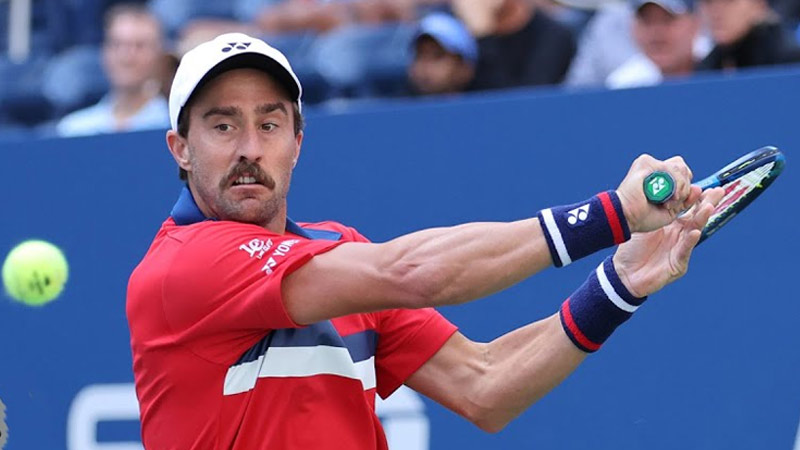
Steve Johnson is famous in tennis as arguably the greatest collegiate player in history, defined by an incredible 72-match winning streak and leading the USC Trojans to four consecutive NCAA Team Championships.
His fame extends beyond the university courts; “Stevie” successfully transitioned to the ATP Tour, reaching a career-high ranking of World No. 21 and becoming the top-ranked American male in 2016.
With an Olympic Bronze medal from Rio and four professional singles titles, his legacy combines unprecedented collegiate dominance with elite professional consistency, making him a revered figure for his grit, unique slice backhand, and leadership.
The Historic College Career of Steven Johnson at USC
The foundation of why Steven Johnson is so respected begins with his time at the University of Southern California (USC), where he rewrote the record books between 2008 and 2012.
He wasn’t just a good player; he was an unstoppable force that transformed the landscape of NCAA tennis.
| Metric | Collegiate Achievement (USC Trojans) |
|---|---|
| Singles Record | 149 wins — 21 losses |
| Doubles Record | 134 victories |
| Winning Streak | 72 consecutive singles matches |
| NCAA Team Titles | 4 (Consecutive: 2009, 2010, 2011, 2012) |
| NCAA Singles Titles | 2 (Consecutive: 2011, 2012) |
| All-American Honors | 7-time recipient |
| Hall of Fame | 2026 ITA Men’s Collegiate Tennis Hall of Fame Inductee |
Why is Steven Johnson Considered the Collegiate GOAT?
To understand the magnitude of Johnson’s fame, one must look at the sheer improbability of his statistics.
In an era of high-level competition, his ability to remain undefeated for years at a time is what earned him the “Greatest of All Time” (GOAT) label in the collegiate circuit.
The 72-Match Unbeatable Streak
The hallmark of Johnson’s legendary status is his 72-match winning streak in singles. This run spanned his final seasons at USC and represents a level of consistency that is almost unheard of in modern sports.
Ending a collegiate career on such a high note cemented his reputation before he even stepped onto the professional tour as a full-time athlete.
This streak wasn’t just about talent; it reflected a psychological dominance over every opponent he faced across the United States.
Dominating the NCAA Team Championships
While individual glory is often the focus in tennis, Johnson’s fame is equally rooted in his “team-first” mentality. He led the USC Trojans to a “four-peat,” winning the NCAA Team Championship every single year he was on campus.
Being the centerpiece of a dynasty that never lost a national title during his tenure is a feat that has rarely been replicated. His leadership helped USC maintain a standard of excellence that defined a generation of college tennis.
How Steve Johnson Dethroned a Giant as the #1 American
Transitioning from college to the professional ATP Tour is notoriously difficult, yet Johnson made it look seamless. By 2016, he had climbed the rankings to become the leading man in American tennis, a position long held by power-servers like John Isner.
Climbing the ATP Rankings to World No. 21
Johnson’s rise was steady and calculated. He broke into the global elite by maintaining a spot in the Top 50 for five consecutive years between 2014 and 2018. His career-high ranking of World No. 21, achieved in July 2016, proved that his collegiate success was not a fluke.
He possessed the physical tools and the mental stamina required to compete with the best players in the world on a weekly basis, earning him millions in career prize money.
Ending the Reign of John Isner
One of the most significant moments for Johnson’s fame occurred in July 2016. By reaching his peak ranking, he officially overtook the legendary John Isner to become the No. 1 ranked American male tennis player.
In a country with a rich history of tennis icons like Sampras and Agassi, being the top-ranked player is a massive cultural milestone.
This achievement solidified his place in the history of American sports and made him the face of the U.S. Davis Cup efforts and Olympic representation.
Steve Johnson’s ATP Titles and Olympic Bronze Medal
Beyond the rankings, Johnson’s trophy cabinet is filled with hardware that spans multiple surfaces and formats. His ability to win on grass, clay, and in doubles showcases his versatility as a complete tennis player.
- 2016 Nottingham (Grass): His first ATP singles title, defeating Pablo Cuevas.
- 2017 Houston (Clay): A masterful performance to win on home soil against Thomaz Bellucci.
- 2018 Houston (Clay): Successful title defense, proving his dominance on the dirt by beating Tennys Sandgren.
- 2018 Newport (Grass): Capturing his fourth title at the historic International Tennis Hall of Fame.
- 2016 Rio Olympics: Secured the Bronze Medal in doubles alongside Jack Sock.
- 2022 Houston (Doubles): Adding another title to his name in doubles with Max Purcell.
Success Across Different Surfaces
Johnson’s fame is partially due to his “all-court” game. While many American players struggle on clay, Johnson excelled, winning back-to-back titles in Houston.
His success on grass in Nottingham and Newport further highlighted a game style that could adapt to the low-bouncing, fast conditions of summer tournaments.
This versatility allowed him to remain a threat at Grand Slams, most notably reaching the fourth round at Wimbledon in 2016.
That Memorable 2016 Rio Olympics Run
The 2016 Rio Olympics provided a global stage that significantly boosted Johnson’s fame outside of hardcore tennis circles. Winning the Bronze Medal in men’s doubles with his close friend Jack Sock was a highlight of the games for Team USA.
Additionally, his performance in singles was equally impressive, where he reached the quarterfinals, effectively finishing 5th in the world for that tournament. Standing on the Olympic podium is a rare feat that grants a player a permanent place in sporting history.
Analyzing the “Slice-and-Dice” Mastery of His Game
Technical uniqueness is another reason why Steven Johnson is so famous. Unlike many modern players who rely on a double-handed topspin backhand, Johnson utilized a throwback style that frustrated the world’s best.
The Tactical Use of the Backhand Slice
Johnson lacked a natural topspin backhand, a potential weakness that he turned into a tactical weapon. He relied on a “slice-and-dice” approach, using a heavy backhand slice to keep the ball low and reset the point.
This old-school technique forced opponents out of their comfort zones, as they were unable to attack high-bouncing balls. It required immense skill and touch, making his matches a fascinating study in tactical problem-solving.
The Power of the Inside-Out Forehand
To complement his defensive slice, Johnson possessed a “shield and sword” dynamic. His serve was massive, often setting up his primary weapon: the punishing inside-out forehand.
He would run around his backhand to dictate play with his forehand, hitting the ball with extreme pace and precision. This combination of a frustrating slice and a lethal forehand made him one of the most difficult players to game-plan against on the ATP Tour.
The Retirement and Legacy of a True Locker-Room Leader
Every athlete eventually faces the end of their competitive journey, but Johnson’s departure from the sport was handled with the same class that defined his career. His 2024 retirement marked the end of an era for American tennis.
Final Matches at the 2024 BNP Paribas Open
Johnson chose to retire at the 2024 BNP Paribas Open in Indian Wells, a tournament often called the “Fifth Grand Slam” and located in his home state of California. It was a poetic conclusion to a career that began with local dominance at USC.
Upon his exit, he expressed immense pride in his work ethic, stating that he “never cheated the game” and always gave his maximum effort, regardless of the scoreline or the stage.
Induction into the Tennis Hall of Fame
Though he has retired from active play, his accolades continue to mount. In 2026, he was officially inducted into the ITA Men’s Collegiate Tennis Hall of Fame.
This induction ensures that his name will forever be associated with the highest levels of achievement in the sport.
His peers remember him not just for his wins, but as a “locker-room leader”—a player who was both a fierce competitor and a fair sportsman who guided younger generations of American talent.
Frequently Asked Questions About Steven Johnson
How many Grand Slam titles did Steve Johnson win?
While Johnson did not win a Grand Slam singles title, he had deep runs in the majors. His best singles result was reaching the fourth round (Round of 16) at Wimbledon in 2016. In doubles, he reached the semifinals of the US Open in 2015.
What is Steve Johnson’s career prize money?
Throughout his decade-long career on the ATP Tour, Steve Johnson earned a total of $8,082,688 in prize money from both singles and doubles competitions.
Who was Steve Johnson’s doubles partner in the Olympics?
Steve Johnson won his Olympic Bronze Medal at the 2016 Rio Games playing alongside his close friend and fellow American tennis star, Jack Sock.
What made his college career better than others?
Johnson’s college career is unique because he won both the team and individual titles simultaneously. Very few players have ever led their team to four straight titles while also going undefeated in singles for two consecutive years.
Conclusion: A Legacy Built on Grit and Consistency
Steven Johnson is famous because he represents the pinnacle of what a student-athlete can achieve.
From the courts of USC, where he established a 72-match winning streak, to the global stages of the ATP Tour and the Olympics, “Stevie” remained a model of consistency. He proved that the path through college tennis is a viable route to the world’s Top 25.
His unique playing style, defined by that legendary backhand slice and a powerful forehand, challenged the status quo of modern tennis.
As he enters the Hall of Fame, his legacy is secured as a champion who played with integrity, led with heart, and dominated his era with a level of excellence that may never be seen again in collegiate sports.