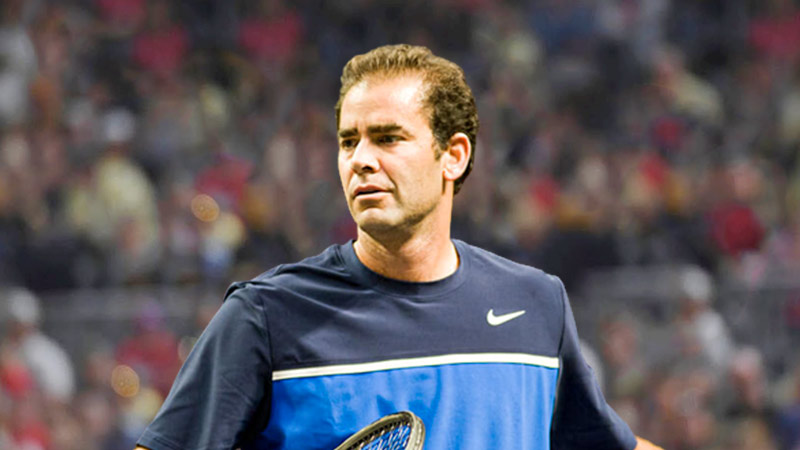
Pete Sampras won 14 Grand Slam singles major titles during his legendary professional career. This total stood as the all-time men’s world record for seven years until it was eventually surpassed by Roger Federer in 2009.
Known as “Pistol Pete” for his explosive serve, Sampras dominated the 1990s by securing 7 Wimbledon trophies, 5 US Open titles, and 2 Australian Open crowns.
His 84.2% winning percentage across 52 Grand Slam appearances underscores his status as an elite competitor. From becoming the youngest US Open champion at 19 to retiring after winning his 14th major in 2002, his career remains a benchmark of professional excellence.
Detailed Breakdown of Pete Sampras Grand Slam Titles
Pete Sampras achieved his record-breaking success primarily on the fast grass of London and the hard courts of New York.
His ability to maintain top-tier performance over 14 years is reflected in the distribution of his trophies. Below is the definitive breakdown of his 14 major singles titles.
| Grand Slam Tournament | Titles Won | Years Won | Match Record | Win % |
|---|---|---|---|---|
| Wimbledon | 7 | 1993, 1994, 1995, 1997, 1998, 1999, 2000 | 63–7 | 90.0% |
| US Open | 5 | 1990, 1993, 1995, 1996, 2002 | 71–9 | 88.8% |
| Australian Open | 2 | 1994, 1997 | 45–9 | 83.3% |
| French Open | 0 | N/A (Best: Semifinals 1996) | 24–13 | 64.9% |
| Career Total | 14 | 1990–2002 | 203–38 | 84.2% |
Why Was Pete Sampras So Dominant at Wimbledon?
The grass courts of the All England Club were the stage for Sampras’s greatest achievements. His 90.0% winning percentage there is the highest among all four majors, reflecting a unique mastery of the surface.
The Seven Wimbledon Finals Mastery
Sampras reached seven Wimbledon finals between 1993 and 2000 and maintained a perfect 7-0 record in those matches. He defeated high-caliber opponents such as Andre Agassi, Boris Becker, and Goran Ivanišević to secure these titles.
This efficiency in finals demonstrates his mental fortitude and ability to execute his game plan under the highest pressure.
Unlike many of his peers, Sampras never lost a final on the grass of Center Court, a feat that solidified his reputation as the premier grass-court player of his generation.
The Unstoppable 31-Match Winning Streak
A defining metric of his Wimbledon dominance was his 31-match winning streak that spanned from the start of the 1997 tournament until the fourth round of 2001.
During this period, Sampras seemed invincible on grass, utilizing his heavy first serve and precise volleys to dictate points before opponents could establish a rhythm. This streak cemented his status as the “King of Grass” for nearly a decade.
The run only ended when he met a 19-year-old Roger Federer in a historic five-set thriller, a match often cited as the ceremonial passing of the torch in men’s tennis history.
Technical Superiority on Fast Grass
The success Sampras enjoyed at Wimbledon was no accident; his game was built for the surface. His “Pistol Pete” serve was nearly impossible to break when he found his spots, and his athletic ability at the net allowed him to put away volleys with clinical precision.
By winning 7 out of 8 Wimbledon titles between 1993 and 2000, he set a standard for grass-court excellence that few have ever matched.
Pete Sampras US Open Record: From Youngest to Oldest
The US Open served as the perfect bookend for the career of Pete Sampras. It was the tournament where he first announced his arrival as a global star and the stage where he played his final professional point.
Making History as the Youngest US Open Champion
In 1990, at just 19 years and 28 days old, Pete Sampras defeated Andre Agassi in straight sets to win his first major title.
He became the youngest male player in history to win the US Open, a record that remains a testament to his early maturity and technical proficiency.
His run in 1990 included significant victories over previous champions Ivan Lendl and John McEnroe, proving that the teenager was ready to lead a new generation of American tennis.
Remarkable Consistency in the Hard Court Major
Sampras was consistently deep in the draw at the US Open, reaching at least the quarterfinals in 11 out of his 14 appearances in New York.
Aside from his five championship trophies, he reached the finals in 1992, 2000, and 2001, falling to Stefan Edberg, Marat Safin, and Lleyton Hewitt respectively.
His overall match record of 71-9 in New York reflects an 88.8% winning percentage, showing that the fast hard courts were nearly as favorable to his game as the Wimbledon grass.
The Perfect Retirement Match in 2002
Sampras ended his career on his own terms at the 2002 US Open. Entering the tournament as the 17th seed after a long title drought, he fought his way to the final to face his greatest rival, Andre Agassi.
In a classic four-set battle, Sampras won his 14th major title with scores of 6–3, 6–4, 5–7, 6–4. He never played another professional match after that victory, making him one of the few athletes to retire at the absolute pinnacle of their sport.
How Did Sampras Perform in Australian and French Opens?
While grass and hard courts were his preferred surfaces, Sampras still managed significant success and deep runs at other majors, even if he did not reach the same level of total dominance.
Two Trophies in Melbourne
Sampras enjoyed strong results at the Australian Open, winning titles in 1994 and 1997. In the 1994 final, he defeated Todd Martin, and in 1997, he overcame Carlos Moyá in straight sets.
He finished his career with a 45–9 record in Melbourne, reaching the semifinals or better in five separate campaigns. His 83.3% winning percentage in Australia shows that he was a threat on any fast surface, regardless of the extreme heat often found in Melbourne.
The Clay Court Hurdle at Roland Garros
The French Open remained the only major title that eluded Sampras during his career. The slow red clay of Roland Garros often neutralized his massive serve and allowed baseliners to exploit his serve-and-volley tactics.
His best result came in 1996, where he reached the semifinals before losing to the eventual champion, Yevgeny Kafelnikov.
Despite never winning the title, his 24–13 record on clay proves he was still a top-tier competitor on the surface, even if it did not suit his natural aggressive instincts.
Statistical Mastery and the Year-End World No. 1 Ranking
Beyond the 14 trophies, Sampras established several records that emphasized his sustained excellence over many seasons. His statistical profile paints a picture of a player who peaked during the most critical moments of the year.
Six Consecutive Years at World No. 1
Driven by his success in major tournaments, Sampras finished as the ATP year-end World No. 1 for six consecutive years, from 1993 to 1998.
This remains a historic record on the ATP Tour, reflecting his ability to remain the best player in the world despite the physical toll of his high-intensity playing style.
His dominance was not just about winning individual matches but maintaining a standard of excellence that prevented any other player from claiming the top spot for over half a decade.
Five-Set Resilience and High-Pressure Performance
A key component of the 14 titles won by Sampras was his resilience in long matches. He held a 29–11 record (72.5%) in five-set matches throughout his career.
He was famously able to elevate his serve speed and accuracy when facing break points or during critical tiebreakers.
This mental toughness earned him the reputation of being the ultimate “big-match” player, someone who could find an extra gear when the stakes were at their highest.
A Career-Long 84.2% Winning Percentage
Across 52 Grand Slam appearances, Sampras accumulated a 203–38 match record. This 84.2% winning rate is remarkably high considering the depth of the field in the 1990s, which included multiple Hall of Famers.
He rarely lost early in majors, reaching at least the quarterfinals in 23 out of his 52 entries. This level of consistency ensured that he was always in the conversation for the title whenever a major tournament began.
The Legendary Sampras vs Agassi Rivalry in Majors
No discussion of the 14 titles won by Pete Sampras is complete without mentioning his rivalry with Andre Agassi. Their contrasting styles—the aggressive server versus the elite returner—provided some of the most memorable moments in the history of the sport.
Dominating the Head-to-Head in Finals
Sampras and Agassi met in five Grand Slam finals, and Sampras won four of them. His victories at the 1990 US Open, 1995 US Open, 1999 Wimbledon, and 2002 US Open were pivotal in cementing his lead in the record books.
Agassi’s lone victory over Sampras in a major final came at the 1995 Australian Open. This head-to-head dominance in championship matches is a primary reason why Sampras was able to pull ahead in the race for the most major titles.
Stylistic Contrast and Mutual Respect
The rivalry pushed both players to improve their respective games. Sampras often noted that Agassi was the only player who could consistently put his best serves back into play, forcing Sampras to become more versatile and patient at the net.
Their matches were often high-stakes battles for the World No. 1 ranking, making their encounters at the majors even more significant for their respective legacies.
Year-By-Year Grand Slam Progress: A 15-Year Timeline
To understand the arc of the career of Pete Sampras, it is helpful to look at his year-by-year progress from his debut as a teenager to his final match as a veteran.
| Year | Australian Open | French Open | Wimbledon | US Open |
|---|---|---|---|---|
| 1988 | DNP | DNP | DNP | 1st Round |
| 1989 | 1st Round | 2nd Round | 1st Round | 4th Round |
| 1990 | 4th Round | DNP | 1st Round | Champion |
| 1991 | DNP | 2nd Round | 2nd Round | Quarterfinals |
| 1992 | DNP | Quarterfinals | Semifinals | Runner-up |
| 1993 | Semifinals | Quarterfinals | Champion | Champion |
| 1994 | Champion | Quarterfinals | Champion | 4th Round |
| 1995 | Runner-up | 1st Round | Champion | Champion |
| 1996 | 3rd Round | Semifinals | Quarterfinals | Champion |
| 1997 | Champion | 3rd Round | Champion | 4th Round |
| 1998 | Quarterfinals | 2nd Round | Champion | Semifinals |
| 1999 | DNP | 2nd Round | Champion | DNP |
| 2000 | Semifinals | 1st Round | Champion | Runner-up |
| 2001 | 4th Round | 2nd Round | 4th Round | Runner-up |
| 2002 | 4th Round | 1st Round | 2nd Round | Champion |
Frequently Asked Questions About Sampras Majors
Who has more Grand Slam titles, Pete Sampras or Roger Federer?
Roger Federer currently has more titles than Pete Sampras. Sampras held the record with 14 titles until Federer won his 15th at Wimbledon in 2009.
Did Pete Sampras ever win the French Open?
No, Sampras never won the French Open. It was the only Grand Slam tournament that eluded him throughout his career, with his best performance being a semifinal finish in 1996.
In which major did Pete Sampras have the most success?
Wimbledon was his most successful tournament. He won 7 titles there and maintained a 90.0% winning percentage, including a perfect 7-0 record in finals.
How many times did Sampras beat Agassi in a Grand Slam final?
Sampras defeated Agassi in four out of their five Grand Slam final meetings: the 1990 US Open, 1995 US Open, 1999 Wimbledon, and 2002 US Open.
What was the win-loss record for Sampras in Grand Slam finals?
Sampras reached 18 major finals and finished with a 14–4 record, giving him a 77.7% success rate in championship matches.
Conclusion: The Lasting Legacy of Pistol Pete
The 14 Grand Slam titles of Pete Sampras represent an era of professional tennis defined by technical precision and serving dominance.
While the “Big Three” of the modern era have since surpassed his numerical total, the context of his achievements remains significant.
He competed in an era of diverse playing surfaces and fierce rivalries, yet he managed to finish as the World No. 1 for six consecutive years.
His decision to retire immediately after winning his 14th major at the 2002 US Open is often cited as the most graceful exit in the history of the sport.
By leaving at the very top, Sampras ensured that his legacy would always be associated with championship-winning excellence.
For fans and analysts alike, the answer to the question of how many major titles Pete Sampras won is not just about the number 14—it is about a decade of dominance that forever changed the standards of professional tennis.