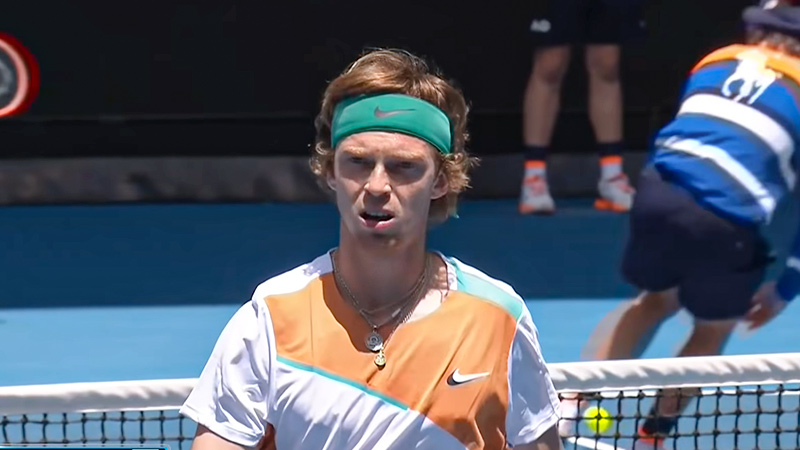
Andrey Rublev is an elite, world-class tennis professional who has solidified his position in the upper echelons of the ATP Tour through relentless consistency and explosive baseline power.
With a career-high ranking of world No. 5 and 18 singles titles, including two Masters 1000 trophies, his talent is undeniable.
He is widely considered the ultimate “gatekeeper,” rarely losing to lower-ranked opponents due to his high-velocity forehand and intense competitive motor.
However, his legacy remains tied to a unique paradox: despite reaching 10 Grand Slam quarterfinals, he has yet to cross the threshold into a Major semifinal.
How Good is Andrey Rublev? His Elite Career Highlights
Understanding the standing of this athlete requires a deep dive into the metrics that define professional success at the highest level of the sport.
Rublev is not merely a participant; he is a decorated champion whose achievements place him among the top earners and competitors in tennis history.
| Milestone / Metric | Achievement Details |
|---|---|
| ATP Singles Titles | 18 titles (including 2 Masters 1000s: Monte-Carlo 2023, Madrid 2024) |
| Career High Ranking | World No. 5 (First achieved in September 2021) |
| Olympic Success | Gold Medal in Mixed Doubles at the 2020 Tokyo Olympics |
| Grand Slam Consistency | Reached the Quarterfinals at all four Major tournaments |
| Career Prize Money | Over $33.9 Million USD (ranking 13th all-time in history) |
| Recent Form | Winner of the 2026 Nordea Open in Bastad |
The Biomechanical Secrets Behind Rublev’s Explosive Game
To appreciate the effectiveness of Rublev’s game, one must look past the intensity and focus on the flawless technical execution that allows him to generate such devastating pace.
His game is built on a foundation of modern biomechanics that prioritizes timing and kinetic efficiency over raw physical size.
The Violent Forehand and Closed Racket Face
The centerpiece of his arsenal is a forehand that experts describe as one of the most violent and high-velocity weapons in the modern era.
A key technical element is the “closed” racket face during the backswing, where the strings are tilted downward toward the court. This specific orientation creates a more compact loop, which is essential for maintaining clean timing under pressure.
By minimizing the complexity of the swing, he can consistently “crack” the ball with immense power from almost any position behind the baseline.
Kinetic Uncoiling and Lower Body Power
Power in the modern game is generated from the ground up, and Rublev provides a masterclass in this principle. He utilizes an incredibly wide, athletic stance to create a stable base.
Relying heavily on a “semi-open” stance, he uses his right leg as a loading spring, storing energy that he then releases forward into the ball.
This sequential twisting of the hips and shoulders, known as kinetic uncoiling, allows him to generate massive racket head speed without over-relying on arm strength alone.
Timing and Aggressive Baseline Positioning
While many players are forced to retreat under pressure, Rublev’s compact swing allows him to maintain a position close to the baseline. He excels at taking the ball early on the rise, a tactic that robs his opponents of valuable reaction time.
This aggressive positioning, combined with his ability to hit clean winners from anywhere on the court, forces his adversaries into a defensive posture, as they are constantly hurried by the relentless pace of his groundstrokes.
Why Rublev is the Ultimate ATP Tour Gatekeeper
Consistency is often the dividing line between a talented player and a fixture in the top 10, and Rublev has mastered the art of winning the matches he is expected to win.
His ability to maintain a high level of play throughout the long calendar year has earned him a reputation as a “model” of dedication on the tour.
Unmatched Consistency Against Lower-Ranked Players
One of the most striking aspects of his career is how rarely he drops matches to players ranked below him. This reliability makes deep runs at ATP 500 and Masters 1000 tournaments a regular occurrence, ensuring he remains a constant threat for titles.
His game is mechanically identical on nearly every shot, providing a level of baseline stability that lower-ranked players simply cannot disrupt over the course of a multi-hour match.
This “gatekeeper” status ensures that only the very best in the world can find a way past him.
High-Margin Depth and Semi-Western Grip Mechanics
Despite the appearance of swinging with reckless abandon, his shots possess a calculated safety margin. He utilizes a semi-western grip that imparts heavy topspin onto the ball.
This spin creates a loop that keeps his deep groundstrokes within the lines while maintaining a safe clearance over the net.
This combination of depth and spin is exhausting for opponents, who are forced to strike the ball from uncomfortable heights and positions far behind the baseline.
The Unrelenting Competitive Motor
On-court intensity is a hallmark of his professional identity. He approaches every point with a cadence of heavy grunts and maximum effort, playing with an intensity that often feels as though he is in a major final even during early rounds.
This “unrelenting competitive motor” allows him to overwhelm opponents physically and mentally, as he never grants them a “cheap” point or a moment to breathe.
His recent victory at the 2026 Nordea Open, won in straight sets, serves as a testament to this enduring competitive drive.
Analyzing the Grand Slam Quarterfinal Hurdle
While his success on the main tour is legendary, the conversation around his career often turns to the “Grand Slam hurdle”.
Having reached the quarterfinals of all four Major tournaments a total of 10 times without a victory, this statistical anomaly represents the final barrier to true tennis immortality.
Overcoming the Psychological and Emotional Bottleneck
The transition from a quarterfinalist to a champion is as much mental as it is physical, and he has been candid about his internal struggles. He has admitted to “disastrous moments” during high-stakes matches where his emotions become a liability.
Known for episodes of on-court self-flagellation, his tendency to lose composure when a match begins to slip away has often hampered his ability to mount a comeback against the world’s best. Regulating this emotional intensity is perhaps the most critical step in his evolution.
The Strategic Need for a Tactical Plan B
A common critique of his game is the lack of tactical variety when his primary strategy is neutralized. His ultra-aggressive baseline game can blow away 90% of the tour, but top-tier defensive counter-punchers have found ways to absorb his pace and force errors.
Because he often refuses to vary his tactics or incorporate “Plan B” options like drop shots or serve-and-volley plays, he can become predictable for the most elite defenders who are comfortable playing long, grueling rallies.
Breaking the “Hoodoo” to Achieve Tennis Legend Status
Despite these hurdles, it is important to remember that Rublev remains an exceptional, tier-one talent. He is one of the few players capable of winning any tournament on the calendar.
To join the ranks of true legends, he must overcome this Grand Slam “hoodoo” by blending his world-class power with improved emotional control and strategic flexibility.
His career-high ranking of No. 5 and his Olympic Gold medal already place him in an elite bracket, but a Major semifinal or title would silence the few remaining skeptics.
Frequently Asked Questions About Andrey Rublev’s Career
How many titles has Andrey Rublev won?
He has captured 18 ATP singles titles, including two prestigious Masters 1000 championships in Monte-Carlo (2023) and Madrid (2024).
What is Andrey Rublev’s highest ranking?
His career-high ranking is world No. 5, a milestone he first reached in September 2021.
Has Andrey Rublev won an Olympic medal?
Yes, he won a Gold Medal in Mixed Doubles at the 2020 Tokyo Olympics.
What is his record in Grand Slam quarterfinals?
He has reached 10 Grand Slam quarterfinals but currently holds a 0-10 record in those matches.
How much prize money has he earned?
He has earned over $33.9 million USD in career prize money, ranking him 13th on the all-time list.
What is considered his biggest weapon?
His high-velocity, “violent” forehand is widely considered his primary weapon on the court.
Is he still a top contender in 2026?
Yes, he recently won the 2026 Nordea Open in straight sets, proving he remains a significant threat on the tour.
Conclusion: A Legacy in Motion
Andrey Rublev represents the pinnacle of professional dedication and baseline power. His ability to maintain an elite ranking and consistently challenge for titles across different surfaces makes him one of the most respected figures in the sport.
While the Grand Slam quarterfinal remains a formidable obstacle, his technical foundations and competitive spirit suggest that he has the tools to eventually break through.
Whether or not he captures a Major title, his status as a “fixture in the upper echelons” of tennis is firmly established, and his career remains a compelling study in the pursuit of perfection.