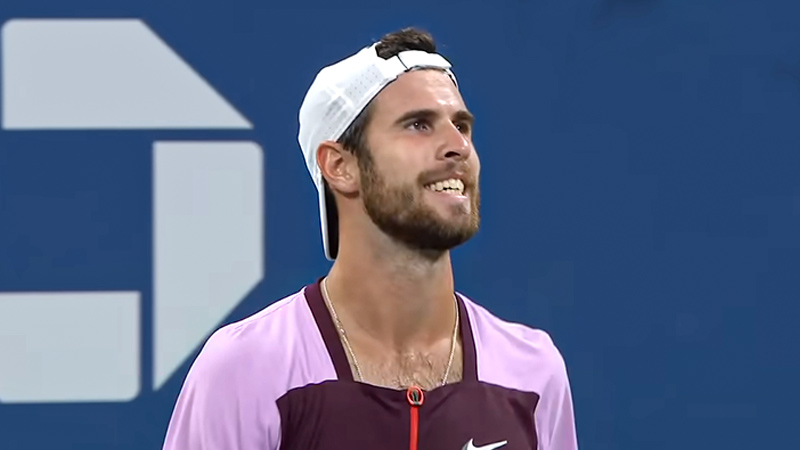
Karen Khachanov has not quit professional tennis permanently; however, the phrase often refers to his historic mid-match retirement at the 2025 Cincinnati Masters or his forced withdrawals from major tournaments.
After completing a staggering 528 consecutive matches without retiring—a streak spanning 12 years—Khachanov finally stopped mid-match against Alexander Zverev due to a debilitating back injury.
This decision was a strategic medical choice to preserve his long-term career rather than a permanent exit from the sport.
Today, Khachanov remains an active ATP competitor, though he continues to battle significant physical challenges like sacrum fractures and chronic exhaustion.
Why Did Karen Khachanov Quit the Cincinnati Masters Match?
The tennis world was shocked in August 2025 when Karen Khachanov, known for his legendary durability, walked off the court during his fourth-round match. This moment marked the end of an era for the “Iron Man” of the ATP tour.
The End of a 528-Match Iron Man Streak
For over a decade, Khachanov was a symbol of physical resilience. Before the 2025 Cincinnati Masters, he had successfully completed 528 consecutive professional matches without a single mid-match retirement.
This “Tour-leading streak” was a point of pride and a testament to his fitness. However, while trailing 7-5, 3-0 against Alexander Zverev, the physical toll finally became insurmountable.
The sudden, intense lower back pain he experienced was too severe to ignore, forcing him to prioritize his future over a single match outcome.
Strategic Withdrawal Before the US Open
Choosing to “quit” a match is rarely easy for a top-tier athlete, but Khachanov’s decision was calculated. With the US Open—the final Grand Slam of the year—looming on the horizon, he opted to stop to avoid a permanent tear or career-threatening aggravation.
He stated to media outlets that he was unwilling to risk long-term damage for the sake of a match that was already slipping away. This strategic medical decision highlights the shift in his approach: moving from raw durability to calculated longevity.
The Physical Toll: Navigating the “Zombie State” on Tour
Behind the scenes of high-stakes tennis lies a grueling schedule that pushes even the strongest athletes to their breaking point. Khachanov’s recent struggles are a direct result of this relentless pace.
| Tournament Event | Performance/Result | Physical Consequence |
|---|---|---|
| Canada Masters (Toronto) | Reached the Finals | Physical exhaustion; “Zombie state” |
| Cincinnati Masters | Retired Mid-Match | Acute lower back pain flare-up |
| Hangzhou Open | Official Withdrawal | Slower-than-expected recovery |
| Roland Garros | Quarterfinal Finish | Sacrum S1 bone stress fracture |
From the Toronto Finals to Cincinnati Exhaustion
The lead-up to his Cincinnati retirement was particularly taxing. Khachanov had just finished a deeply physical and successful run to the finals of the Canada Masters in Toronto, where he lost a high-intensity battle against Ben Shelton.
The immediate travel requirements and rapid turnaround for the next tournament left him in what he described as a physically exhausted “zombie state”. This level of fatigue is a major contributor to the injuries that have recently plagued his season.
The Impact of Overlapping Tournament Schedules
Khachanov has become a vocal advocate for his peers, criticizing the current structure of the ATP tour. He specifically pointed to the “overlapping two-week Masters tournament formats” as a primary reason for the heavy tax on players’ bodies.
When athletes are forced to play back-to-back high-stakes events with minimal rest, the risk of injury skyrockets.
His own experience of reaching a final in one city and being expected to compete at an elite level in another just days later serves as a primary example of this systemic issue.
Is Karen Khachanov Dealing With a Career-Ending Injury?
When fans ask if Khachanov has quit, they are often reacting to the severity of his medical reports. While none are career-ending, they have required significant time away from the court.
The Sacrum S1 Stress Fracture Explained
One of the most serious setbacks in Khachanov’s career occurred following a physical four-set quarterfinal match against Novak Djokovic at Roland Garros.
During this match, Khachanov suffered a stress fracture and a partial fracture in his sacrum S1 bone, located at the base of the spine and hip region.
This type of injury is exceptionally painful and dangerous for a tennis player, as the sacrum is central to the rotational force required for serves and heavy groundstrokes.
Why He Withdrew From the Wimbledon Championships
Despite his desire to compete at the All England Club, Khachanov was forced to pull out of the Wimbledon Championships due to the sacrum injury. He attempted an aggressive rehabilitation program to make it back in time, but his medical team intervened.
They firmly stated that playing on a fractured sacrum would jeopardize his long-term health and could lead to a permanent, career-threatening condition. Consequently, he prioritized healing over the prestige of the tournament.
What is Karen Khachanov’s Current Professional Status?
Despite the headlines regarding his retirements and withdrawals, Khachanov remains a prominent fixture in the world of professional tennis.
Continued Participation on the ATP Tour
Khachanov is still very much an active competitor. While he has had to be more selective with his appearances—such as withdrawing from the Hangzhou Open in late 2025 due to a slow recovery—he has not stepped away from the sport permanently.
His focus has shifted toward “long-term career sustainability,” ensuring that he can continue to compete at the highest level for years to come.
A New Approach to Health and Longevity
The transition from a 12-year streak of never retiring to a season of strategic withdrawals marks a new phase in Khachanov’s career. He now utilizes medical advice to make difficult choices about when to step back.
This proactive management of his back and spine is intended to prevent the kind of chronic issues that have shortened the careers of many other power players. He remains highly regarded for his resilience and remains a threat in any draw he enters.
Frequently Asked Questions About Khachanov’s “Retirement”
Did Karen Khachanov announce a permanent retirement?
No, he has not announced a permanent retirement from professional tennis. The term “retirement” in the context of his recent headlines refers specifically to “retiring mid-match,” which means stopping a game early due to an injury or illness. He remains an active player on the ATP circuit.
What exactly was the injury that broke his 528-match streak?
The injury was an acute flare-up of intense lower back pain during the Cincinnati Masters. This was likely exacerbated by the physical exhaustion from reaching the Toronto finals the week prior and a pre-existing sensitivity in his lower back and sacrum area.
Why did he withdraw from the Hangzhou Open in 2025?
Khachanov withdrew from the Hangzhou Open because his physical recovery from the summer hardcourt season was slower than expected.
Tournament organizers and his medical team emphasized the need to prioritize his long-term health over immediate competition.
Is his back injury related to his previous sacrum fracture?
While both involve the lower back and spine region, they were distinct events. The sacrum S1 stress fracture occurred during Roland Garros (June 2023), while the acute back pain flare-up happened during the 2025 North American swing.
However, the physical demands of the tour mean that one injury can often make a player more susceptible to related issues in the same region.
Conclusion: Resilience in the Face of Physical Adversity
Karen Khachanov’s story is not one of quitting, but one of remarkable endurance and the wisdom to know when to pause.
His 12-year streak of never retiring mid-match is a record that may not be broken for decades, illustrating a level of toughness rarely seen in modern sports.
While the injuries to his sacrum and lower back have forced him to make difficult decisions, they have also turned him into a powerful voice for player safety and schedule reform.
As he continues to navigate the complexities of the ATP tour, his focus remains clear: sustaining his career through strategic health management while remaining a top competitor on the global stage.
Fans can expect to see him back on court, fueled by the same resilience that allowed him to compete in over 500 consecutive matches without ever giving up.