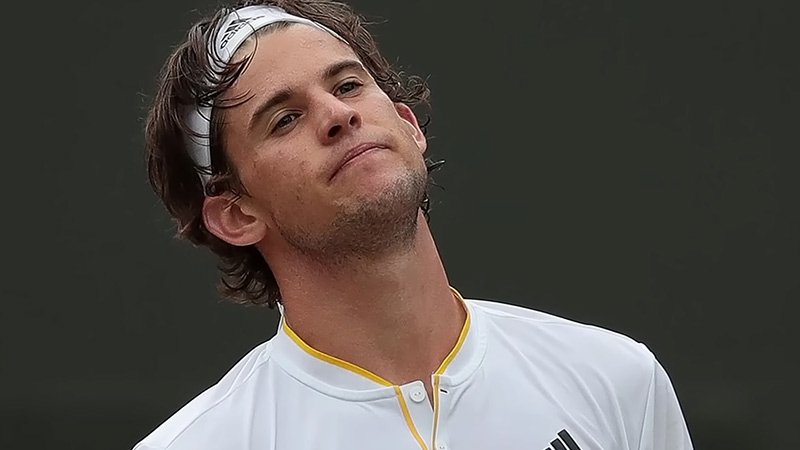
Dominic Thiem suffered a career-altering detachment of the posterior sheath on the ulnar side of his right wrist. This complex structural injury involved tearing the ligaments and stabilizing tissues that hold the tendon in place along the wrist’s outer edge.
The damage was compounded by chronic extensor carpi ulnaris (ECU) tendonitis and persistent joint inflammation.
After a single high-intensity moment in June 2021 and a severe relapse during practice, the former US Open champion faced a permanent loss of physical power.
This chronic instability ultimately forced his retirement in October 2024, ending a legendary career at age 31.
What Injury Did Dominic Thiem Have?
The injury that derailed Dominic Thiem’s career was not a simple strain but a multi-layered structural failure of the right wrist joint.
While the initial reporting focused on general discomfort, the medical reality was far more severe, involving the destabilization of the entire ulnar side of his dominant hand.
The Anatomy of the Posterior Sheath Detachment
The primary diagnosis was a detachment of the posterior sheath on the ulnar side of his right wrist. In elite tennis, the posterior sheath acts as a crucial stabilizer for the tendons that allow for high-velocity rotation and impact absorption.
When this sheath detached, the ligaments and stabilizing tissues holding the tendon in place along the outer edge of his wrist were pulled and torn.
This meant that every time Thiem attempted to strike a ball, the tendon lacked the necessary structural support to remain in its natural groove, leading to immediate mechanical instability.
Secondary Complications: ECU Tendonitis and Inflammation
Beyond the primary detachment, the injury triggered a cascade of secondary medical issues that made a full recovery nearly impossible. The structural destabilization led to chronic, recurring extensor carpi ulnaris (ECU) tendonitis.
This condition involves the inflammation of the tendon that runs along the back of the wrist, which is essential for the “flicking” motion Thiem used to generate topspin.
This was further aggravated by persistent fluid accumulation and severe joint inflammation whenever he attempted to train at maximum intensity.
Biomechanical Analysis: Why Did Dominic Thiem’s Wrist Break?
To understand the severity of this injury, one must look at the biomechanics of Thiem’s game. His injury was categorized as an overuse catastrophe that took nearly 17 years to manifest.
The following table outlines the factors that contributed to the eventual structural failure of his wrist:
| Factor | Description | Long-term Impact |
|---|---|---|
| Technique Style | Hyper-aggressive, heavy-topspin baseline style. | Extreme load on the wrist joint during every session. |
| The “Wrist Snap” | Violent acceleration at the exact moment of ball contact. | Funneled blunt-force trauma directly into the ulnar side. |
| Training Duration | High-intensity training since age 10 or 11. | 17 years of cumulative micro-trauma to stabilizing tissues. |
| Physical Intensity | Whipping the racket for raw power. | Reached the structural breaking point of the ligaments. |
The Timeline of the Dominic Thiem Wrist Injury
The progression of Thiem’s injury from an acute incident to a career-ending chronic condition followed a tragic timeline. What began as a single “crack” on a grass court evolved into a three-year struggle against his own physiology.
The 2021 Mallorca Open Incident
The physical breaking point occurred on June 22, 2021, during the Mallorca Open. While leading 5-2 in the first set against Adrian Mannarino, Thiem reached wide for a running forehand.
As he made contact, he heard an audible physical “crack” in his wrist and was forced to retire immediately. This moment represented the culmination of 17 years of strain finally exceeding the structural limits of his joint.
The Critical August Relapse and Professional Rift
The most damaging phase of the injury occurred in August 2021. While attempting to rush back to defend his US Open title, Thiem’s recovery was mismanaged.
His physiotherapist, Alex Stober, reportedly pushed him into heavy hitting too early in the rehabilitation process. During a practice session, Thiem tore the healing tissue a second time while striking a forehand.
This relapse turned an acute injury into a permanently unstable condition and led to a massive rift and eventual parting of ways between Thiem and Stober.
Why Did Dominic Thiem Choose Non-Surgical Treatment?
The decision of whether or not to undergo surgery is often the most difficult choice for an elite athlete. For Thiem, the choice was guided by some of the world’s leading hand specialists who hoped to preserve the natural mechanics of his wrist.
The Conservative Rehabilitation Protocol
In October 2021, renowned hand specialist Dr. Frederik Verstreken conducted an in-depth analysis of the joint. He determined that the wrist was stable enough to avoid a surgical procedure, which would have required a much longer and more invasive recovery period.
Thiem opted for a strict, non-surgical conservative approach. This involved keeping his entire arm fully immobilized in a splint for several months to allow the detached posterior sheath to attempt to reattach to the bone naturally.
The Challenges of Functional Physical Therapy
Once the period of immobilization ended, Thiem began grueling functional physical therapy. The goal was to rebuild the small stabilizer muscles in the wrist that had atrophied during months of inactivity.
However, the 10-month absence from the ATP Tour took a heavy toll. By the time he returned to competitive tennis in March 2022, his ranking had collapsed outside the top 350, forcing him to fight for every point without the benefit of his former physical strength.
Impact on Performance: How the Injury Blunted His Forehand
The most devastating consequence of the injury was the permanent loss of Thiem’s primary weapon: his explosive forehand. This shot, which once dominated the tour, became a shadow of its former self.
Mechanical Loss of Topspin and Velocity
Post-injury, Thiem’s wrist lacked the structural integrity to withstand the force of his old swing. He could no longer execute the violent “wrist snap” that had defined his game.
Consequently, his forehand generated significantly less topspin and lost its signature explosive velocity. Without the ability to “whip” the ball, he was forced to play a more defensive game that did not align with his natural instincts.
The Tactical Shift of Opponents
The tennis world is unforgiving, and professional opponents quickly identified that Thiem’s “underpowered wing” was now a liability.
Opponents began targeting his forehand in heavy baseline exchanges, knowing that his wrist could no longer withstand the blunt force of high-speed rallies.
He was unable to dictate play, and his inability to hit through the court allowed lower-ranked players to stay in points that he previously would have ended with a single winner.
The Final Setback and Decision to Retire in 2024
Despite a brief return to the top 100, the physical reality of the injury eventually caught up with Thiem. The “comeback” was marred by the constant fear of re-injury and the return of debilitating symptoms.
Signs of Permanent Structural Failure
The end began to take shape in March 2024 during an intense training block. Thiem reported hearing concerning “clicking” sounds in his wrist, accompanied by intense structural pain and new inflammation.
This was a clear signal that the joint had reached its absolute limit and could no longer support the rigors of elite professional training. Every time he tried to ramp up the intensity to regain his old form, the wrist failed.
Retirement at the Vienna Open
By the time he reached October 2024, Thiem accepted that his wrist would never safely recover the strength required for the top tier of tennis. He officially retired at the Vienna Open at the age of 31.
He noted that his wrist had become “just a little bit too weak” and ultimately “broke,” leading to a permanent loss of the “feeling” he once had on the court. He chose to retire on his own terms rather than continue competing in lower-tier Challenger events.
Frequently Asked Questions: Dominic Thiem’s Career and Health
What exactly caused the wrist to “crack” in 2021?
The crack was the sound of the posterior sheath detaching from the ulnar side of the wrist under the load of a running forehand.
Could surgery have saved his career?
While debated, specialists like Dr. Verstreken believed a conservative approach was better. However, the relapse in August 2021 made the condition chronic regardless of the initial treatment path.
How did the injury affect his ranking?
The 10-month absence caused him to drop outside the top 350. Though he briefly fought back into the top 100, he could never maintain the consistency needed for a higher position.
What were the final symptoms before retirement?
In early 2024, he experienced recurring fluid buildup, inflammation, and a “clicking” sensation that indicated the joint was no longer stable.
Conclusion
Dominic Thiem’s career serves as a testament to the physical price of greatness. His hyper-aggressive style, while beautiful and effective, ultimately exceeded the biological limits of the human wrist.
While he left the sport earlier than many expected, he did so having reached the pinnacle as a US Open champion and one of the few players to truly challenge the dominance of the “Big Three” on all surfaces.