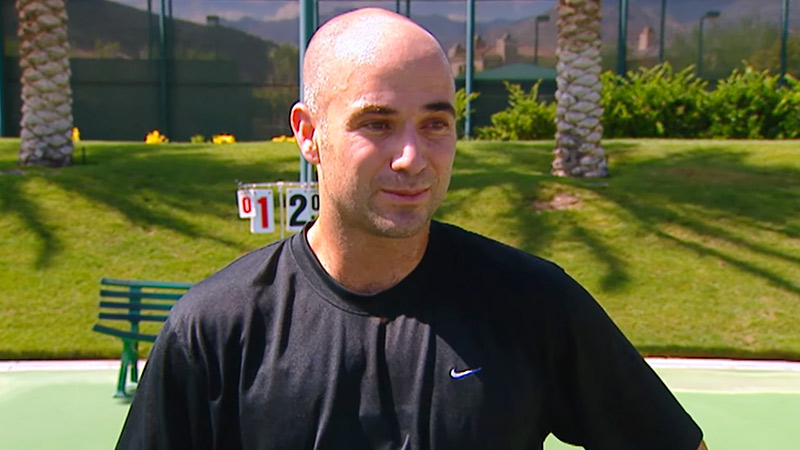
The career of Andre Agassi is a masterclass in evolution, resilience, and unparalleled achievement.
From his early days as a flashy, baseline-dominating newcomer to his transformation into one of the most respected elder statesmen of the game, Agassi’s journey is etched into the record books through a series of historic victories.
He didn’t just win tournaments; he conquered every surface the game had to offer, securing a legacy that few in the history of the sport can claim.
To understand Agassi’s impact, one must look beyond the trophies and examine the breadth of his success. He is one of a select few to achieve the Career Golden Slam, a feat that requires winning all four major championships plus an Olympic gold medal.
The Grand Slam Record: A Study in Versatility
Andre Agassi won a total of eight Grand Slam singles titles. What makes this number particularly impressive is the chronological and surface-level diversity of these wins.
He proved that his aggressive return-of-serve and relentless baseline game could translate to the grass of London, the red clay of Paris, and the hard courts of Melbourne and New York.
The following table provides a clear breakdown of his Grand Slam dominance by tournament:
| Tournament | Years Won | Total Titles |
|---|---|---|
| Australian Open | 1995, 2000, 2001, 2003 | 4 |
| French Open | 1999 | 1 |
| Wimbledon | 1992 | 1 |
| U.S. Open | 1994, 1999 | 2 |
| Total Major Titles | — | 8 |
The Australian Open: The King of Melbourne
Agassi’s most successful hunting ground was the Australian Open. His four titles there (1995, 2000, 2001, 2003) highlight his exceptional physical conditioning and his ability to thrive in the heat of the Australian summer.
His victory in 1995 was particularly significant as it was his debut in the tournament, immediately establishing his dominance on the Rebound Ace surface.
His late-career surge, winning three titles in four years between 2000 and 2003, cemented his status as a legendary figure in Melbourne Park history.
The French Open: The Final Piece of the Puzzle
Perhaps the most emotional victory of his career came at Roland Garros in 1999. After years of struggling on the red clay and reaching the finals earlier in the decade without success, Agassi staged a historic comeback from two sets down in the final to defeat Andrei Medvedev.
This win was the cornerstone of his legacy, as it made him one of only five men in tennis history to complete the Career Grand Slam.
Wimbledon: Defying the Critics
In 1992, many experts believed Agassi’s baseline style would never succeed on the fast grass courts of Wimbledon.
He proved them wrong by defeating Goran Ivanišević in a five-set thriller to claim his first-ever major title. This victory changed the perception of his game and proved that a great returner could dismantle the biggest servers in the world on grass.
U.S. Open: The Home Hero
Agassi was a perennial favorite in New York, where his energy matched the atmosphere of Arthur Ashe Stadium. He secured the U.S. Open title twice, first in 1994 as an unseeded player—a monumental achievement at the time—and again in 1999.
His 1999 victory in New York, coupled with his French Open win that same year, marked one of the most successful seasons of his professional life.
Olympic Gold and the Golden Slam
While the Grand Slams are the traditional measure of a tennis player’s greatness, Agassi elevated his status by excelling on the world’s biggest sporting stage: the Olympic Games.
- 1996 Atlanta Olympics: Competing on home soil, Agassi captured the gold medal in men’s singles.
- The Career Golden Slam: By adding this Olympic gold to his collection of all four major titles, Agassi achieved the Career Golden Slam. This distinction is incredibly rare, placing him in a category of elite athletes who have mastered every possible peak of the sport.
The significance of the Olympic win cannot be overstated. In the mid-90s, professional tennis players were still establishing the importance of the Olympics compared to the Grand Slams.
Agassi’s participation and eventual victory helped elevate the prestige of the Olympic tennis event for future generations.
International and Year-End Excellence
Agassi’s commitment to the sport extended beyond his individual pursuits. He was a cornerstone of American tennis on the international stage and a consistent performer in the year-end championships.
Davis Cup Success
Agassi was a passionate representative for the United States in the Davis Cup. His ability to perform under the unique pressure of team competition helped the U.S. secure multiple world titles.
- Champions: 1990, 1992, 1995.
- His participation in these years often provided the critical singles points needed to advance through the difficult world group brackets.
ATP Tour World Championships
To be the best in the world, one must beat the best in a concentrated format. In 1990, Agassi won the ATP Tour World Championships.
This event, now known as the ATP Finals, features only the top eight players in the world rankings at the end of the season. Winning this title early in his career was a clear signal that Agassi was destined for the top of the rankings.
Strategic Analysis: Why Agassi’s Wins Endure
The reason Agassi’s list of wins is so revered by analysts and historians is the sheer variety of his accomplishments.
He was not a “specialist.” In an era where players often focused strictly on one surface—such as “clay-court specialists” or “serve-and-volleyers” on grass—Agassi was a universal threat.
Key Pillars of His Success:
- The Return of Serve: Widely considered the greatest returner in the history of the game, Agassi turned an opponent’s greatest weapon into a liability.
- Physical Transformation: His mid-career dedication to fitness allowed him to win Grand Slams well into his 30s, an age when most of his contemporaries had retired.
- Mental Fortitude: His 1999 French Open win and his unseeded run at the 1994 U.S. Open demonstrated a level of psychological resilience that defined his later years.
Conclusion
Andre Agassi’s career is defined by the word “complete.” By winning on the grass of Wimbledon, the clay of Roland Garros, and the hard courts of the U.S. and Australian Opens, he proved his technical mastery over the entire sport.
When you factor in his Olympic Gold and his Davis Cup triumphs, you see a portrait of a player who conquered every challenge available to him.
His eight major titles and his status as a Career Golden Slam winner ensure that whenever the greatest players of all time are discussed, Agassi’s name remains at the forefront of the conversation.
He didn’t just play the game; he mastered its every iteration, leaving behind a blueprint for versatility that continues to inspire the champions of today.